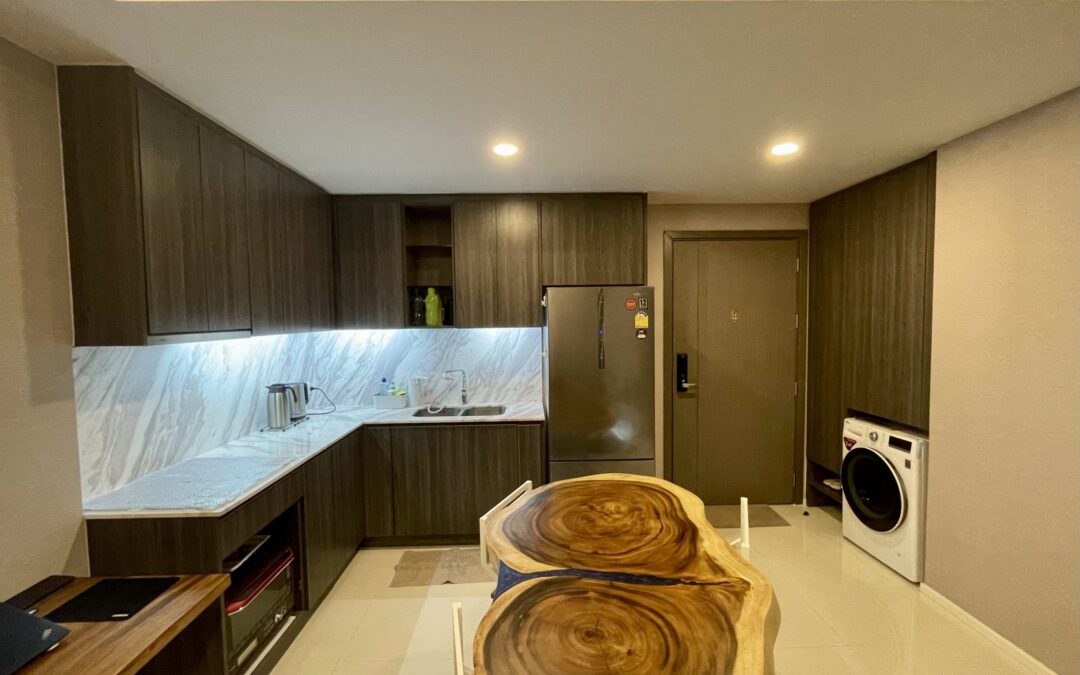
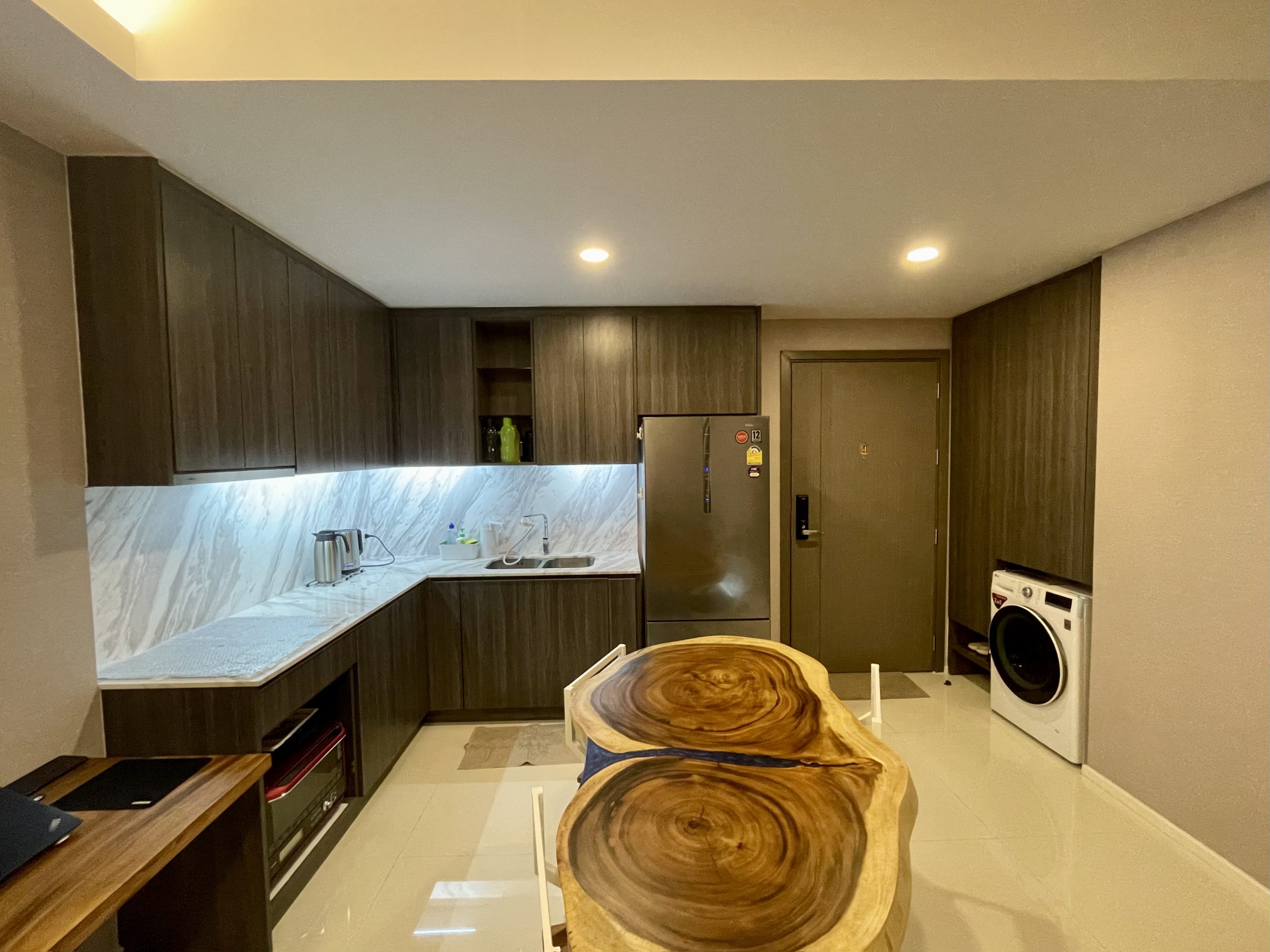
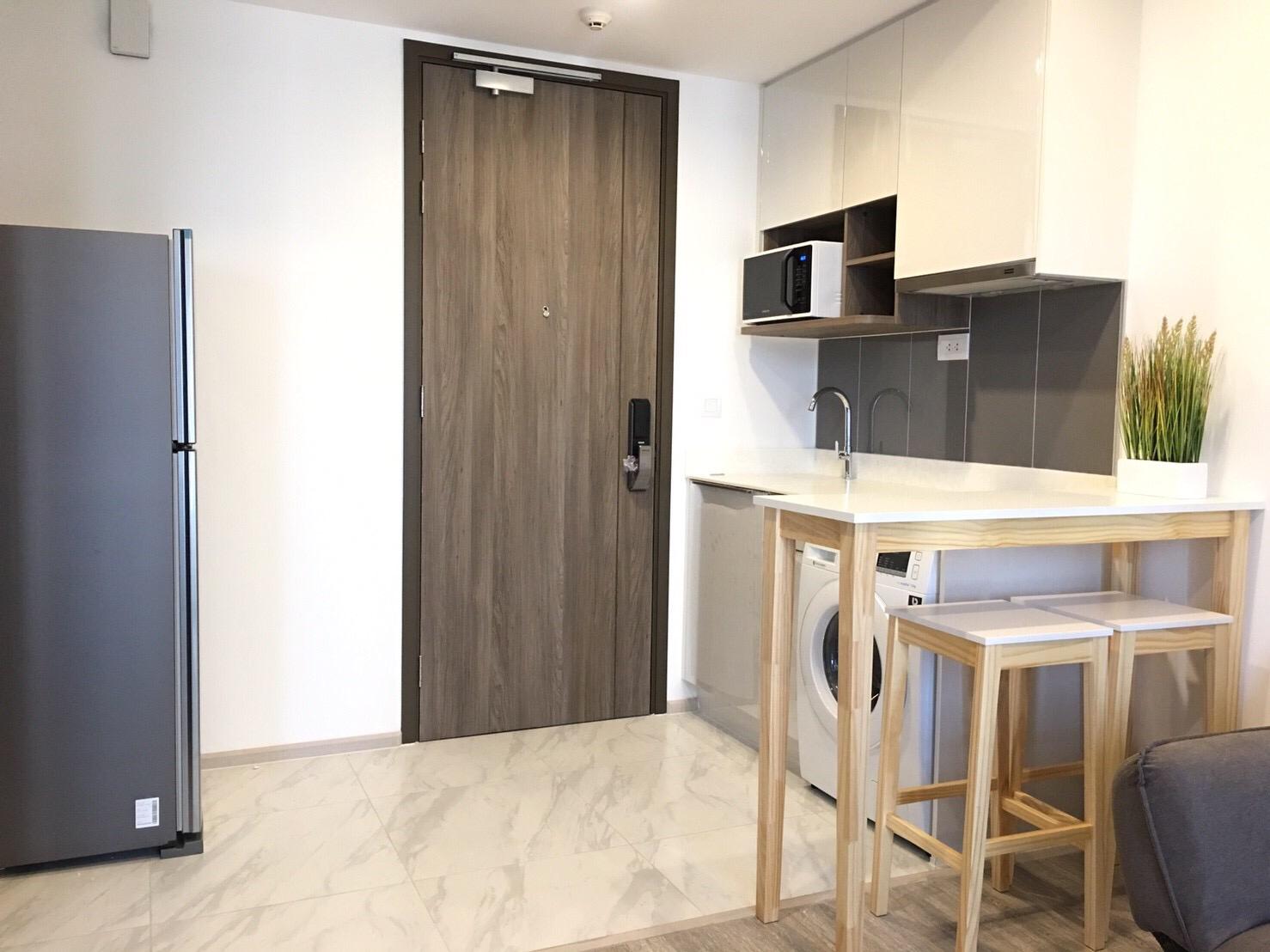
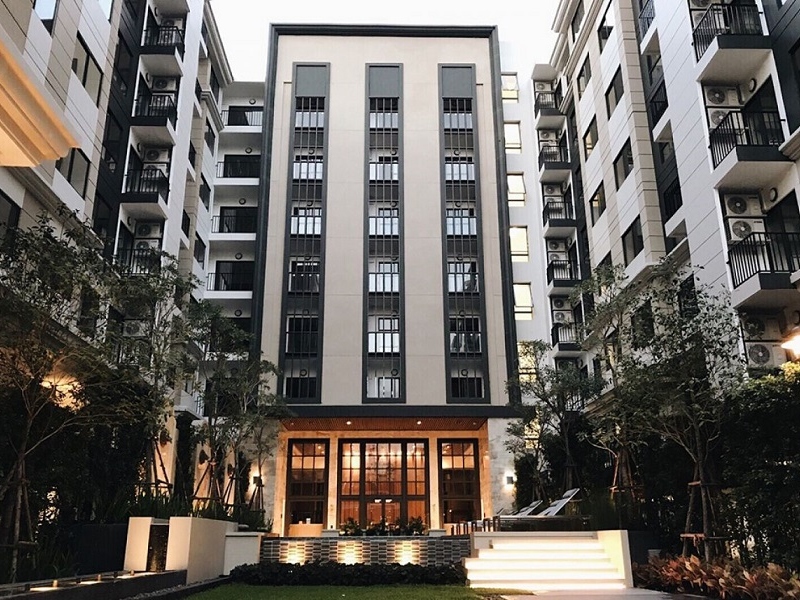
A Bangkok condo kitchen can be a beautiful backdrop and still be frustrating to use. Expat buyers should look beyond cabinet colour and appliance brands to ventilation, worktop space, storage, electrical capacity, cleaning and the way food actually fits into their Bangkok routine.
A kitchen should be judged by the resident’s real cooking and dining routine, not only by styling.
The right kitchen depends on the resident. Someone who mainly reheats food needs a different layout from a family cooking every day. An investor also needs to consider future tenants: a compact kitchen can be perfectly suitable when it is honest, robust and matched to the likely audience.
Start with the cooking brief
List how often the resident cooks, which appliances they use and whether meals are simple, aromatic, high-heat or prepared for several people. Check whether the kitchen must support baking, coffee equipment, a large refrigerator, water filtration or storage for imported ingredients. A clear brief stops buyers from paying for decorative features they will not use.
Also consider dining. A breakfast counter may suit one resident but become awkward for a couple working from home or a family hosting friends. Measure the table, chairs and circulation rather than trusting wide-angle photography.
Test ventilation carefully
Look at whether the kitchen is open to the living room or enclosed, where the hood vents and whether windows can be used safely. Switch on the extraction system with permission and listen to it. A hood that is too noisy may be ignored; one that only recirculates air may perform differently from an externally ducted system.
Check odour paths to bedrooms, curtains and air-conditioning returns. Buyers planning frequent high-heat or aromatic cooking may prefer an enclosed kitchen, balcony utility zone or stronger verified extraction. Any alteration to ducts, facade openings or services should be approved through the building’s proper process.
Storage, worktop depth, electrical capacity and appliance access determine how usable a compact kitchen feels.
Measure worktop and storage
Compact kitchens often lose usable worktop to a sink, hob, drying rack and small appliances. Place the expected coffee machine, kettle, rice cooker or preparation board on the plan and see what remains. Check drawer depth, corner access, overhead cabinets and space for bins, cleaning products and dry food.
Open doors and drawers with permission. Confirm that they do not collide with appliances or the main circulation route. Tall residents should check worktop and hood height, while families may care about child access and secure storage. Good design uses a small footprint efficiently without making every task sequential.
Inspect appliances as equipment
Record what is included in the sale or lease, including model, approximate age and visible condition. Open the refrigerator, oven, microwave and dishwasher where present. Check ventilation clearances and whether appliances can be removed for repair without dismantling the entire cabinet run.
Ask who services the brands in Bangkok and whether manuals or warranties remain. Imported premium equipment can be attractive but expensive or slow to repair. For a rental unit, robust, familiar appliances may be more valuable than a complicated specification the target tenant does not need.
Check power, water and drainage
Count accessible sockets and consider the load from appliances that may run together. Do not add high-load equipment or move electrical points without qualified advice and any required building approval. Look for staining, swollen cabinets, poor sealant, slow drainage and evidence of leaks around sinks and appliances.
Confirm hot-water arrangements where relevant and check access to shut-off valves. A practical kitchen allows maintenance without damaging finished joinery. In an older unit, a professional inspection can help assess concealed services and the consequences of previous alterations.
Shared facilities can add flexibility, but buyers should confirm booking, cleaning and guest rules.
Understand gas and building rules
Do not assume a preferred cooking fuel is permitted. Ask the juristic office for current rules on gas, extraction, fire safety, balcony equipment, deliveries and renovation. The rules can differ by building and may be more restrictive than the resident expects from another country.
If a condominium provides a shared cooking or dining facility, inspect how it is booked, cleaned and supervised. Ask about guest limits, charges and operating hours. Shared space can add flexibility for occasional larger meals, but it should not be treated as a substitute for a missing facility unless access is reliable.
Connect the kitchen to Bangkok food life
Part of Bangkok’s liveability is choice. Residents can combine home cooking with markets, supermarkets, food courts, restaurants and delivery. Map where groceries actually come from, how heavy shopping reaches the unit and whether parcels or food deliveries are easy to collect.
A smaller kitchen may work well when daily food options are excellent and the resident cooks lightly. A family or keen cook may value a larger refrigerator, pantry and enclosed preparation area more than an extra decorative amenity. The neighbourhood and the kitchen should be assessed together.
Consider tenants and resale
For investors, the kitchen should match the unit’s likely audience. A studio aimed at a single professional needs clean storage, a usable refrigerator and simple maintenance. A two- or three-bedroom home may be judged more critically on worktop, ventilation, dining and family storage.
Avoid highly personal alterations that reduce flexibility or are difficult to reverse. Keep approval records, appliance details and renovation invoices. A future tenant or buyer can assess the property more confidently when the kitchen is maintained and its equipment is clearly documented.
Kitchen viewing checklist
Define the resident’s real cooking routine.
Test extraction and odour paths.
Measure clear worktop and dining circulation.
Open storage and appliance doors.
Check included equipment and service access.
Inspect water, drainage and visible sealant.
Confirm power and building restrictions.
Map groceries, deliveries and waste disposal.
A well-matched kitchen can make Bangkok condo life more comfortable and sustainable, while a poor one creates friction every day. Browse IBP’s expat living guides and district guides, or contact IBP Real Estate for a lifestyle-focused property shortlist.
Thailand’s tourism authorities are preparing a 2027 direction centred on value over volume. The Government Public Relations Department reported that the Tourism and Sports Minister opened the Tourism Authority of Thailand Action Plan 2027 meeting in Bangkok on 13 July 2026, setting out a push for higher-value, balanced and more resilient tourism growth.
Thailand’s tourism leadership met in Bangkok to set a value-over-volume direction for 2027.
This is relevant to Bangkok property because tourism supports a wide urban economy: hotels, restaurants, retail, wellness, culture, transport, events and professional services. It is not a forecast that condominium prices will rise. Foreign buyers should treat the plan as a confidence and positioning signal, then return to evidence for the exact district and building.
What the official direction says
The government release describes four broad strategic themes for TAT. “Shape market portfolio” focuses on high-value target markets. “Shape experience platform” moves from selling travel commodities towards value-driven experiences throughout the year. “Shape new growth engine” includes life economy, creative culture, subculture and sustainable tourism. The fourth theme concerns TAT’s own transformation into a high-performance organisation.
The announcement also emphasises information, technology, innovation, competitiveness and cooperation across the sector. TAT is expected to announce its 2027 marketing promotion plan in August 2026. Buyers should therefore understand the July statement as direction-setting; detailed campaigns and measurable outcomes will require later evidence.
The official direction combines high-value markets, year-round experiences, innovation and resilience.
Why value over volume matters
A volume-led tourism story counts arrivals. A value-led approach asks how visitors spend, how long they stay, which experiences they use and whether growth supports durable businesses and communities. For Bangkok, that can reinforce premium hospitality, dining, wellness, design, retail and cultural sectors that also shape resident liveability.
Higher-value visitors often expect reliable transport, quality accommodation, strong healthcare, safe public environments and internationally legible service. Investment in those capabilities can benefit residents as well as travellers. The property link is indirect but meaningful: a city that works well for demanding visitors can become easier to understand for executives, entrepreneurs, long-stay residents and regional families.
Bangkok is central to the premium-city story
Bangkok concentrates gateways, corporate offices, major hotels, restaurants, shopping, medical services, convention space and cultural venues. It can serve as both a destination and the first point of contact with Thailand. A visitor who returns for business, healthcare, events or lifestyle reasons may develop a deeper relationship with the city than a one-off leisure traveller.
That does not mean every tourist becomes a tenant or buyer. The more defensible property connection comes through employment, business formation, repeat travel and long-stay demand around real urban anchors. Districts with transport depth, established services and maintained public environments are better placed to translate a national strategy into everyday relevance.
For property buyers, the relevance lies in sustained business activity and premium city positioning, not a guaranteed price effect.
Year-round experiences can support steadier activity
The official plan’s 365-day experience theme aims to reduce reliance on a narrow seasonal proposition. Bangkok already has an advantage here because dining, shopping, wellness, healthcare, culture and events can operate across the year. Seasonal campaigns can add another reason to visit without requiring the city to depend only on weather.
For landlords and investors, steadier urban activity may be more useful than a short visitor spike. Yet ordinary residential condominiums should be underwritten on lawful, building-compatible rental demand rather than hotel-style occupancy assumptions. A strong tourism environment supports confidence; it does not override lease rules or due diligence.
Creative culture and wellness strengthen liveability
The life-economy and creative-culture themes matter beyond tourist spending. Wellness services, food, design, music, craft and cultural programming help make Bangkok attractive for residents who could choose among regional cities. They also give neighbourhoods a recognisable identity and can widen the reasons people stay longer.
Foreign buyers should look for genuine ecosystems rather than slogans. Check whether a district offers accessible healthcare, parks, dining, daily retail, transport and community life. Premium positioning is most resilient when these elements are already used by residents, not only planned for future visitors.
How property buyers should use the announcement
First, treat the plan as national context. It shows that tourism policy is prioritising quality, innovation, year-round experiences and resilience. Second, identify which Bangkok sectors and locations have a credible connection to those themes. Third, verify unit-level economics: purchase price, rent evidence, common costs, management, tenant audience and resale competition.
A buyer should not pay a premium simply because a project uses words such as wellness, culture or luxury. Inspect the service model, operating cost and real neighbourhood. If the unit works only when tourism targets are fully achieved, the investment case is too dependent on one policy narrative.
Signals to watch next
The detailed TAT 2027 marketing promotion plan expected in August 2026.
Campaigns aimed at high-value and repeat visitors.
Evidence of year-round events and experience development.
Business investment in hospitality, wellness, retail and culture.
Transport and public-realm improvements supporting city use.
Actual long-stay, employment and leasing evidence in relevant districts.
Thailand’s high-value tourism direction strengthens Bangkok’s case as a premium, globally connected city, but careful property selection remains essential. Read IBP’s Thailand economy and investment news and investment analysis, or contact IBP Real Estate to connect macro signals with a defensible Bangkok shortlist.
Ratchayothin offers foreign buyers a different Bangkok proposition from prime Sukhumvit or the central business districts. The area sits within the established Phahonyothin corridor and combines rail access, offices, education, retail and residential neighbourhoods. Its appeal is practical: buyers can seek a usable city base without paying only for an internationally famous postcode.
Ratchayothin buyers should test the complete door-to-platform route rather than rely on a map pin.
The district still requires careful selection. Condominiums vary in age, walking route, unit size, management and relationship to the station. Ratchayothin can work for residents whose jobs and routines are in north or central Bangkok, but it is less compelling when the buyer’s daily life is concentrated far across the city.
Begin with the real rail journey
Ratchayothin station is on the BTS Sukhumvit Line’s northern section. Buyers should map the complete journey to work, university, meetings and social destinations, including any interchange and the final walk. A station on the same line does not make every trip short or comfortable, particularly at busy times.
Walk from each shortlisted building to the station entrance you would use. Check crossings, pavement continuity, shade, lighting, drainage and traffic. A condominium can look close on a map while the most practical pedestrian route is longer. Test the journey during the hours the resident expects to travel.
Understand the wider Phahonyothin corridor
Ratchayothin forms part of a broader northern Bangkok urban corridor rather than an isolated residential pocket. Nearby office clusters, universities, government-related workplaces, retail and established communities can support several resident profiles. This is useful for investors because demand need not depend on one attraction.
However, a broad district story is not enough. Identify who would choose the exact unit: a professional with a northern commute, a student or university employee, a couple seeking more space, or an owner-occupier with family connections nearby. The furnishing, layout and rent should match that audience.
The investment case rests on real work, education, retail and transport routines in the wider north-Bangkok corridor.
Test daily convenience on foot
Map groceries, food, pharmacy, healthcare, exercise, banking, parcel collection and reliable transport for late returns. Large retail anchors are useful, but buyers should also inspect the smaller services that make a weekday easy. The best location is not necessarily beside the busiest destination if noise, traffic or an awkward entrance reduces comfort.
Visit in the morning, after work and at the weekend. Street activity and traffic patterns can change significantly. Check taxi pickup, motorcycle access and car routes as well as rail. A resident may use the BTS often while still relying on road transport for shopping, family visits or airport journeys.
Compare new and established buildings
Ratchayothin gives buyers a chance to compare several condominium generations. Newer stock may offer contemporary common areas, smart access and compact layouts. Established buildings may provide larger internal space, a proven management record and clearer evidence of how the property ages. Neither is automatically better.
For older buildings, inspect lifts, water systems, facade, parking, fire-safety arrangements and evidence of major maintenance. For newer projects, test whether the layout is genuinely usable and whether the amenities justify common costs. In both cases, review juristic records, current fees and planned work through proper due diligence.
Building quality and unit differentiation matter where buyers can compare several condominium generations.
Measure supply and unit differentiation
Where several buildings compete for similar residents, an undifferentiated unit can be difficult to lease or resell. Compare floor, orientation, noise, view, storage, kitchen, parking, furniture and condition. A small price difference may be justified when one unit has a materially better daily experience.
Search both within the building and across nearby alternatives. Ask how many similar units are available, how long listings remain active and whether achieved evidence supports the proposed rent. Avoid treating one asking price or agent estimate as a market benchmark.
Think carefully about the tenant audience
Ratchayothin may appeal to Thai professionals, regional employees, students, educators, couples and residents with family or work ties in the north of the city. Some foreign tenants will value direct rail access and better space, while others will prefer the international services and shorter central trips associated with Asoke, Phrom Phong, Thong Lo or Sathorn.
This means the rental case should be specific. A compact investment unit needs a clear reason to win against other compact units. A larger home needs a resident who values space enough to choose the location. Furnishing and marketing should present the real strengths instead of applying generic luxury language.
Compare Ratchayothin with nearby alternatives
Buyers may also consider Saphan Khwai, Ari, Chatuchak, Lat Phrao, Ha Yaek Lat Phrao and other northern-line locations. Ari can offer a more established lifestyle identity at a different price point. Chatuchak has a major transport and park story. Lat Phrao provides broader road and rail choices in selected pockets. Ratchayothin’s case is strongest when its exact work, study and retail links fit the resident.
Make the comparison using total ownership cost, unit quality and commute, not only price per square metre. A cheaper unit that adds daily travel friction may be poor value for an owner-occupier and harder to explain to a future tenant.
Plan the resale audience before buying
A future sale should not depend on foreign buyers alone. Consider whether Thai owner-occupiers and local investors can also understand the unit’s value. Efficient layouts, maintained buildings, documented costs and sensible pricing widen the audience. Highly personalised renovation or an optimistic premium can narrow it.
Keep leasing records, maintenance invoices, juristic documents and improvements organised. Evidence makes the property easier to assess and helps a future buyer distinguish the unit from a crowded online listing set.
Ratchayothin viewing checklist
Walk the exact route to the correct BTS entrance.
Test common journeys and interchange time.
Map weekday services beyond major retail.
Visit during traffic and evening periods.
Compare several building generations.
Identify the realistic tenant and resale audience.
Check competing units and achieved evidence.
Review management, fees and planned work.
A Ratchayothin BTS condo can offer connected, practical Bangkok living when the location fits the resident rather than a marketing map. IBP helps foreign buyers compare station routes, building quality and resale logic. Browse our district guides or contact IBP Real Estate for a north-Bangkok shortlist.
Condominium house rules can change whether a Bangkok property is suitable for a foreign buyer. They affect pets, guests, renovations, deliveries, parking, amenity use, noise and the practical management of a rental unit. A buyer who reads them only after transfer may discover that an intended lifestyle or ownership plan is difficult to operate.
Buyers should obtain the current written rules and identify which points affect their intended use.
Rules vary by condominium and can be updated through the building’s proper processes. This checklist is therefore a method for reviewing the exact property, not a statement that every Bangkok building follows the same policy. Obtain the current written documents, ask the juristic office about recent changes and use professional translation or legal advice where the meaning matters.
Request the complete rule set early
Ask for the registered condominium regulations where available, current resident handbook, juristic notices and any separate policies for renovations, moving, parking, pets, amenities and letting. A short welcome sheet may not contain every obligation. Compare documents from the seller, agent and juristic office so an old copy is not mistaken for the current version.
Identify how future changes are communicated and where formal records are kept. Buyers should also ask whether an English translation exists, while recognising that a translated convenience copy may not be the controlling document. Important rights and restrictions should be reviewed with the buyer’s own adviser before a binding commitment.
Match the rules to the intended use
An owner-occupier, long-term landlord and occasional-use buyer will focus on different points. The owner-occupier may care most about pets, family visits, deliveries and amenity hours. A landlord needs to understand lease registration procedures, tenant documents, move-in deposits, access cards, inventories and who may deal with the juristic office on the owner’s behalf.
Write down the proposed use before reading the rules. If the buyer expects to renovate, keep a pet, receive regular guests, employ household help or rent to a particular tenant type, test each activity explicitly. Do not rely on the fact that another resident appears to be doing the same thing.
Practical rules shape how residents, guests, deliveries and contractors use the building every day.
Check access, guests and deliveries
Understand how residents receive access cards, parking stickers and digital credentials, and what happens when a card is lost or an owner is overseas. Ask how guests register, whether overnight visitors require notice and how household staff or carers are admitted. These procedures affect daily convenience as well as security.
Delivery policies matter in a city where food, parcels and services are part of ordinary life. Some buildings use a lobby counter or parcel room; others restrict riders from residential floors. Check cold-food handling, large-item delivery, service-lift booking and collection hours. A rule that looks minor on paper may shape the resident’s routine every week.
Review letting and tenant procedures
Confirm the building’s current requirements for leases, tenant identification, owner authorisation, move-in booking and deposits. Ask who communicates with a tenant when the owner lives abroad and whether a property manager needs a letter of authority. Keep building procedures separate from wider legal, tax and immigration obligations that may also apply to the owner or occupant.
Do not buy on an assumption that short stays or hotel-like use are acceptable. The intended rental model should be checked against the law, contract documents and the condominium’s own rules. If the investment depends on a particular lease length or tenant process, obtain advice before treating projected income as reliable.
Pets need precise questions
A building described informally as pet-friendly may still limit species, size, number, lift use, common-area routes or registration. Ask about deposits, vaccination records, cleaning duties and complaint procedures. Also inspect the unit and surrounding streets to decide whether the actual environment suits the animal.
For landlords, clarify whether a tenant’s pet needs separate owner consent and how damage is handled in the lease and inventory. A permissive rule does not remove the need for sensible flooring, furnishings and neighbour consideration.
Renovation approvals, work hours, deposits and lift protection should be understood before completion.
Understand renovation controls before completion
Renovation rules can affect the cost and timetable for making a unit usable. Ask about approved working hours, contractor registration, owner deposits, lift and corridor protection, rubbish removal, noisy-work periods and drawings or engineering documents. Plumbing, electrical, structural, facade, balcony and air-conditioning changes may receive different treatment.
Show the proposed scope to the juristic office before committing to a contractor or assuming a refurbishment budget. If the seller has already altered the unit, request evidence that important work was approved where required. A beautiful renovation can still create risk if services are difficult to maintain or building procedures were ignored.
Inspect amenity and conduct rules
Check operating hours, booking systems, guest limits, dress or age conditions and any additional charges for pools, gyms, lounges, work rooms, play areas or shared kitchens. Observe whether the rules are enforced consistently. Amenities have limited value when they are difficult to book, poorly maintained or regularly disrupted.
Noise, smoking, balcony use, waste disposal and common-corridor storage deserve attention. Buyers should understand both the written standard and the complaint process. Ask how the juristic office records repeated problems and what an owner must do if a tenant causes them.
Check parking, bicycles and electric mobility
Parking may be attached, allocated, rotating or subject to registration and vehicle limits. Confirm the position through the correct documents rather than assuming a sales listing guarantees a particular bay. Ask about visitor parking, bicycle storage, motorcycle access and present procedures for electric-vehicle charging where relevant.
If these facilities are essential, inspect them at a busy time. A nominal right is less useful if access is awkward, spaces are routinely full or the vehicle does not fit the building’s limits.
Keep evidence in the ownership file
Save the version reviewed before purchase, any written answers from the juristic office and later notices of change. Give a property manager or tenant the rules relevant to their role instead of expecting them to discover procedures after a problem. Written records reduce confusion when staff change or the owner is in another time zone.
House-rules checklist
Obtain the current complete documents.
Translate important provisions professionally.
Match rules to occupation, letting and renovation plans.
Confirm guest, delivery and access procedures.
Verify pet conditions precisely.
Review amenity, parking and conduct rules.
Check how changes and complaints are recorded.
Keep the reviewed version with the ownership file.
House rules are not a minor after-sale detail. They are part of whether a condominium works for the intended resident and remains manageable for an overseas owner. Browse IBP’s foreign buyer guides and due-diligence articles, or contact IBP Real Estate to compare buildings against a practical ownership brief.
Break-even rent is the monthly income a Bangkok condominium needs to cover the costs an investor has chosen to include. It is not the highest rent shown in a listing, and it is not the same as gross yield. Used properly, it gives foreign buyers a disciplined way to test whether a unit can carry itself under realistic leasing conditions.
Break-even rent should be tested against the exact unit, building costs and realistic tenant market.
The calculation is most useful before purchase. It reveals whether the investment depends on an unusually strong rent, perfect occupancy or very low maintenance. It also helps compare two properties with different common fees, furnishing needs and tenant profiles. A lower-priced unit is not automatically safer if it needs a high rent relative to competing stock.
Choose what break-even means
There is more than one valid break-even figure. A basic operating break-even can cover recurring property costs such as common fees, management, insurance where applicable, routine maintenance and an allowance for vacancy. A cash-flow break-even can also include financing payments if the buyer uses debt. A full-return target can add an expected return on the capital invested.
Keep these versions separate. Calling every target “break-even” can disguise the difference between avoiding an annual cash loss and earning an acceptable return. A unit may cover common costs while still producing too little income for the purchase price, transfer expenses, furnishing and the owner’s opportunity cost.
Build the annual cost base
List recurring costs line by line. Depending on the property and ownership plan, these may include condominium common fees, management, insurance, accounting or tax support, routine servicing, utilities paid by the owner, internet, minor repairs and replacement of furniture or appliances. Use evidence from the actual building and management proposal where possible.
Add irregular costs through annual allowances rather than pretending they will never occur. Air-conditioning service, repainting, appliance replacement, deep cleaning and inventory refresh may not happen every year, but they belong in a long-hold model. Keep major capital work separate so the buyer can see whether a future building contribution or unit refurbishment would materially change the result.
Layout, condition and furnishing influence achievable rent as well as preparation and replacement costs.
Allow for vacancy and leasing costs
Break-even rent should be based on collected months, not automatically divided across twelve occupied months. If the model assumes a gap between leases, divide the annual cost by the expected number of rent-paying months. Keep leasing commission, tenant-finding costs and preparation expenses visible as their own lines.
This is where optimistic models often fail. The investor may quote a monthly asking rent, multiply it by twelve and treat the result as income, even though the unit needs time to prepare, market and hand over. A modest vacancy allowance can raise the rent needed to break even, especially when turnover costs are high.
Separate achievable rent from required rent
Calculate the required rent first, then estimate achievable rent independently. Use evidence from comparable units in the same building or a genuinely similar competitive set. Compare layout, floor, view, condition, furnishing, parking, pet policy and the walking route to transport. Asking rents are useful context but do not prove what tenants agreed to pay.
If achievable rent is only slightly above break-even, the margin for error is thin. A repair, a rent reduction or a longer vacancy can remove the surplus. A wider gap does not guarantee a strong investment, but it provides more resilience and more freedom to price competitively when the leasing market softens.
Run three practical cases
A base case should reflect the evidence the buyer considers most likely. A softer case can use lower rent, an extra vacant month or higher maintenance. A stress case can combine a longer gap with a major appliance replacement or one-off building cost. The objective is not to predict the precise future; it is to see which assumptions can break the plan.
Record every assumption beside the figure. That makes it easier to update the model when a new common-fee statement, management quote or comparable lease becomes available. It also prevents a buyer from unconsciously using conservative costs for one property and optimistic costs for another.
A useful break-even figure is compared with evidence from the real tenant pool and competing stock.
Use the tenant market as a reality check
The required rent must make sense for the resident who is likely to choose the unit. A compact unit near offices may compete on access and efficient furnishing. A family unit may depend on bedrooms, storage, school routes and building management. A luxury property may face a smaller tenant pool and higher expectations for service and condition.
Ask how many competing units are offered, how long similar stock remains available and whether owners are using incentives. If the break-even figure sits above well-presented competition, the investor needs a clear, defensible advantage. Hope that the market will “catch up” is not a substitute for present evidence.
Do not confuse break-even with investment quality
A low break-even rent can result from a sensible purchase price and controlled costs. It can also hide deferred maintenance, underfunded management or a unit that needs future capital. Review the building’s financial and physical condition alongside the spreadsheet. Cheap ownership today can become expensive when essential work is postponed.
Currency also matters to an overseas owner. Thai-baht rent may cover Thai-baht property costs while producing a different return in the owner’s home currency. Keep property break-even and personal currency objectives as related but distinct questions.
Break-even rent checklist
Define operating, cash-flow and return-target versions separately.
Use actual common fees and management terms.
Annualise maintenance and replacement allowances.
Model collected months rather than perfect occupancy.
Keep leasing commission and turnover work visible.
Compare required rent with achieved evidence.
Run base, softer and stress cases.
Update the calculation before every lease renewal.
A clear break-even figure does not promise profit, but it exposes fragile assumptions before money is committed. IBP helps foreign buyers compare rent evidence, building costs and tenant demand. Explore our investment analysis and rental market guides, or contact IBP Real Estate for a rental-led shortlist.