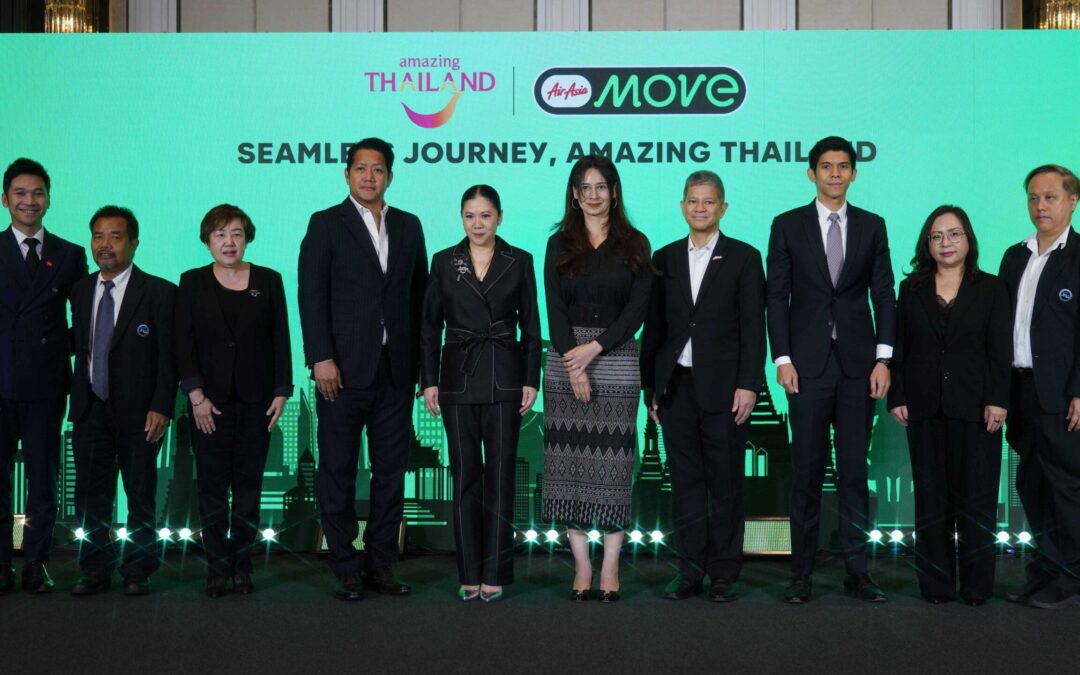
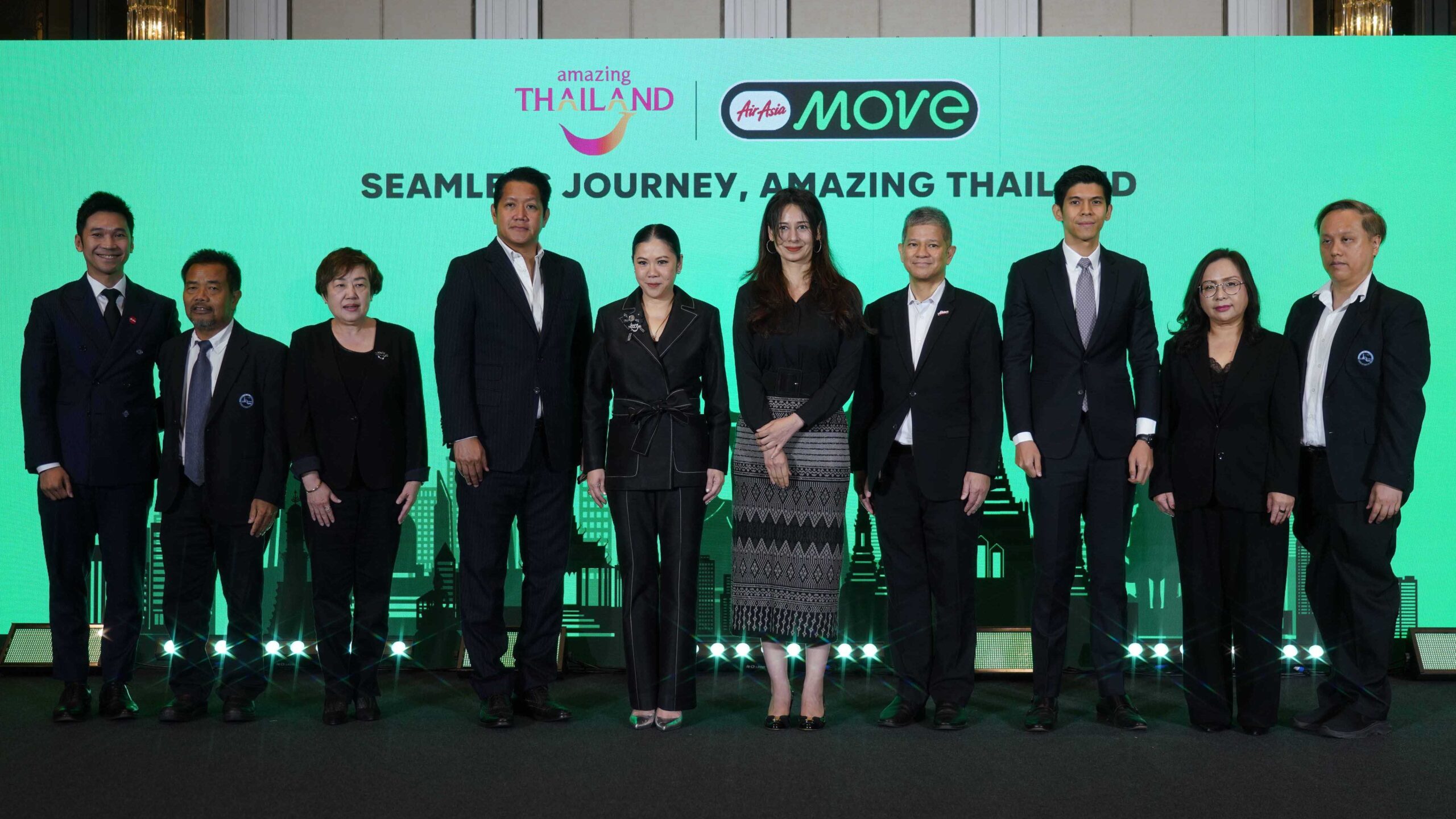
The Tourism Authority of Thailand and AirAsia MOVE announced a three-year digital travel partnership in Bangkok on 23 June 2026. The agreement sits under the TAT x MOVE: Seamless Journey, Amazing Thailand theme and is designed to connect destination marketing, traveller insights, co-branded campaigns and travel bookings across Thailand.
TAT and AirAsia MOVE announced a three-year digital travel partnership in Bangkok.
For Bangkok property buyers, the importance is not that one tourism partnership changes condo prices. It does not. The relevance is confidence: Thailand is continuing to invest in digital travel distribution, regional visitor access and better use of travel behaviour data. Those signals support Bangkok’s position as a connected base for investors, residents and frequent visitors.
What the partnership covers
TAT said the partnership covers co-branded campaigns, content promotion and joint marketing across TAT channels and the AirAsia MOVE platform. AirAsia MOVE brings a regional travel ecosystem and more than 17 million monthly active users. The stated aim is to strengthen Thailand’s position as a world-class tourism destination and use traveller insights from Asia and beyond for more focused destination marketing.
This matters because modern travel decisions often begin on digital platforms. A visitor may discover Thailand through content, compare destinations, book flights, arrange accommodation and plan domestic trips through the same ecosystem. Better distribution can help Thailand convert interest into actual travel, particularly from regional markets with repeat-visitor potential.
The partnership connects destination marketing with traveller data and booking behaviour.
Why Bangkok benefits from travel distribution
Bangkok is the natural starting point for many Thailand trips. It has airports, hotels, hospitals, retail, dining, business services, cultural sites and onward transport. When digital campaigns make Thailand easier to discover and book, Bangkok often benefits as the arrival city, meeting point, shopping stop, medical base or long-stay hub.
For property buyers, that supports the broader case for locations that connect well with airports, rail, hotels, offices, hospitals and lifestyle districts. A condo is still judged by its own fundamentals, but the city around it becomes easier to explain when travel access and destination marketing remain active.
Useful traveller signals from the announcement
TAT cited AirAsia MOVE travel behaviour and booking data for the first half of 2026. Asia remained the main inbound driver, with Malaysia, India, China and Indonesia continuing as top source markets for Thailand on the platform. The United States remained an important long-haul market, with travellers aged 50 and above accounting for 32% of US visitors on the platform and a 77% round-trip booking rate.
Those details are useful because they show Thailand’s visitor story is not limited to one country or travel style. Regional travellers, long-haul visitors, couples, older travellers and gateway users can all support different parts of the tourism economy. Bangkok property investors should not turn these figures into rent forecasts, but they can include them in a wider confidence view.
Digital travel platforms can influence how regional visitors discover and plan Thai trips.
What buyers should not overread
A travel-marketing partnership is not a reason to overpay for a weak condo. It does not solve poor building management, difficult station access, oversupply, inefficient layouts or unrealistic seller pricing. Foreign buyers still need to review comparable listings, ownership route, transfer documents, tenant demand and exit strategy.
The correct reading is city-level. Thailand is working with a major digital travel platform to improve reach, data use and campaign targeting. Bangkok remains a beneficiary when visitors use the capital as an entry point, business base, medical hub, shopping centre or second-home location.
That makes access, neighbourhood clarity and building quality the practical buyer filters.
Property takeaway
The TAT and AirAsia MOVE partnership strengthens the argument that Thailand is still actively competing for digitally connected, quality-led travel demand. For Bangkok property buyers, that supports confidence in well-located condos tied to transport, lifestyle and international access. The investment decision should still be made at unit level, with disciplined pricing and a clear tenant or owner-use story.
IBP helps foreign buyers connect Thailand tourism and economic news with practical Bangkok property choices. Read more in our Thailand economy and investment news archive or contact IBP Real Estate for a Bangkok property brief.
A Bangkok condo’s unit mix can shape investment performance as much as the view, floor or headline price. Foreign buyers often compare one unit against another, but the better question is how many similar units the building contains, who those units are likely to attract, and whether the chosen type has enough rental and resale depth.
Unit mix affects how many similar homes compete for the same tenant or resale buyer.
Unit mix is the distribution of studios, one-bedroom, two-bedroom, larger family units and special layouts within a condominium. It affects competition inside the building, the tenant profile, the resale audience and the amount of pressure an owner may face when several similar units are listed at the same time.
Why unit mix matters to investors
A building with hundreds of similar compact units can be easy for tenants to compare. If many owners are competing for the same renter, the cheapest well-presented unit may set the tone. That does not make compact units bad investments, but it means the buyer must be realistic about rent, furnishing standard, vacancy risk and resale timing.
A building with a more varied mix can give certain units a clearer identity. Larger corner units, efficient two-bedroom layouts, duplexes or rare stacks may stand out if the district has the right tenant base. The challenge is liquidity. A rare unit type can command attention, but it may also require a narrower buyer or tenant audience.
A good building can still have weak investment logic if the chosen unit type is oversupplied.
Match the unit type to the district
Unit mix should be read against the surrounding demand. Near office districts, compact one-bedroom units may appeal to professionals who want an easy commute. Near international schools or hospitals, larger layouts may have more practical value. In lifestyle districts with strong dining and transport, well-furnished one-bedroom units may lease faster than oversized units with weak layouts.
The mistake is buying a unit type simply because it looks affordable. A low ticket price is useful only if there is a clear tenant and future buyer for that space. Foreign investors should ask who would live in the unit, why they would choose this building, and what alternatives they would see at the same rent or purchase budget.
Check internal competition
Before buying, review current listings in the same building. Count how many similar units are for rent or sale, then compare furnishing, view, floor, condition, asking price and time on market where information is available. If several near-identical units are listed, your rent assumption should be conservative unless your unit has a visible advantage.
Internal competition is especially important in buildings dominated by one-bedroom units. Tenants can compare photographs quickly. Small differences in furniture quality, storage, light, kitchen usability and balcony condition can decide which unit receives viewings. Investors should budget for presentation because an ordinary unit in a crowded type can become price-led.
The strongest unit mix is the one that matches real district demand, not only brochure assumptions.
Beware of false scarcity
Agents sometimes describe a layout as rare because there are not many similar units in the building. Scarcity is useful only if demand exists. A large unit may be rare because the developer built few of them, but it still needs a buyer who wants that size, location and running cost. A small unit may be common but highly liquid if it matches the strongest tenant pool.
Foreign buyers should separate rarity from liquidity. Rarity helps when the unit solves a real problem for residents. It hurts when the market sees the unit as awkward, expensive to furnish, hard to cool, difficult to rent, or too large for the neighbourhood’s usual demand.
Furnishing and operating costs vary by unit type
A larger unit usually needs a larger furnishing budget, more air-conditioning capacity, more maintenance, higher common-area fees and a broader repair plan. A compact unit may be cheaper to prepare, but it can suffer more from weak storage or poor furniture choices. Unit mix analysis should therefore include the cost of making the unit competitive, not only the purchase price.
For landlords, the expected tenant stay also matters. A compact unit aimed at short professional tenancies may need more frequent cleaning, touch-ups and relisting. A family-sized unit may have fewer tenant changes but higher expectations for appliances, curtains, beds, storage and management response.
Questions to ask before buying
How many units in the building are similar to this one?
Which tenant profile does this size and layout serve best?
Does the building have too many competing units at the same rent level?
Would the unit still stand out if several owners lowered asking rents?
Is the resale audience broad enough for the intended holding period?
Does the furnishing budget fit the unit’s likely rent ceiling?
Buyer takeaway
A sensible Bangkok condo investment starts with more than the individual unit. The building’s unit mix tells buyers who they will compete against, how visible their unit can be online, and how easy the resale story may be later. The safest choice is not always the cheapest or rarest unit. It is the unit type that matches real district demand and remains easy to explain to the next tenant or buyer.
IBP helps foreign buyers compare Bangkok condos by unit type, building mix, tenant demand and exit strategy. Explore our investment analysis archive or contact IBP Real Estate for a shortlist built around your budget and holding plan.
The Tourism Authority of Thailand’s latest Jim Thompson collaboration is not a property launch, but it does say something useful about Bangkok’s premium positioning. TAT Newsroom reported that on 19 June 2026, TAT and Jim Thompson launched the Amazing Thailand x Jim Thompson collection in Bangkok, linking Thai silk, contemporary design, cultural storytelling and high-value travel.
TAT’s collaboration with Jim Thompson connects Thai silk, design heritage and premium travel storytelling.
For foreign property buyers, the relevance is indirect. Bangkok’s best long-term appeal does not come only from office towers and transport lines. It also comes from culture, design, hospitality, retail, food, heritage and the city’s ability to turn Thai identity into experiences that international residents and visitors remember.
Why this collaboration matters
The release positions the collection under TAT’s Luxury Tourism initiative, Soul of Siam: Crafted Luxury. TAT describes the aim as creating greater value from tourism by connecting cultural strengths with meaningful travel experiences. Jim Thompson is named as one of 15 participating brands, recognised for Thai silk heritage, craftsmanship, lifestyle, retail and hospitality.
That matters because Thailand’s tourism strategy has increasingly emphasised quality, value and distinctive experiences rather than simple visitor volume. For Bangkok property, this helps explain why central districts with culture, retail, transport and premium services can remain attractive to internationally mobile buyers, even when they are not the cheapest locations.
Heritage-led retail and cultural programming can strengthen Bangkok’s appeal to high-value visitors.
Bangkok as a cultural base, not just a gateway
Bangkok is often described as a gateway to Thailand, but the Jim Thompson story reminds buyers that the city is also a destination in its own right. The TAT article highlights a Bangkok journey from the Jim Thompson House Museum, where visitors can learn about teak architecture, silk demonstrations, private art collections and the Baan Krua weaving community, to the Jim Thompson Art Center and the Surawong Flagship Store.
This type of route is important because it gives high-value visitors reasons to spend time in the city, not only pass through it. It links shopping, heritage, museums, canals, art, dining and neighbourhood movement. Those are exactly the details that make a city feel more livable to foreign residents evaluating whether Bangkok could be a second home or long-term base.
What property buyers should not overread
A cultural tourism collaboration does not mean condo prices will rise. Buyers should not use it as a reason to overpay for a weak unit, ignore building due diligence or assume all central locations benefit equally. Property performance still depends on entry price, rent evidence, building management, layout, ownership costs and resale depth.
The better reading is confidence-based. When TAT and major Thai brands invest in premium storytelling, Bangkok’s wider brand becomes richer. That can support demand for areas where international visitors, residents and tenants can access culture, retail, hospitality, transport and daily convenience together.
Premium destination positioning works best when it is linked to real places, retail, culture and hospitality.
Districts that can benefit from premium positioning
The most obvious beneficiaries are central districts with a strong lifestyle and cultural offer: Siam, Ratchaprasong, Chit Lom, Langsuan, Silom, Sathorn, riverside areas, Phrom Phong and parts of Sukhumvit. But the lesson is broader. Foreign buyers should look for districts where Bangkok’s premium story is easy to experience from the front door.
A good condo location should make it simple to reach galleries, restaurants, shops, hotels, hospitals, parks, offices and transport. The more those features overlap, the easier it becomes to explain the unit to a future tenant or buyer. A beautifully branded city story is useful only when the property also sits inside a practical daily routine.
How investors can use the signal
Investors can use this news as part of a macro confidence checklist. Is Thailand still investing in high-value tourism? Are major brands connecting Bangkok with culture, craftsmanship and premium travel? Are central districts continuing to attract residents who want a refined urban lifestyle? If the answer is yes, the city remains easy to explain to foreign buyers, but the unit still needs a disciplined purchase case.
For owner-occupiers, the takeaway is personal as much as financial. Bangkok’s appeal lies in how easily a resident can move from home to culture, dining, retail, wellness and travel. The strongest properties are those that make this lifestyle feel natural, not forced.
Buyer takeaway
The Amazing Thailand x Jim Thompson collection strengthens Bangkok’s premium cultural narrative. It gives foreign buyers another example of how Thailand presents heritage, design and hospitality to global audiences. The correct property response is not speculation. It is to choose condos where location, building quality and daily lifestyle genuinely connect with Bangkok’s high-value positioning.
IBP can help foreign buyers connect Thailand economic and tourism news with district-level property decisions. Read more in our Thailand economy and investment news archive or contact IBP Real Estate for a Bangkok property brief.
A Bangkok condo view can make a unit easier to love at first sight. It can also make investors careless. A skyline, river, park or open outlook may support photography, tenant interest and resale appeal, but only if the buyer understands how secure that view is, how it affects daily comfort and whether the price already assumes too much future value.
A strong view can help a listing, but investors should test how durable that advantage really is.
Foreign buyers should treat view risk as part of investment underwriting. The question is not simply whether the unit has a good view today. The better question is whether the outlook is durable enough to support the rent, resale and holding period being modelled. A premium paid for a view that later disappears can be difficult to recover.
Why views matter to the return case
A strong view can improve listing photos, create emotional appeal during viewings and help a unit stand out in a building with many similar layouts. This can matter in competitive rental markets, especially when tenants compare units online before visiting. A bright, open unit may also feel larger and more comfortable than a darker unit with the same registered area.
However, views do not produce returns by themselves. Investors still need a sensible entry price, efficient layout, good building management, realistic rent evidence and a clear resale audience. A weak building with a nice outlook can still be a poor investment. A well-managed building with an ordinary view may perform better if the total package is easier for tenants and future buyers to understand.
View, orientation, heat, noise and layout should be assessed together, not in isolation.
Check what could be built nearby
The most obvious view risk is future obstruction. Empty land, low-rise buildings, old commercial blocks, surface parking and ageing houses can all change over a long holding period. A buyer cannot know every future development decision, but they can walk the immediate area, look at neighbouring plots, ask about land ownership where possible and compare the building’s position with nearby roads and parcels.
Do not rely only on a sales agent’s statement that a view is protected. Ask why it is protected. Is there a river, park, school, temple, public facility, road or permanent low-rise use in the sight line? Or is the view simply open because the neighbouring land has not yet been redeveloped? Those are very different risk profiles.
Orientation can be as important as scenery
A view that photographs well may be uncomfortable if the unit receives hard afternoon sun, has poor shading, or becomes too hot to use without heavy air-conditioning. For owner-occupiers, this affects daily comfort. For landlords, it can affect tenant satisfaction and electricity costs. A pleasant morning view with softer light may be more useful than a dramatic west-facing view that overheats the living room.
Buyers should visit at different times if possible. Check glare on screens, balcony usability, curtain quality, heat near the windows and whether the air-conditioning can cool the room efficiently. The view should support liveability, not only marketing.
Building position and surrounding land use can matter as much as the view seen on viewing day.
Noise and privacy are part of the same check
Open outlooks can come with traffic noise, construction noise, elevated rail exposure or nearby office towers looking directly into the unit. Higher floors are not automatically quieter, especially near expressways or rail curves. A buyer should open balcony doors, stand quietly for a few minutes and listen. If the unit is shown with music, closed curtains or closed windows, ask to inspect it in normal conditions.
Privacy is also important. A unit with a direct view into another tower may feel less premium even if it is high up. Tenants may keep curtains closed, reducing natural light and the sense of space. Resale buyers will notice the same issue.
How to price view risk
Investors should separate the base value of the unit from the view premium. Compare similar units in the same building and nearby buildings. If the target unit is materially more expensive because of its view, ask whether that premium is justified by rent evidence or likely resale demand. If the view could be blocked, the buyer should be cautious about paying as if it were permanent.
For resale units, check historical listing behaviour where available. Some view units sell quickly because they are genuinely rare. Others sit on the market because sellers overprice the outlook. A good view is an advantage only if the next buyer also accepts the premium.
Investor checklist
Walk the surrounding plots and identify what could plausibly change.
Check orientation, heat, glare and air-conditioning load.
Listen for traffic, rail, school, nightlife or construction noise.
Test privacy from neighbouring towers and common areas.
Compare the view premium with realistic rent and resale evidence.
Ask whether the unit would still be attractive if the view weakened.
Buyer takeaway
A Bangkok condo view can be valuable, but only when it is bought with discipline. Foreign investors should pay for a view only after testing obstruction risk, orientation, privacy, noise and resale defensibility. The safest view premium is the one that still leaves the unit attractive on fundamentals if the skyline changes.
IBP helps foreign buyers compare Bangkok condos by layout, building quality, view risk and exit strategy. Read more in our investment analysis archive or contact IBP Real Estate for a buyer shortlist.
ASEAN’s Digital Economy Framework Agreement is not a Bangkok property policy, but it is relevant to the confidence story behind Bangkok real estate. The Government Public Relations Department reported on 9 June 2026 that ASEAN member states had concluded negotiations on the agreement, with legal scrubbing underway before an expected signing by regional leaders at the ASEAN Summit in November 2026.
ASEAN’s digital-economy framework is a regional policy signal rather than a single-project property catalyst.
For foreign property buyers, the important point is not to treat DEFA as a direct trigger for condo prices. The more useful reading is structural. A more harmonised ASEAN digital economy can support business formation, cross-border services, digital payments, data flows, cybersecurity standards and regional investor confidence. Bangkok benefits when Thailand is seen as a credible operating base inside that wider system.
What DEFA is trying to change
According to PRD, the agreement is intended to unify fragmented national regulations into a higher-standard regional digital trade framework. The official release also says DEFA is projected to more than double ASEAN’s digital economy, reaching US$2 trillion by 2030. Those are regional figures, not Bangkok property forecasts, but they show the scale of policy ambition.
Digital-economy rules matter because companies choose locations partly on operating friction. If cross-border payments, e-commerce, data and cybersecurity standards become easier to navigate, regional firms may find it simpler to serve several ASEAN markets. Bangkok’s appeal then depends on how well it combines those rules with talent, transport, offices, housing, lifestyle and airport access.
Digital trade and data standards matter most to property when they support real business activity.
Why Bangkok remains part of the conversation
Bangkok is already Thailand’s central hub for finance, law, corporate services, hospitality, media, retail and international travel. Digital-economy growth does not remove the need for physical cities. It often increases demand for places where executives, product teams, investors, consultants and regional managers can meet, hire, live and travel easily.
This is where property buyers should pay attention. The strongest real estate demand tends to form where economic activity and daily liveability overlap. A digital firm may not rent a large office in the same way as an older industrial company, but its staff and founders still need housing, transport, healthcare, schools, dining and flexible work settings. Bangkok districts that serve those routines can remain relevant.
What investors should not assume
DEFA should not be used as a reason to buy any condominium at any price. A regional digital agreement does not rescue a weak building, an awkward layout or an overpaid unit. Property performance still depends on rent evidence, resale depth, building management, common fees, future supply and the buyer’s holding period.
Investors should also avoid assuming that digital-economy growth benefits only one district. Bangkok’s demand map is varied. Central Sukhumvit, Silom-Sathorn, Rama IV, Phaya Thai, Ari, Punnawithi, Bang Na and other areas can each serve different parts of the employment and lifestyle market. The right question is which tenant or future buyer a specific unit can realistically attract.
Bangkok’s regional role depends on digital rules, transport, talent and corporate mobility working together.
How foreign buyers can use the signal
Use DEFA as part of a broader confidence checklist. Does Thailand continue to position itself for regional business? Are transport links, digital infrastructure and corporate services improving? Are companies still choosing Bangkok for regional functions, meetings or specialist teams? If the answer is yes, Bangkok’s long-term property case becomes easier to explain, but the purchase still needs building-level discipline.
For buy-to-let investors, this means focusing on units that suit mobile professionals, entrepreneurs, executives and regional staff. For owner-occupiers, it means choosing a district that makes Bangkok feel globally connected without sacrificing daily comfort. For resale buyers, it means avoiding assets that depend only on a broad macro story.
Buyer takeaway
ASEAN DEFA reinforces the idea that Thailand wants to compete in a more integrated regional digital economy. For Bangkok property buyers, the value is indirect but meaningful: stronger regional rules can support corporate confidence, mobility and the city’s business narrative. The correct response is not speculation. It is to use the macro signal while buying only units with a clear tenant, owner and resale case.
IBP can help foreign buyers connect Thailand economic news with district and building-level property decisions. Read more in our Thailand economy and investment news archive or contact IBP Real Estate for a Bangkok property brief.
Thailand’s wellness positioning is becoming part of the wider confidence story foreign property buyers watch. The Tourism Authority of Thailand marked Global Wellness Day 2026 on 14 June with Thai wellness experiences nationwide, including Bangkok activity on the Chao Phraya River.
This is not a direct condo-price signal. It is a softer but useful indicator of how Thailand presents itself to higher-value visitors, long-stay residents and internationally mobile households: hospitable, health-aware, culturally rooted and lifestyle-led.
TAT used Global Wellness Day 2026 to reinforce Thailand's wellness tourism positioning.
What TAT Highlighted
TAT said Global Wellness Day 2026 was held under the #JoyMagenta theme and used the occasion to present Thailand as a leading destination for wellness and hospitality. The agency supported activities in Ko Samui and Bangkok, while hotels and wellness operators across the country also joined the movement.
In Bangkok, TAT supported activities at Anantara Riverside Bangkok Resort on 13 June. The programme centred on Eastern wisdom and joyful living, with Thai and international participants exploring traditional healing knowledge, Thai botanicals, mindful movement and modern longevity practices in a riverside setting.
The Bangkok activities included herbal tea blending, selected Thai botanical ingredients, Muay Thai, Tai Chi, yoga and sound healing. For property buyers, the important point is the positioning: Bangkok is not only a business and retail city, but also a place where hospitality, healthcare and wellness routines are part of the urban offer.
Bangkok's wellness positioning is strongest when it connects hospitality, healthcare, river access and daily liveability.
Why Wellness Tourism Matters To Bangkok
Wellness tourism connects several Bangkok strengths. The city has international hospitals, hotels, spas, riverfront resorts, premium retail, restaurants, private clinics, fitness studios and serviced residences. These are not all property demand drivers by themselves, but together they make Bangkok easier to understand as a long-stay and repeat-visit city.
Foreign buyers often move from visitor to resident gradually. A first trip may be for leisure, medical care, business, school research or a family visit. If the city feels comfortable, service-led and easy to navigate, some buyers later consider a rental base, second home or investment condo.
The wellness story also supports districts that offer real daily convenience. A building near healthcare, parks, river access, gyms, restaurants and transport can turn a national tourism theme into a practical resident experience.
Thai wellness, botanicals and mindful movement add to the wider lifestyle story foreign residents consider.
What Investors Should Not Assume
Wellness branding does not make every condo a good investment. Buyers should avoid turning a tourism theme into a blanket price assumption. A weak building, poor management, awkward route or overpriced unit will not be saved by national marketing.
The correct use of the signal is contextual. It can support confidence in Bangkok’s long-term lifestyle appeal, but the purchase still depends on title, foreign quota, building quality, common fees, rent evidence, tenant profile and resale depth.
Investors should also separate hotel and resort demand from residential demand. A wellness traveller may book a hotel or serviced apartment, while a condo tenant may need a very different package: privacy, transport, work space, internet, storage and practical management.
District Implications For Buyers
Districts with strong wellness relevance include riverside areas, central hospital corridors, park-adjacent neighbourhoods and mixed-use locations with reliable retail and dining. The strongest condos make these amenities easy to use without complicated travel.
For owner occupiers, the question is whether the district supports the life they want after the first few weeks. Can they reach healthcare, exercise, quiet space, food, transport and social routines comfortably? For investors, the question is whether the same features broaden the tenant pool and improve renewal prospects.
A buyer should therefore test the lifestyle in person. Visit the area in the morning, evening and weekend. Check routes to hospitals, parks, river piers, BTS or MRT, gyms and supermarkets. Wellness value is practical when it reduces friction in daily life.
Buyer Takeaway
TAT’s Global Wellness Day 2026 activity reinforces the direction Thailand wants to project: quality, hospitality, health and experience. For Bangkok property, that is a confidence backdrop rather than a purchase instruction.
Foreign buyers should use the signal to ask better questions. Which buildings actually benefit from Bangkok’s wellness and healthcare ecosystem? Which districts make healthy daily routines easy? Which units are priced as though a lifestyle premium is guaranteed when the evidence is still thin?
IBP tracks how tourism, infrastructure and lifestyle positioning connect to property decisions. Read more in our Thailand economy and investment news section or contact IBP for a buyer strategy session.
Bangkok condo buyers often start with price per square metre, but the better investor question is how much of that area is genuinely useful. A larger unit can underperform if the plan wastes space in corridors, awkward corners, deep dark rooms or a balcony that does not suit the target tenant. A smaller unit can compete well when it feels simple, bright and easy to furnish.
Layout efficiency matters because foreign buyers pay for every registered square metre, while tenants and future buyers respond to daily usability. The aim is not to buy the smallest unit. It is to buy a plan that converts paid area into comfort, rentability and resale clarity.
Layout efficiency should be tested against the way tenants and future buyers actually use the space.
Why Layout Efficiency Affects Returns
A rental decision is usually made quickly. Tenants compare the bedroom, living area, work space, storage, kitchen, bathroom, light and route to the lift. If those elements feel clear, the unit is easier to understand and easier to show. If the plan feels cramped or confusing, the listing may need a discount even when the building and district are strong.
The resale effect is similar. A future buyer does not pay only for area on a title document. They ask whether the living room can take normal furniture, whether the bedroom can fit a proper bed, whether there is a place to work, and whether the view and light make the space feel better than competing units. Efficient plans help the next buyer see value quickly.
For foreign investors, layout efficiency also protects against management friction. A practical unit is easier to furnish, photograph, clean, repair and re-let. The wrong layout can turn every tenant change into a small negotiation about missing storage, weak work space or furniture that never quite fits.
The same square metre count can perform very differently across buildings, floor plans and tenant groups.
Do Not Let Size Hide A Weak Plan
A large headline area can hide wasted space. Long entry corridors, oversized bathrooms, columns in difficult places, narrow kitchens and odd corners may look acceptable in a plan but disappoint in person. Buyers should walk through the unit and ask what each square metre actually does.
Balcony size deserves a separate check. Some Bangkok buyers like a generous balcony for drying clothes, plants or river views. Others prefer more internal space because heat, rain, road noise or building rules limit balcony use. An investor should not assume that outdoor area has the same value as indoor living space.
Ceiling height and window placement also change how area feels. A compact unit with good ceiling height, natural light and sensible furniture walls may feel better than a larger unit with poor proportions. The lived experience is what tenants and future buyers remember.
Match The Plan To The Tenant Profile
Layout should be judged against the likely tenant. A young professional near BTS may value a desk zone, easy kitchen, laundry space and quick access to daily services. A couple may need a larger wardrobe, better living room and more privacy between bed and work areas. A family may prioritise bedrooms, storage, schools, parking and noise control.
A unit near hospitals or universities may need different furnishing from a unit in a finance or embassy district. A short commute can attract tenants, but the unit still has to support their actual routine. The strongest investment plans make the target tenant obvious.
Avoid buying a plan that requires too many explanations. If an agent has to justify why a dining table cannot fit, why the bedroom door clashes with the wardrobe, or why the kitchen is hidden in a corridor, the future resale conversation may be just as difficult.
Good layouts turn paid area into usable rooms, storage, work space and a clearer resale story.
How To Compare Layouts Fairly
Compare the target unit with at least three alternatives in the same price band. Use the same questions each time: usable living area, bedroom function, storage, light, kitchen practicality, bathroom ventilation, furniture walls, balcony usefulness, laundry position and privacy. A simple scorecard reduces the risk of being influenced by one attractive photo.
Then compare the plan with listings in the same building. If many identical units are available, the buyer needs price discipline because the layout is not scarce. If the plan is genuinely better than typical alternatives, it may deserve a premium, but only when rent and resale evidence support it.
Investors should also look at furnishing cost. A weak layout may need custom furniture, which increases upfront spending and can be harder to repair. A standard, efficient plan may be less dramatic, but it is often easier to manage from overseas.
Red Flags During A Viewing
Watch for beds pushed against walls with no walking space, sofas that block balcony doors, dining tables removed for photography, wardrobes that cannot open fully, air-conditioning units aimed at uncomfortable angles, and kitchens with poor work surfaces. These are not cosmetic details. They show whether the unit works in daily life.
Also check how the plan handles noise and light. A bedroom beside the corridor or lift lobby may need a discount. A living room that faces a hot west exposure may require better curtains and air-conditioning. A unit with windows only on one side may feel darker and less flexible.
If the unit is tenanted, ask what furniture belongs to the owner and what belongs to the tenant. The layout may look better because the current resident has adapted it in ways that will not transfer with the sale.
Buyer Takeaway
Layout efficiency is a quiet investment factor, but it affects rent, vacancy, furnishing cost and resale depth. A foreign buyer should not pay simply for square metres. The stronger approach is to pay for usable rooms, a clear tenant story and a plan that future buyers can understand without persuasion.
Before bidding, model the unit as if no layout premium appears. If the deal still works, a strong plan gives extra resilience. If the numbers only work because the buyer assumes a high rent for a difficult layout, the margin is thin.
Thailand’s overseas tourism marketing can look distant from Bangkok property, but it is part of the confidence backdrop foreign buyers watch. The Tourism Authority of Thailand’s Amazing Thailand Fest 2026 in Amsterdam is a useful example because it links Thai gastronomy, wellness, culture and travel inspiration with one of Europe’s visible lifestyle settings.
The property conclusion should be measured. A food and culture showcase does not forecast condo prices. It does, however, reinforce Thailand’s ability to keep Bangkok and the wider country visible to quality long-haul visitors, repeat travellers and potential future residents.
Amazing Thailand Fest 2026 in Amsterdam presents Thai food, wellness, culture and travel to European visitors.
What TAT Announced
TAT said the event, branded Amazing Thailand Fest 2026: The Wholesome Taste of Thai, is being presented from 3 to 16 June 2026 at de Bijenkorf in Amsterdam, in collaboration with the Royal Thai Embassy in The Hague and Central Group. The opening ceremony took place on 5 June 2026.
The official release framed the showcase around Thai food, wellness, culture, craftsmanship and travel storytelling. It also noted participation by Thai tourism and business partners including Blue Elephant Bangkok, Thai Airways International, the Office of Agricultural Affairs to the European Union and tour operators.
For Bangkok property buyers, the useful detail is not the event format alone. It is the way Thailand is positioning itself to European audiences: premium, cultural, service-led and experience-led rather than purely volume-driven.
European travel interest supports Bangkok's role as Thailand's main arrival, business and lifestyle gateway.
Why Long-Haul Visibility Matters
Long-haul visitor confidence supports Bangkok in several indirect ways. International visitors arrive through Bangkok, use hotels, restaurants, hospitals, retail, domestic connections and corporate services, and often form their first serious impression of Thailand through the capital. Some later return for longer stays, business trips, medical visits, school searches or property inspections.
TAT’s release said the Netherlands is among Thailand’s top 10 European visitor markets. From 1 January to 31 May 2026, Thailand welcomed 113,878 Dutch visitors, and TAT expects 259,455 Dutch visitors for the full year. Bangkok was listed among popular destinations, alongside Surat Thani, Krabi, Chiang Mai and Phuket.
Those figures should not be converted into a condo demand forecast. They are better read as confidence context. A city that remains easy to market internationally has a stronger platform for hotels, serviced apartments, branded residences, medical travel, education visits and second-home consideration.
Soft-power campaigns are not direct property signals, but they can support visitor and relocation confidence.
The Bangkok Property Link
Bangkok benefits when Thailand’s visitor story is broad. Gastronomy, wellness, culture and shopping are all themes that foreign residents can experience in daily life, not only during a holiday. That matters because many property buyers are not purchasing only square metres. They are buying access to a city that feels liveable, connected and internationally recognisable.
The link is strongest for districts that can convert the national brand into real convenience: rail access, hospitals, premium retail, dining, schools, river culture, parks, hotels and professional services. A weak building in a poor location does not become attractive because of tourism marketing. A well-managed condo in a district that visitors and residents genuinely use may be easier to explain to future tenants and buyers.
European interest can also support the softer side of demand. Buyers from Europe often compare Bangkok with other regional cities for healthcare, climate, cost, culture, airport access and lifestyle depth. Events like the Amsterdam showcase help keep Thailand in that consideration set.
How Buyers Should Use The Signal
The correct response is disciplined optimism. Treat tourism promotion as one macro confidence signal, then return to the property fundamentals: title, foreign quota, building management, common fees, rent evidence, tenant profile and resale depth. Macro visibility can support demand, but it cannot repair a poor purchase.
Investors should focus on buildings that suit repeat use by international residents: easy access, sensible layouts, reliable management, neighbourhood services and a clear exit story. Owner-occupiers should ask whether the district gives them the Bangkok experience they actually want beyond the first trip.
IBP tracks how tourism, infrastructure and corporate confidence connect to Bangkok property decisions. Read more in our Thailand economy and investment news section or contact IBP for a buyer strategy session.
Floor premiums are easy to understand and easy to overpay for. In Bangkok, a higher floor can mean better light, a cleaner outlook, lower street noise and stronger resale appeal. It can also mean more afternoon heat, longer lift waits, a view that is not protected, or a price gap that future tenants will not support.
Foreign buyers often see floor level as a simple quality signal. The stronger approach is to treat it as one investment variable inside a wider building, rent and exit strategy. A thirty-fifth-floor unit may be worth a premium in one project and poor value in another. The difference is evidence.
Floor premiums should be tested against real rent and resale evidence, not assumed from height alone.
Why Higher Floors Can Be Valuable
A higher floor can improve the daily experience of a Bangkok condo. It may reduce road noise, improve privacy, bring more natural light, create a wider city or river view, and make the unit feel more distinct when compared with lower-floor alternatives. For owner-occupiers, that can be a genuine lifestyle benefit. For investors, it can help photography, viewing impressions and resale positioning.
The premium is most persuasive when the view is specific and hard to replace. An open park, river bend, low-rise embassy district, protected temple view or wide skyline corridor may justify a stronger price than a generic city view across other towers. Buyers should ask what makes the outlook scarce, not simply what floor number appears on the listing.
Floor level can also help in dense districts where lower floors face neighbouring buildings, car parks, air-conditioning equipment or busy roads. In those cases, moving up may materially change tenant comfort. The buyer still needs to compare the exact premium with alternatives in the same building and nearby projects.
A higher floor is useful only when the building, lift service and outlook support the premium.
When The Premium Is Weak
A high floor is less valuable when the building has slow lifts, ageing systems, weak management or a view that can be blocked by future development. It is also weaker when the unit layout is poor. A narrow bedroom, awkward kitchen, limited storage or inefficient living area will not become a good investment simply because it sits higher in the tower.
Heat and orientation matter in Bangkok. A west-facing high-floor unit can be bright but hot in the afternoon, increasing air-conditioning use and reducing comfort. Some tenants love dramatic city views; others prioritise quiet sleep, practical furnishing and lower running costs. Investors should not assume that every tenant pays more for height.
The premium can also disappear if many similar high-floor units are available. In a large project with repeated layouts, a buyer may find several units with comparable views. Scarcity is then limited, and bargaining should be more disciplined.
Compare Floor Bands, Not Just One Unit
The useful comparison is by floor band. Look at low, mid and high floors in the same stack or similar stacks. Compare asking prices, achieved rents where available, view quality, furnishing, room size and time on market. If the price jumps sharply but rent barely changes, the premium may be more emotional than financial.
Buyers should also compare across neighbouring buildings. A mid-floor unit in a better-managed project may be safer than a high-floor unit in a weaker building. A lower floor with a protected green view may outperform a higher floor facing future construction. The floor number is not the asset; the liveable and saleable experience is the asset.
For resale, ask who will buy the unit next. A local end-user may pay for a view if the total ticket still feels reasonable. An investor may discount the view if rental yield is thin. A foreign buyer may value privacy and skyline photographs, but still need building quality and legal readiness. The future buyer pool should shape today’s bid.
Layout, light, heat, noise and view protection can matter more than the floor number.
Inspection Checks For Foreign Buyers
Inspect the unit at different times of day if possible. Check morning light, afternoon heat, evening noise, lift waits, corridor ventilation and how the view feels with lights on inside the unit. Take photographs from sitting height as well as standing height, because the lived view can differ from the sales-gallery angle.
Ask about nearby vacant plots, planned towers, road works, rail lines, schools, bars, mechanical equipment and neighbouring balconies. A premium paid for privacy should not depend on a view that is obviously vulnerable. If the agent claims the view is protected, ask what document or physical condition supports that claim.
Also check practical details. High floors may have stronger wind on balconies, different mobile reception, more dependence on lift reliability and longer evacuation routes. Those points rarely decide a purchase alone, but they should be part of the risk review.
How To Price The Decision
A sensible price test starts with the best lower-floor alternative you would actually buy. Add only the premium that can be defended by view, privacy, rent evidence and resale depth. If the higher-floor unit needs a heroic resale assumption to make the numbers work, the buyer is paying for emotion rather than risk-adjusted value.
For rental investors, model the unit both with and without a floor premium in the rent. If the investment is still acceptable without assuming extra rent, the higher-floor upside is a bonus. If the deal only works because a future tenant must pay a large premium, the margin of safety is thin.
Foreign buyers comparing resale units should also read IBP’s investment analysis and resale strategy sections. For help testing whether a view or floor premium is justified, contact IBP before making an offer.
Building age is one of the simplest Bangkok condo facts to check and one of the easiest to underestimate. Foreign buyers often focus first on the view, furniture, floor level or headline price per square metre. Those details matter, but the age and maintenance history of the building can have a larger effect on rent, resale confidence and the real cost of ownership.
Building age should be read together with maintenance quality and resale evidence.
A ten-year-old Bangkok condo can be an excellent purchase if the management is disciplined, the common areas are well funded and the location still has tenant depth. A newer building can be a weak investment if defects, poor juristic management or unrealistic pricing are already visible. Age is not a verdict. It is a prompt for deeper questions.
Why building age changes the investment case
Bangkok condominiums do not age evenly. Some buildings remain attractive because they were well designed, use durable materials and have co-owners who approve sensible maintenance budgets. Others look tired within a few years because common areas were overpromised, repairs were deferred or the juristic office struggles to collect fees. The difference shows up in tenant demand before it shows up in official documents.
For investors, age affects three areas. First, it influences the rent a tenant is willing to pay compared with newer alternatives nearby. Second, it affects holding costs because older lifts, pumps, corridors, facades and air-conditioning systems may need more attention. Third, it shapes the future buyer pool. A resale buyer may accept an older building if the price, location and management record are convincing.
AGM minutes and budgets help buyers understand what older buildings may need next.
Newer does not always mean lower risk
New projects can offer fresh facilities, modern layouts and easier financing for local buyers. They can also carry early-stage uncertainty. Common fees may not yet reflect the true operating cost, defects may still be settling, rental competition may be intense if many owners complete at the same time, and the first few years of juristic management can reveal whether the building culture is serious.
Foreign buyers should therefore avoid a simple new-versus-old rule. A completed five-year-old building with stable occupancy, clear accounts and strong tenant demand may be safer than a brand-new project where the rent case is based mainly on brochure assumptions. Conversely, an older building with poor reserves, weak security and repeated water issues may be cheap for good reason.
Repairs and capital expenditure
The practical question is not only what the unit costs today. It is what the building may ask owners to fund over the next ownership period. Lift upgrades, waterproofing, pipe repairs, fire-system improvements, lobby refreshes, pool repairs, parking equipment and exterior works can all become material. These costs may be covered by the sinking fund, by annual budgets or by special contributions.
Before buying, ask for recent AGM minutes, audited accounts, sinking fund balance, common fee arrears and any notices about major works. If the building is older, ask specifically about lifts, water pressure, drainage, roof and facade condition. A good answer will not always be perfect, but it should be documented. Vague reassurance is not enough.
A physical inspection should match what the building records say about repairs.
How age affects rental demand
Tenants are practical. They may love a central address, but they still notice lifts, corridors, air-conditioning, smell, noise, security, parcel handling, gym quality and the route from station to lobby. In some mature Bangkok areas, older buildings offer larger rooms and better value than new stock. In other areas, new supply can pull tenants away if the older building has not kept pace.
Investors should compare actual rental listings and closed rents in the same micro-market. Look at unit size, view, floor level, furniture quality and building condition. If an older building rents well because of room size and location, the age may be acceptable. If rent is being defended only through discounting, the investment case needs a more conservative model.
Resale depth matters more as buildings mature
As a building ages, the resale buyer becomes more selective. They will ask whether the location is still convenient, whether the project has a recognisable reputation, whether the common areas are clean and whether future works are manageable. For foreign owners, this matters because exit can be harder if the buyer pool narrows to bargain hunters.
A useful test is to imagine explaining the unit to a future buyer in one sentence. If the sentence is easy because the building has a strong address, sensible size, good management and fair price, age may be manageable. If the explanation depends on excuses, the discount should be meaningful.
Foreign buyer checklist
Confirm completion year, developer record and current juristic management.
Read recent AGM minutes, budgets and sinking fund information.
Inspect lifts, corridors, parking, waste rooms, pool, gym and back-of-house areas.
Compare rents with newer and older competitors within the same walking radius.
Ask whether major repairs are planned and how they will be funded.
Model a resale period that is realistic for the age, price bracket and unit size.
Buyer takeaway
Building age should not scare foreign buyers away from Bangkok resale condos. It should make the due diligence sharper. The best older buildings can offer proven locations, larger layouts and established tenant demand. The weaker ones can trap owners in repair costs and slow resale. Age is useful only when it is read together with management quality, cash reserves, rent evidence and exit demand.
IBP can help foreign buyers compare Bangkok condo buildings by age, management record, rent assumptions and resale evidence. Read more in our investment analysis section or contact IBP Real Estate for a building-level review.
TAT and Agoda’s 11 June 2026 travel-intelligence meeting is not a condominium announcement, but it is relevant to foreign buyers watching Bangkok’s long-term property confidence. The official TAT update said the meeting took place at Agoda’s new office in One Bangkok and focused on travel intelligence, digital technology and platform economy tools.
That combination matters because Bangkok property is supported by more than domestic housing demand. The city benefits when tourism, digital platforms, regional offices, business travel, hospitality, retail and lifestyle spending continue to intersect. For investors, the signal is not a direct price forecast. It is evidence that Bangkok remains a practical operating base for high-reach travel companies and national tourism strategy.
TAT and Agoda discussed travel intelligence and destination marketing cooperation in Bangkok.
Why data-led tourism matters
Tourism promotion is changing from broad campaigns toward sharper demand reading. TAT said the cooperation combines Agoda’s travel insights and digital expertise with TAT destination marketing capabilities to support demand generation from international markets while encouraging domestic travel across Thailand. Better demand reading can help the tourism sector target value, timing, interests and traveller behaviour more precisely.
For Bangkok property buyers, this matters because tourism demand feeds the wider city ecosystem. Hotels, serviced apartments, restaurants, malls, wellness clinics, events, hospitals, transport and retail all respond to visitor flows. When those sectors are active, Bangkok’s strongest districts can feel more liquid, more investable and more useful as places to live.
One Bangkok as the meeting point
The location of the meeting is also useful context. Agoda’s new office in One Bangkok places a global travel platform inside one of the capital’s most visible mixed-use districts. One Bangkok is designed around offices, retail, hospitality, public space and transport access near Rama IV and Wireless Road. That kind of setting reflects how Bangkok is trying to compete as a regional business and lifestyle hub.
A corporate office does not make nearby condos automatic buys. It does, however, reinforce the importance of districts where business, transport, hotels and daily amenities overlap. Foreign buyers should pay attention to how mixed-use projects change walking routes, service density and tenant expectations around Lumpini, Wireless Road, Sathorn, Silom and Rama IV.
Agoda hosted the meeting at its new One Bangkok office, linking the story to Bangkok business infrastructure.
Quality tourism, not only arrival volume
The TAT update referred to promoting Thailand’s unique tourism offerings, emerging trends such as wellness tourism, travel to lesser-known destinations, sustainable practices and the ongoing Trusted Thailand collaboration. That is a quality-of-demand story. It suggests that Thailand is trying to deepen visitor value rather than rely only on headline arrival counts.
This is relevant to property because higher-value and repeat visitors are more likely to become long-stay renters, second-home buyers, medical travellers, relocation families or business owners. Bangkok is often the first point of contact, the medical and shopping base, or the city where regional travellers decide whether Thailand could become a more regular destination.
Platform scale supports confidence, not guarantees
TAT noted Agoda’s global platform scale, including access to more than six million accommodation properties, 130,000 flight routes and 300,000 travel activities worldwide. That reach gives Thailand a large digital distribution partner, but buyers should be careful with interpretation. Platform cooperation can support tourism confidence, but it does not guarantee condo rent, resale gains or occupancy in a specific building.
The right property conclusion is disciplined. Look for buildings that can benefit from Bangkok’s broader tourism and business ecosystem without depending on short-stay speculation. Strong candidates usually have legal clarity, good management, easy transport, daily retail, hospital or office access, and a tenant profile that works in both busy and quieter periods.
For buyers, the signal is about tourism quality, digital demand and Bangkok platform-economy depth.
What foreign buyers should watch next
Buyers should track whether data-led tourism cooperation translates into practical city demand: more business events, stronger hotel performance, more wellness travel, better domestic travel campaigns, higher repeat visits and more regional teams using Bangkok as a base. These indicators matter more than one meeting headline.
They should also compare macro confidence with building-level evidence. A condo near a major mixed-use district may still be overpriced, poorly managed or weak on foreign quota. Conversely, a quieter building in a useful location may offer better risk-adjusted value if rents, fees and resale evidence are clearer.
Buyer takeaway
The TAT-Agoda cooperation is a positive confidence signal for Thailand’s data-led tourism and platform economy. For Bangkok property buyers, its value is context: a stronger tourism and business ecosystem can support well-located, well-managed assets, but only careful unit selection turns that context into a defensible purchase.
Parking is easy to overlook when a Bangkok condominium looks attractive on price, view or rental yield. Foreign buyers often focus on the unit, the payment schedule and the building lobby, then ask about parking only when a tenant or future buyer needs it. That can be a mistake because parking rights can affect rent, resale depth and day-to-day convenience.
The issue is not simply whether a building has spaces. Buyers need to know whether the right is fixed, rotating, registered, rented, attached to the unit, controlled by building rules or limited by practical availability. The answer can change the investment case, especially for larger units, family tenants, older buildings and projects away from direct BTS or MRT access.
Parking rights are most valuable when they fit the building, tenant profile and resale audience.
Why parking can change investment value
In central Bangkok, many tenants do not use a car every day. That does not mean parking is irrelevant. A corporate tenant may still want a space for weekend travel, school runs, visiting family or irregular office routes. A Thai end-user buying in the resale market may care more about parking than a short-stay foreign renter. A two-bedroom or three-bedroom unit without practical parking can lose part of its natural buyer pool.
Parking also interacts with location. A compact unit directly beside BTS or MRT may rent well without a dedicated space if the tenant profile is clearly rail-led. A larger unit in a quieter soi, a riverside building, or a project with family appeal may need stronger parking certainty. The weaker the public-transport story, the more carefully parking should be checked.
For investors, the right question is not whether parking sounds convenient. It is whether the parking position supports the unit price. If two comparable units trade at similar prices but one has a clearer parking arrangement, better access and fewer disputes, that unit may have a stronger exit story.
Confirm what is actually attached to the unit
Some buyers hear that a condo has parking and assume the space belongs to the unit. In practice, arrangements vary. A building may have common parking, assigned spaces, mechanical parking, queue systems, paid additional spaces, visitor parking restrictions or committee rules that change over time. The buyer should ask for written confirmation from the seller and the juristic office before deposit.
The title file and sale documents matter. If a parking right is represented as part of the purchase, ask your lawyer to check whether that right is registered, contractual, customary or only a building practice. A casual promise in a chat message is not the same as a transfer-ready right. The more expensive the unit, the less acceptable uncertainty becomes.
Also confirm whether the right can be passed to a tenant. Some buildings are stricter with tenant registration, additional cards, parking stickers, overnight guest parking and second-car use. A landlord who assumes flexibility may disappoint a tenant after the lease is signed.
The parking story starts at building level, not inside the unit.
Read parking through the likely tenant profile
Parking value depends on who will live in the unit. A one-bedroom near Asok, Phrom Phong or Silom may target a tenant who commutes by rail and uses ride-hailing. In that case, parking is still useful but may not drive rent. A two-bedroom near schools, hospitals, embassies or lower-density luxury neighbourhoods may need parking to satisfy families, couples and senior executives.
Investors should ask agents and property managers for evidence from the same building. Which tenants ask about parking first? Do tenants pay more for a unit with a confirmed space? Are vacant spaces available to rent from other owners? Do disputes happen during busy evenings or weekends? Building-specific evidence is better than broad assumptions about Bangkok car ownership.
Questions before relying on parking value
Is the space fixed, rotating, common, rented or separately documented?
Can a tenant use the space without extra approval or cost?
Are access cards, stickers and visitor rules simple to manage?
Is mechanical parking reliable and acceptable to the target tenant?
How does the building handle second cars, motorcycles and EV charging?
Would the unit still rent or resell well if parking became less convenient?
Older buildings need closer checks
Older Bangkok condominiums can be attractive because they may offer larger layouts in established locations. Parking can be one of the hidden strengths or weaknesses. Some older projects have generous surface or basement parking compared with newer compact developments. Others have tight ramps, poor signage, ageing systems, unclear allocation or queues during peak periods.
The buyer should physically inspect the parking area, not just the unit. Look at lighting, ventilation, security, flooding history, ramp width, lift access, CCTV, maintenance and how easy it is to move from parking to the lobby. A car park that feels neglected may say something about the wider building management culture.
If the building has EV charging, treat it as a useful bonus rather than a substitute for parking due diligence. Ask who operates the chargers, how billing works, how many spaces are affected, and whether future installation may change parking allocation. EV readiness can support future value only when governance is clear.
Parking should be modelled beside layout, rent, management and exit strategy.
Model parking as part of resale
Resale is where parking uncertainty often becomes visible. A future buyer may be more cautious than a tenant because they are committing capital. If the unit is large, premium or far from rail, vague parking rights can become a negotiation point. If the seller can show clear records, building rules and practical use, the buyer conversation is easier.
Parking should therefore sit in the same file as title, foreign quota, debt-free letter, common fees, sinking fund, renovation approvals and rental evidence. The stronger the file, the easier it is for a foreign owner to sell from overseas without repeatedly answering basic questions.
This is also a pricing discipline. Do not pay a premium for a parking promise that cannot be documented. Conversely, do not dismiss a unit with a less impressive view if its parking, building management, layout and tenant fit are stronger than a flashier alternative.
Buyer takeaway
Bangkok condo parking rights are not the main reason to buy a unit, but they can protect the investment case. They matter most when the unit targets families, executives, larger budgets or resale buyers who expect complete daily convenience.