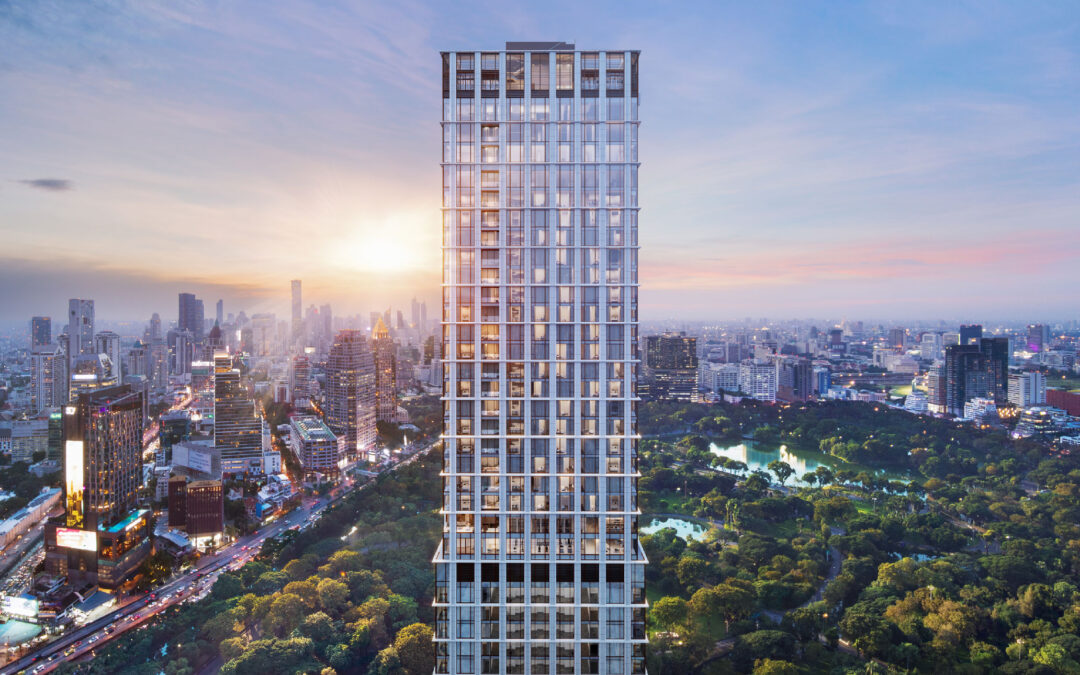
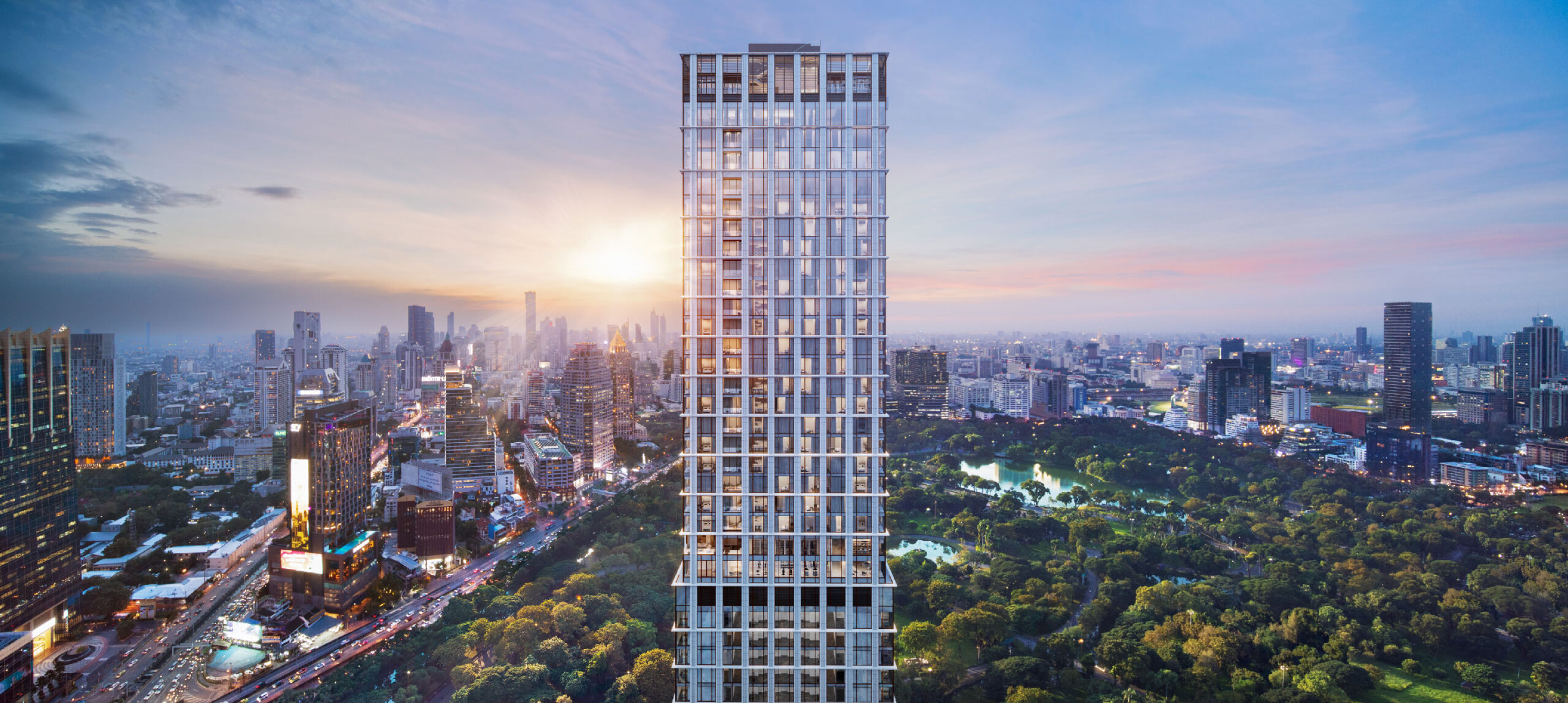
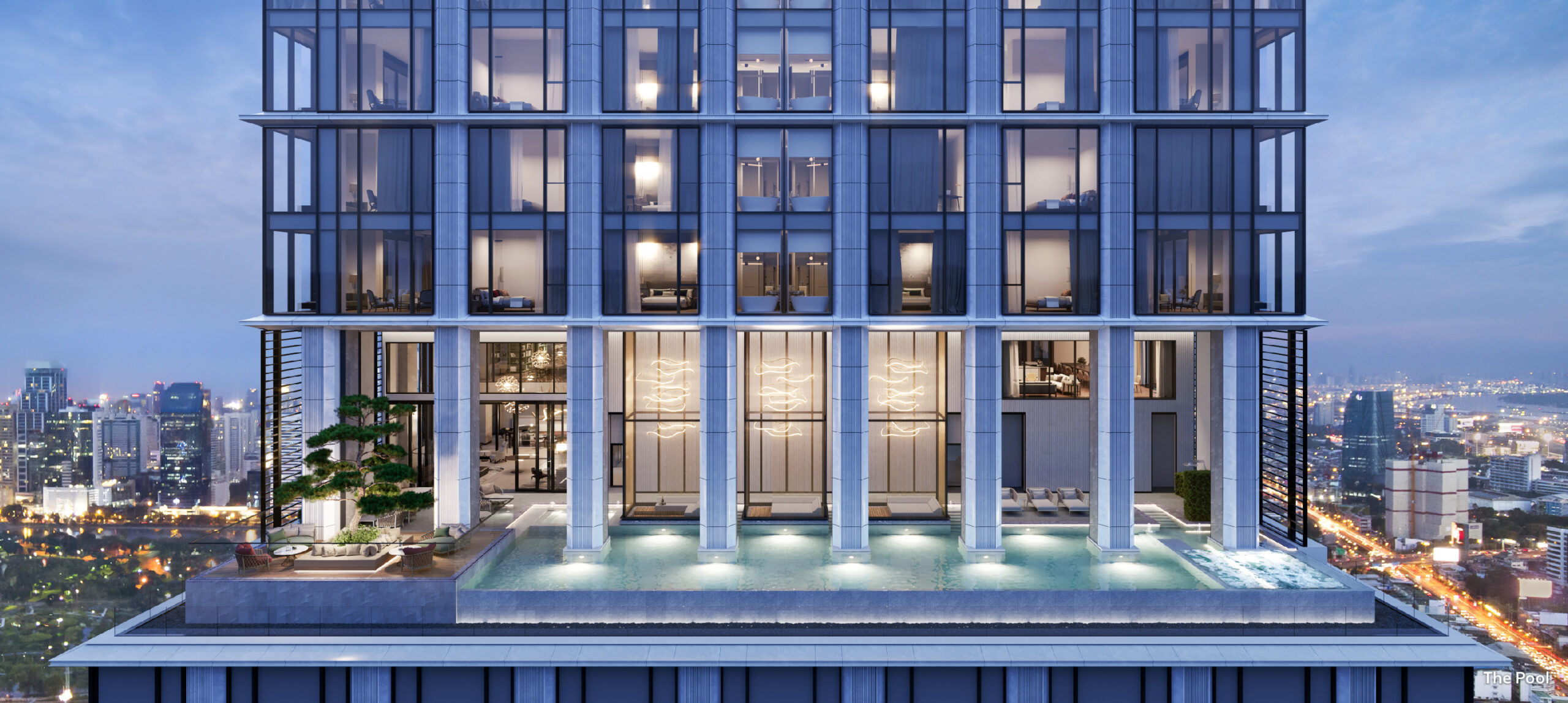
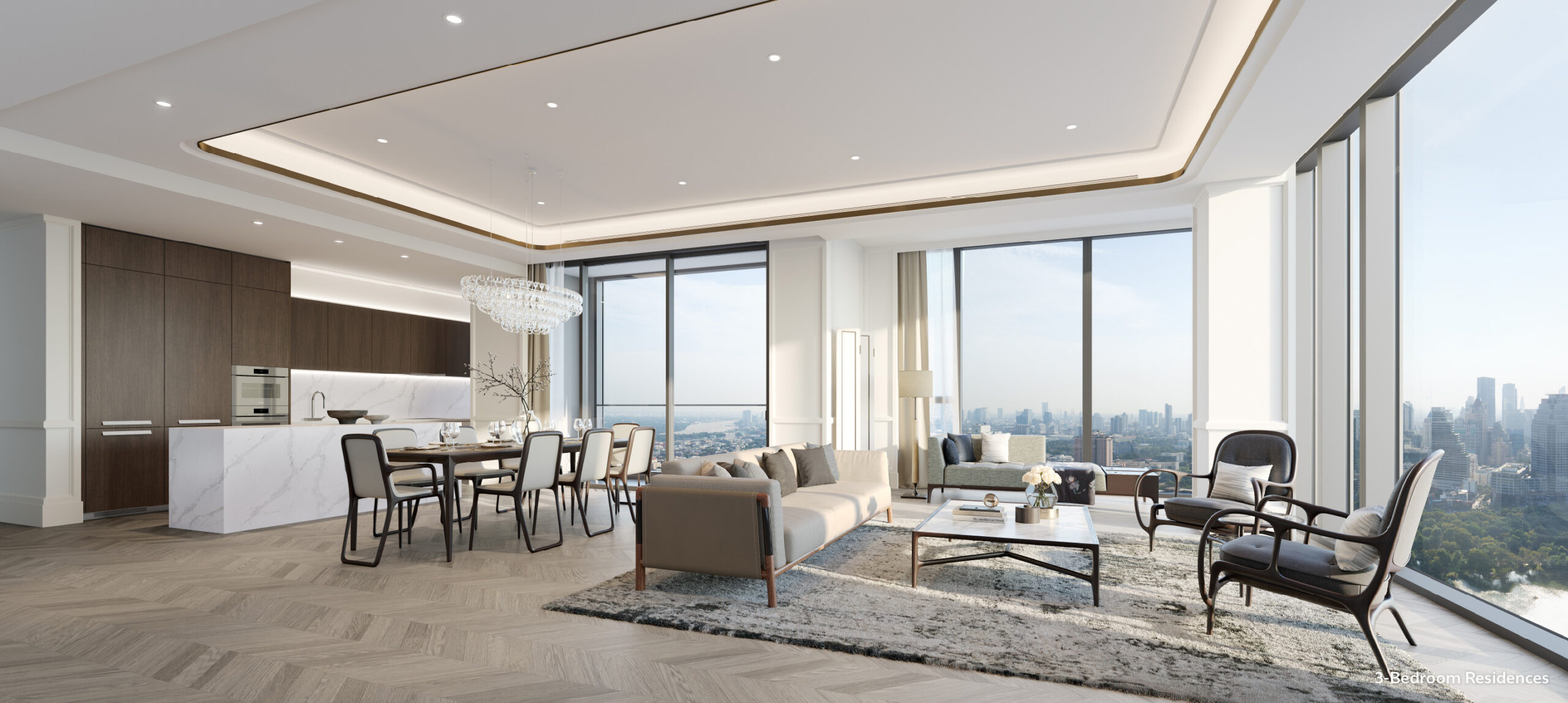
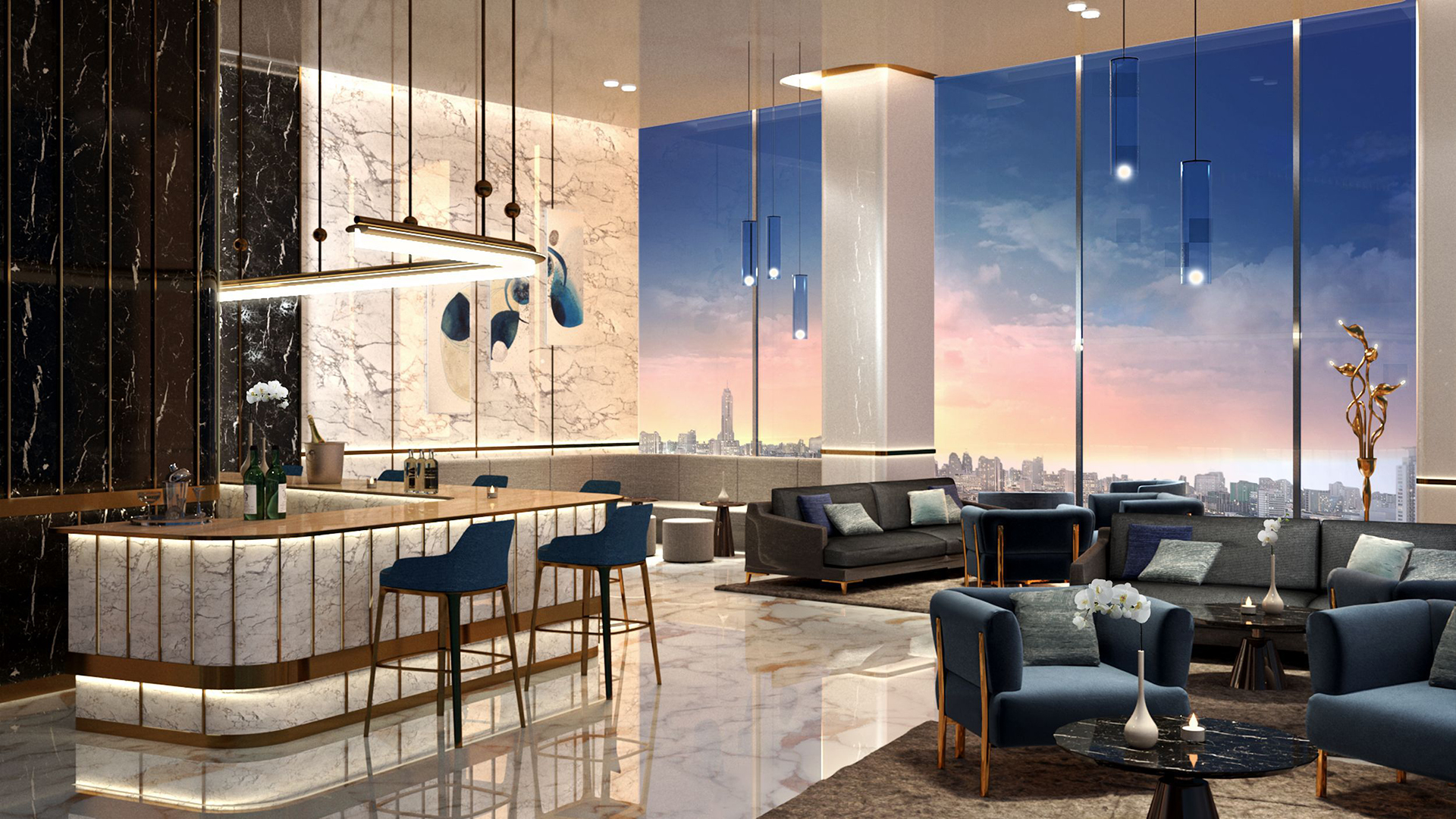
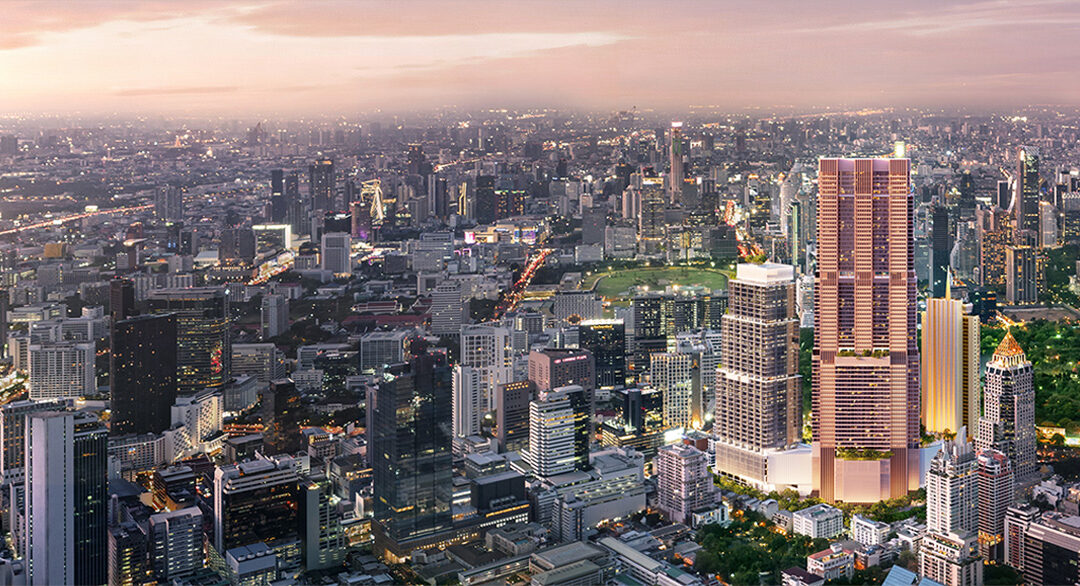
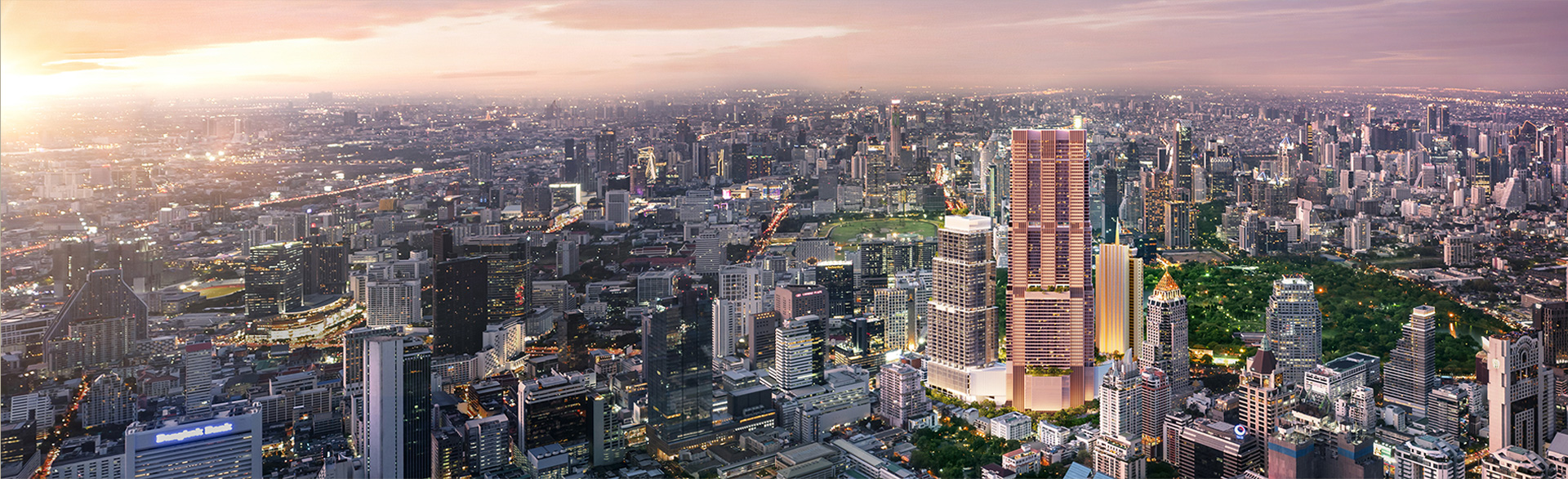
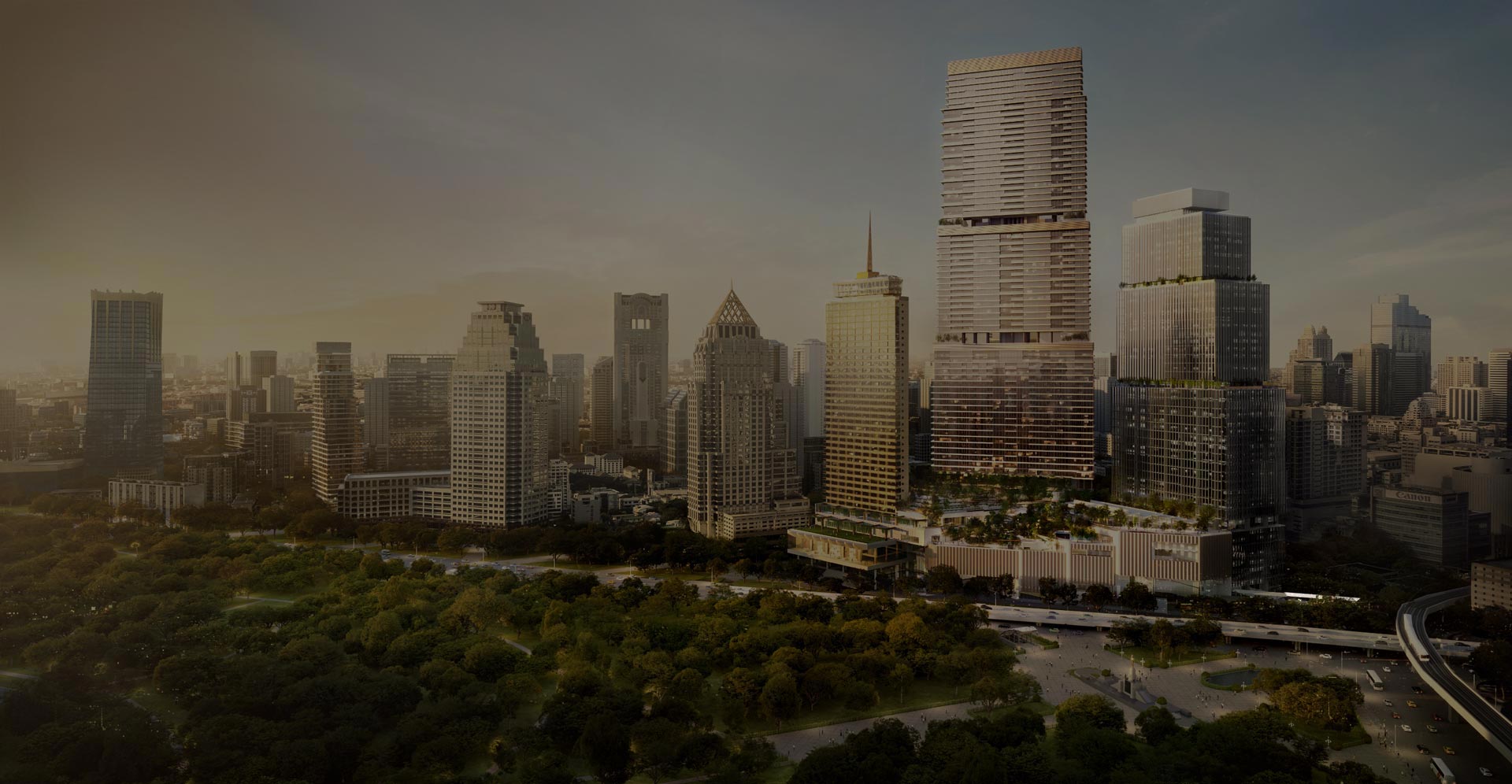
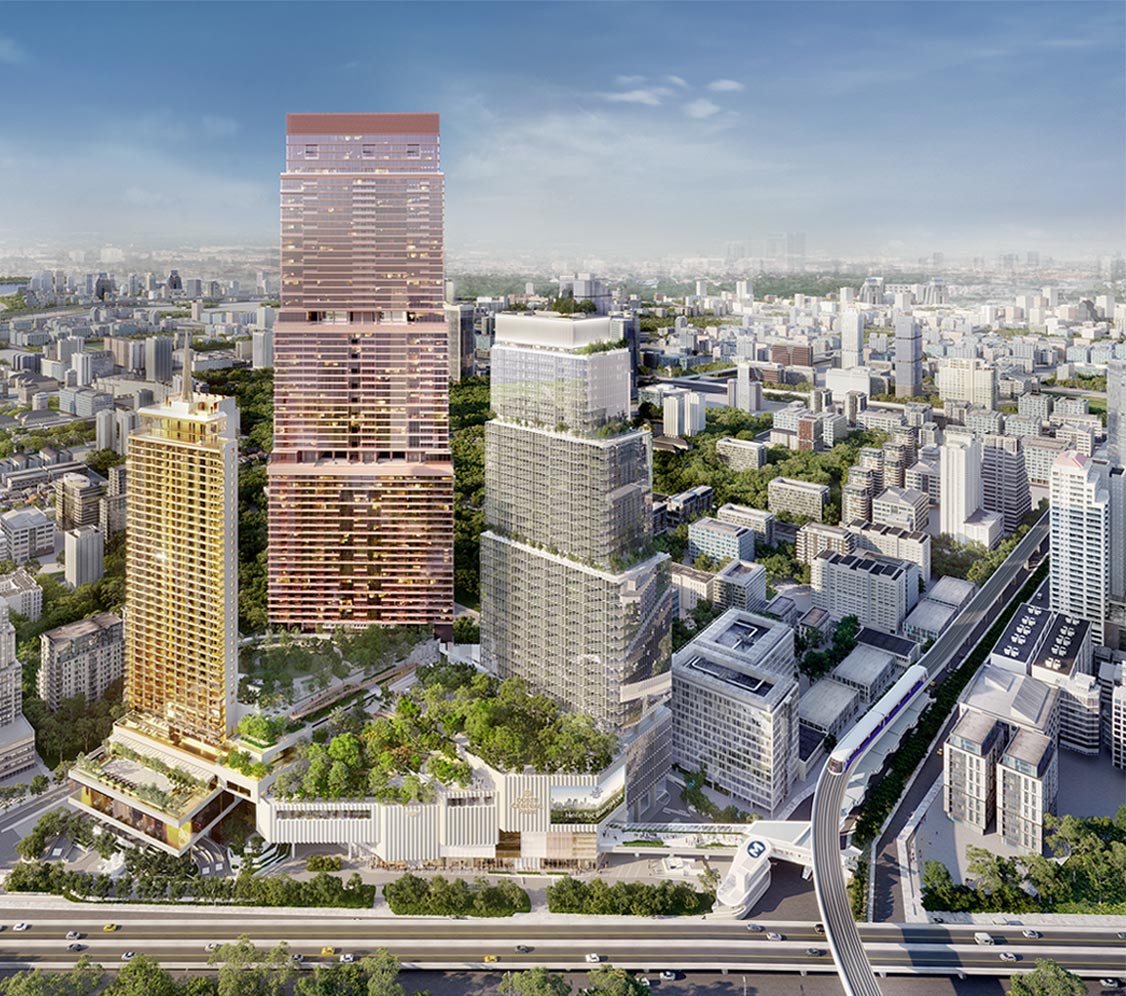
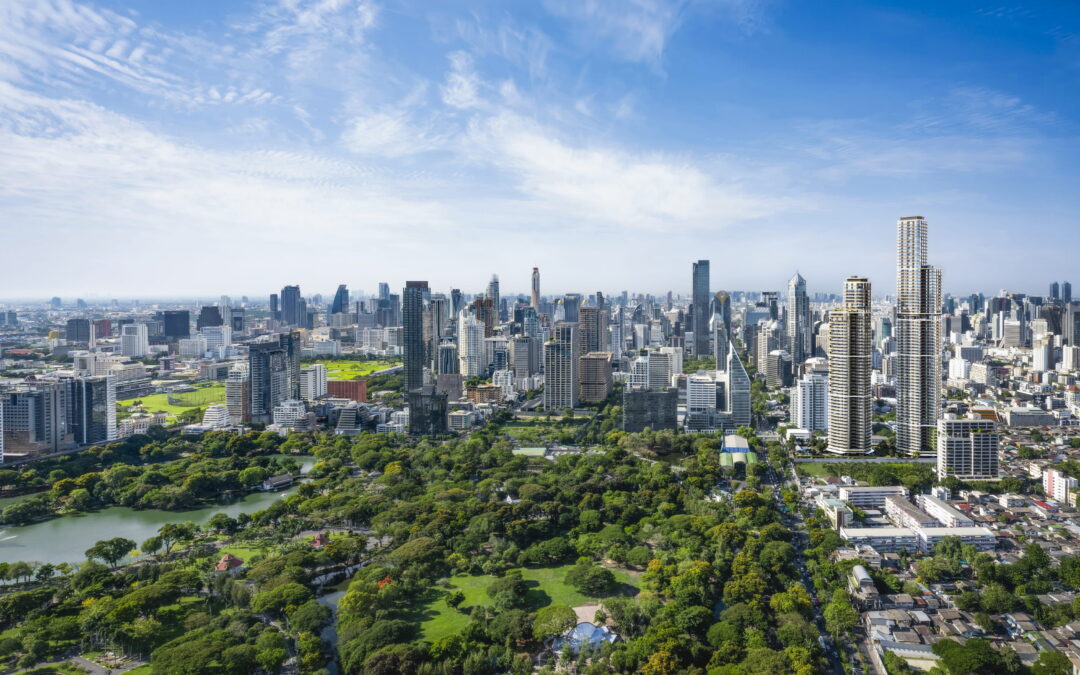
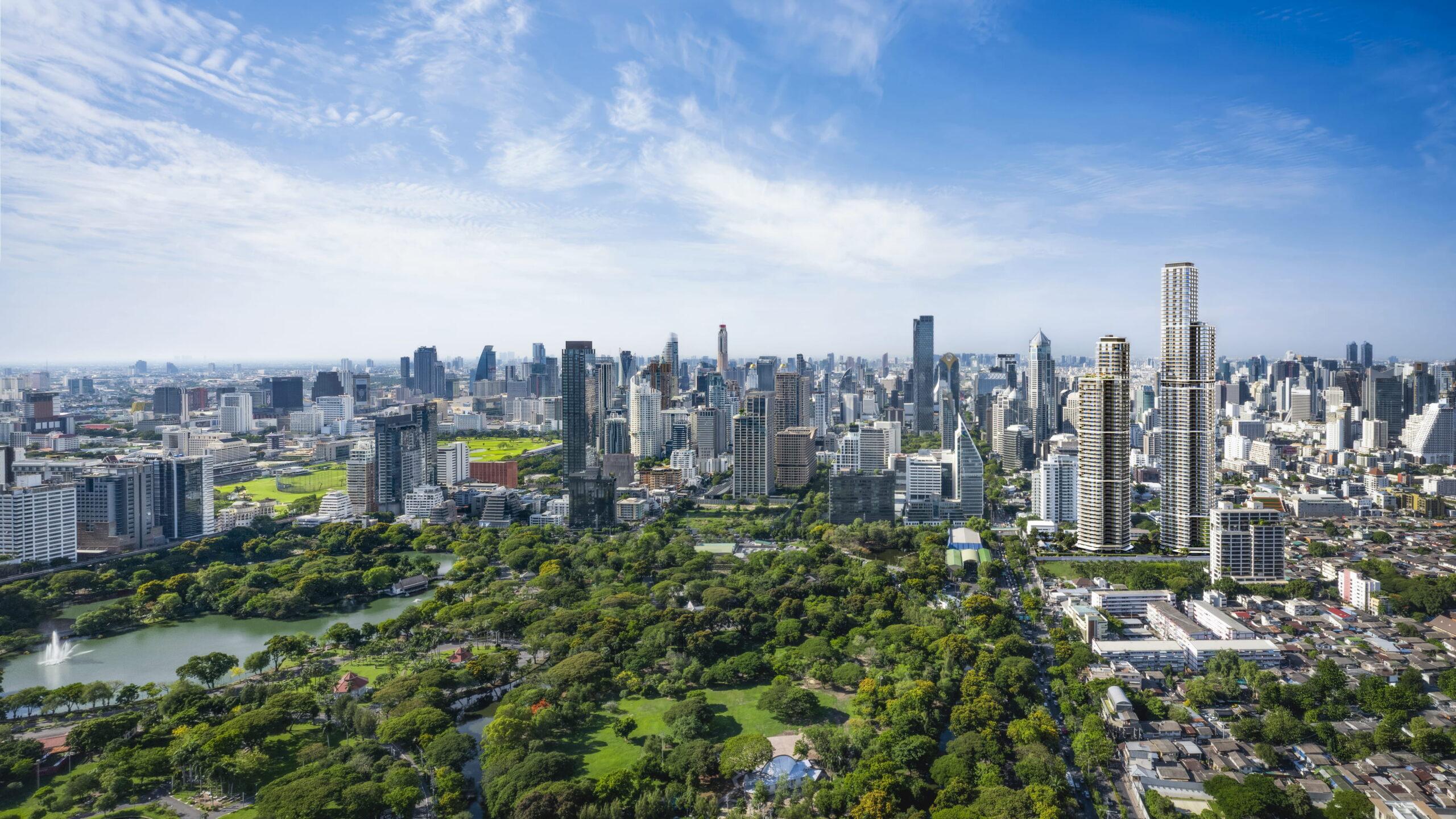
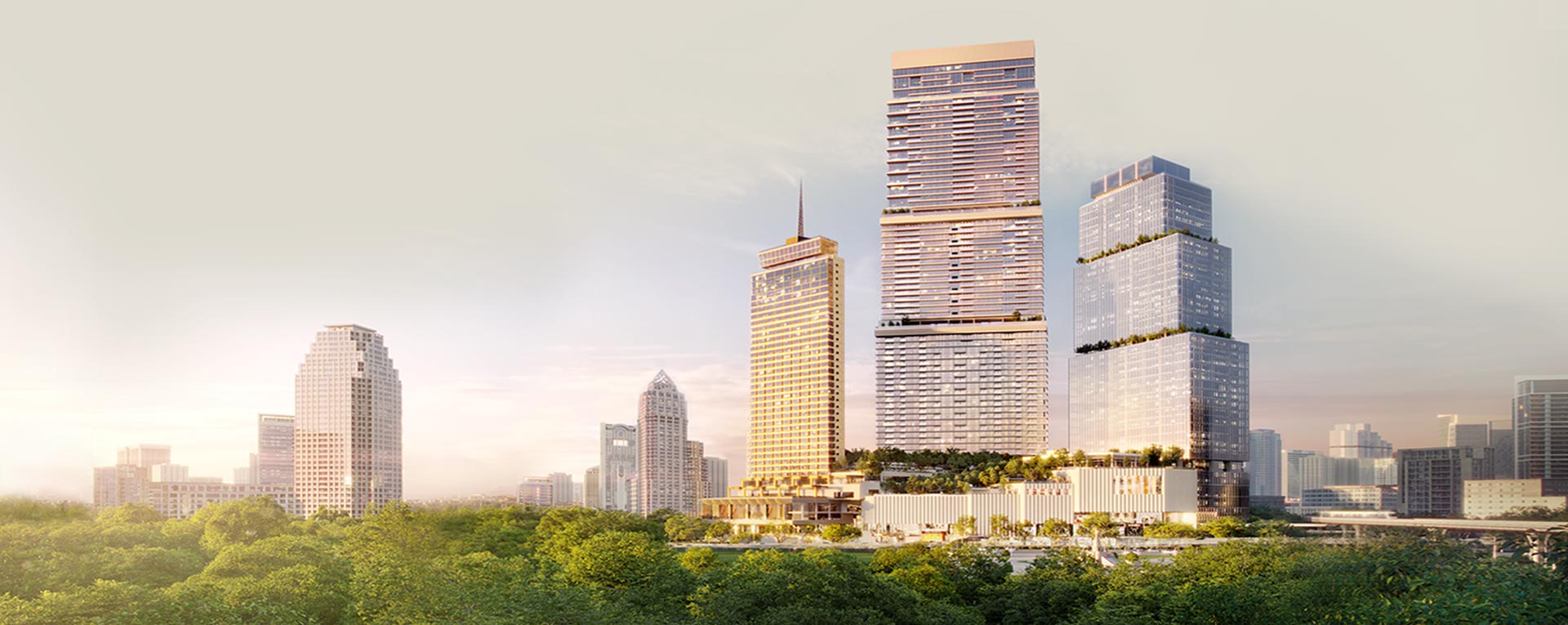
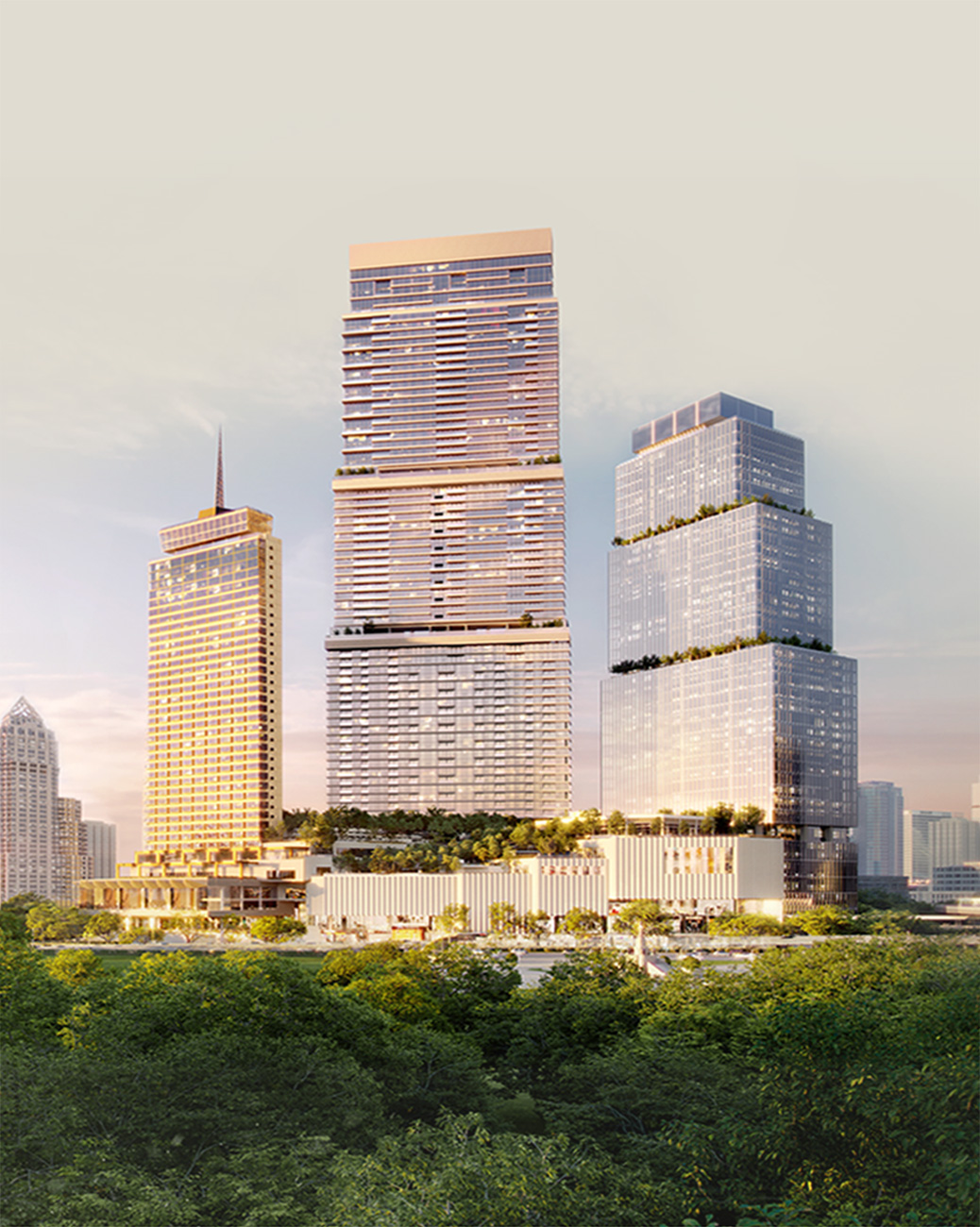
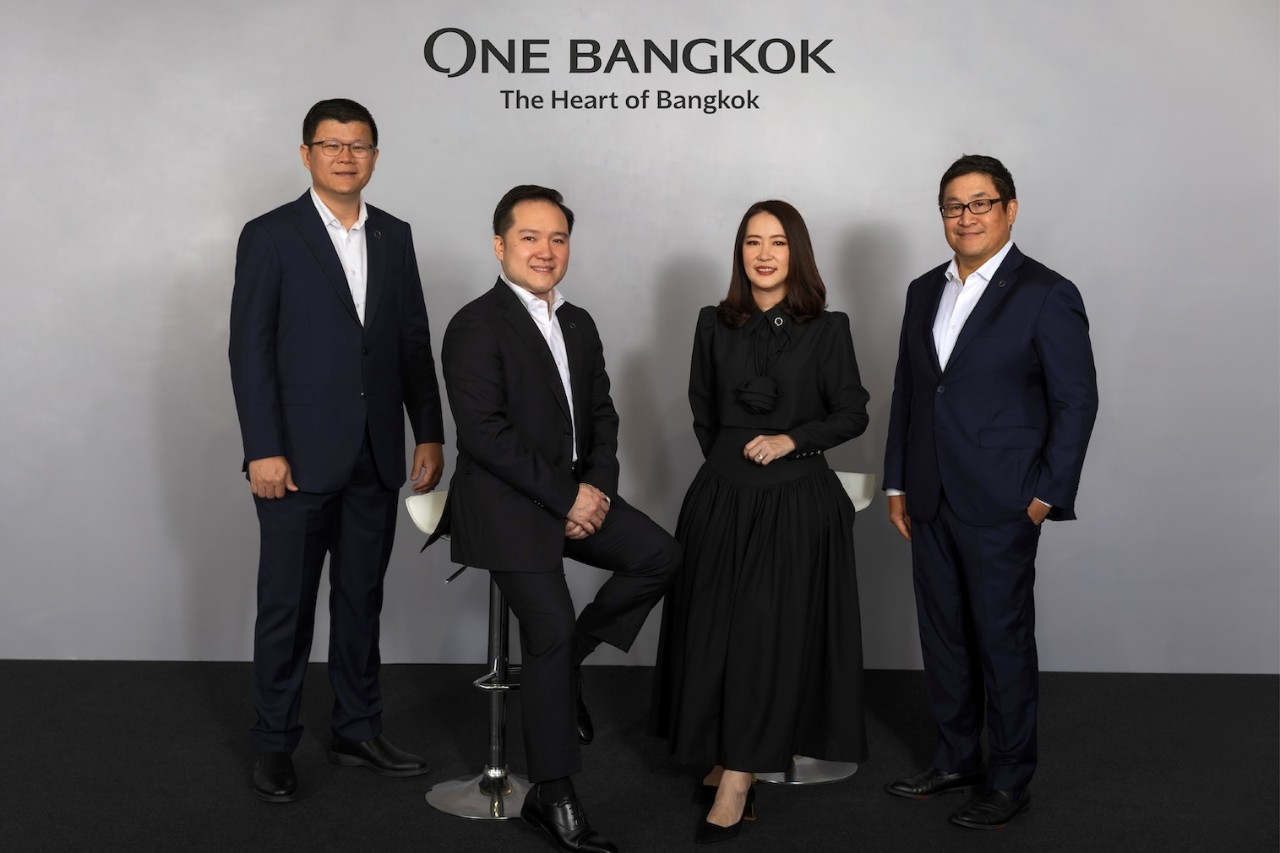
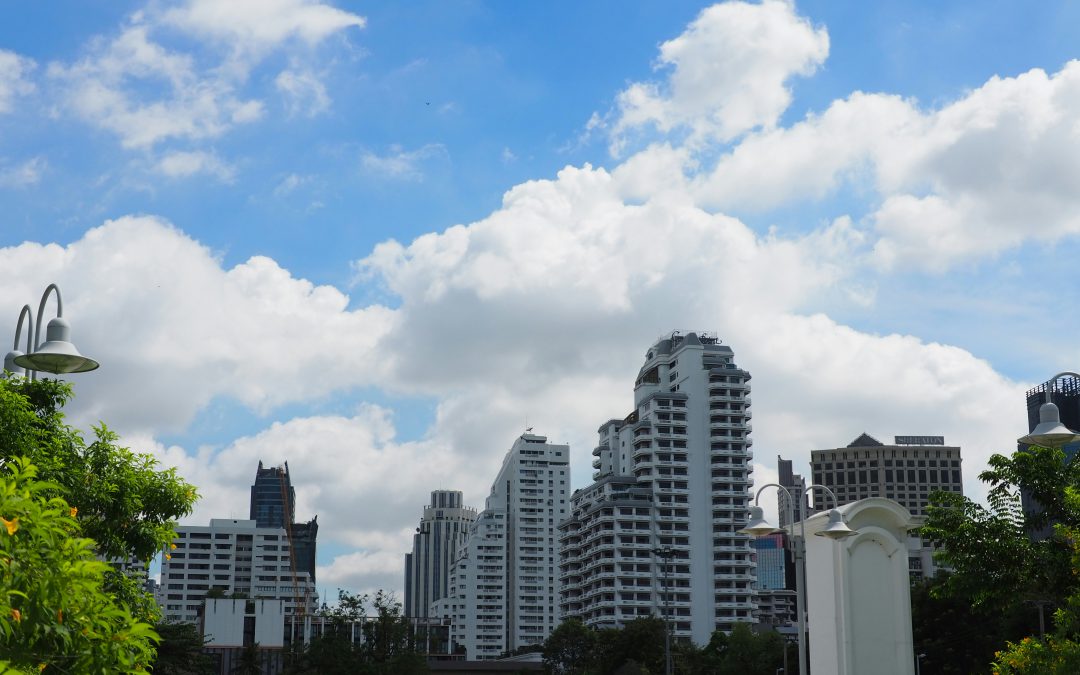
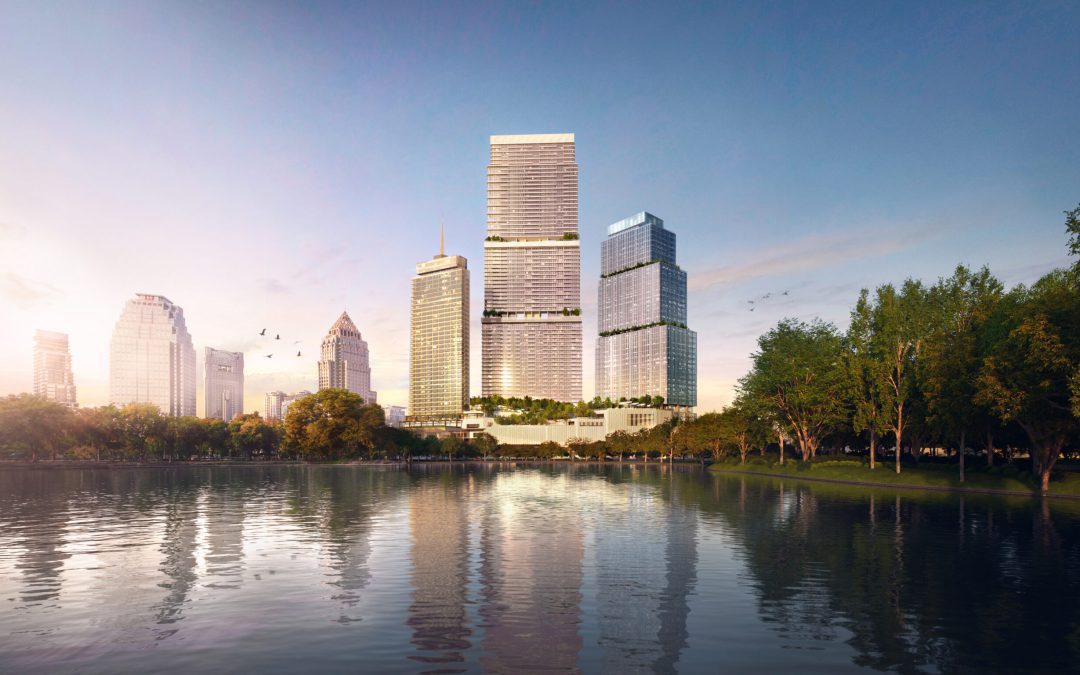
ONE89 Wireless gives foreign buyers a different luxury-condominium question from a typical stand-alone tower. It sits within One Bangkok, the large mixed-use district on Wireless Road and Rama IV Road, close to Lumphini Park, the Silom and Sathorn business areas, and the established embassy-led prestige of Wireless Road.
ONE89 Wireless is positioned within the wider One Bangkok district on Wireless Road.
That context is important. At the top end of Bangkok, buyers are not only comparing unit size and view. They are comparing privacy, arrival experience, daily convenience, district management, long-term placemaking and whether the surrounding environment can stay premium after handover. A residence within a managed mixed-use district may appeal to buyers who want the services and daily amenities of a broader urban setting without leaving the central core.
What the official positioning tells buyers
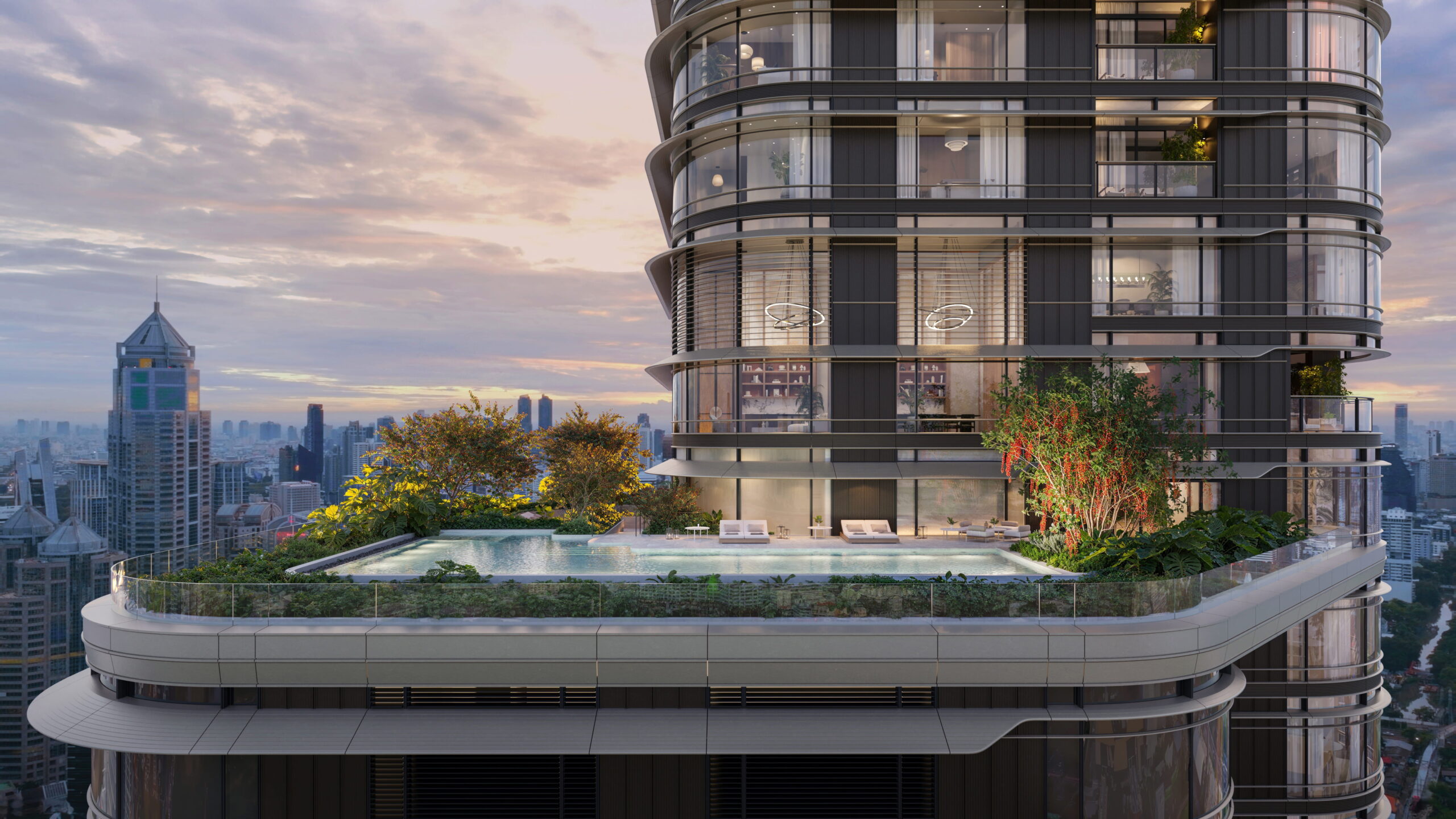
One Bangkok presents ONE89 Wireless as a 90-residence condominium designed by Skidmore, Owings & Merrill, with an emphasis on healthy and sustainable living. The limited residence count matters because ultra-prime buyers usually value privacy, lift efficiency, service consistency and a sense that the building is not being driven by mass-market turnover.
The sustainability message also deserves careful reading. Foreign buyers should ask how sustainability is translated into actual building systems: energy use, ventilation, water management, waste handling, landscaping, building certification, maintenance planning and long-term operating costs. A premium project should be able to explain those systems clearly and connect them to daily comfort, not only branding.
Location strengths for end users
Wireless Road remains one of Bangkoks strongest prestige corridors because it combines embassies, hotels, offices, Lumphini Park access and proximity to the CBD. For owners who will live in Bangkok part time, that can mean fewer compromises: restaurants, business meetings, medical appointments, retail and green space are all within a central radius.
The project is framed around privacy, limited residence count and a central Bangkok address.
The location may also suit regional executives and families who value a secure Bangkok base while travelling across Asia. The key is daily movement. Buyers should test how they will reach the BTS, MRT, offices, schools, hospitals and airport at the times they actually move. Luxury is partly about address, but in Bangkok it is also about the quality of the weekly routine.
Investor questions: depth, not just scarcity
Scarcity can support value, but it does not remove the need for rental and resale analysis. A very high-end unit has a narrower tenant pool than a mid-market condominium, even when the address is excellent. That tenant pool may include diplomats, senior executives, entrepreneurs, regional families and owner-occupiers who want a lock-up-and-leave city base.
Foreign investors should ask who the realistic tenant or future buyer is, what lease terms are common for this bracket, how many comparable ultra-prime units compete nearby and whether the project rules support the intended use. A project can be exceptional and still require patient leasing or resale timing. The investment case should be built around buyer depth, not only the idea that limited supply is always enough.
It is also worth separating personal prestige from financial resilience. Some buyers will accept lower rental efficiency because they value the address for their own use, privacy or family office needs. That is a valid lifestyle decision, but it should be labelled as such. If the purchase is being judged as an investment, the model should include conservative rent, realistic vacancy, furnishing standards, annual running costs and the possibility that resale may depend on a small pool of qualified buyers.
Due diligence before reservation
For an off-plan or newly completed luxury purchase, review the sale contract, payment schedule, completion obligations, defect process, foreign quota, sinking fund, common fees, parking rights, management structure and any branded-service obligations. Ask whether furniture is included, optional or separate, and how changes affect warranty, handover and resale presentation.
For foreign buyers, the appeal should be weighed against running costs, management standards and resale depth.
Buyers should also check how the broader One Bangkok district interfaces with the residence. Access routes, drop-off privacy, service entrances, visitor management, retail traffic, event programming and district construction phases can all affect the owner experience. These are not objections; they are the practical details that define whether a premium mixed-use address performs as expected.
How to compare ONE89 Wireless
The most useful comparison set is not every luxury tower in Bangkok. It is the small group of central freehold or long-life premium residences with credible management, strong arrival experience, protected outlooks, deep amenity access and a buyer pool that recognises the address. Compare Wireless Road, Langsuan, Lumpini, Sathorn, Chidlom and selected riverside projects by lifestyle use case, not only price per square metre.
Buyers should also compare the surrounding mixed-use environment. One Bangkok offers a district-level proposition, while some competing projects offer quieter residential streets, direct BTS convenience, river views or hotel-branded service. None of these is automatically better. The right choice depends on whether the buyer values a managed urban district, park proximity, privacy, walking access, hotel-style service, long-term convenience or a more discreet residential feel.
For buyers who want a rare central Bangkok address, ONE89 Wireless deserves attention. It should still be approached with disciplined questions about total cost, district management, ownership practicalities and future exit liquidity. IBP can help foreign buyers compare ONE89 Wireless with other premium Bangkok condominium choices through the Project Reviews & Site Visits archive and a tailored buying brief.
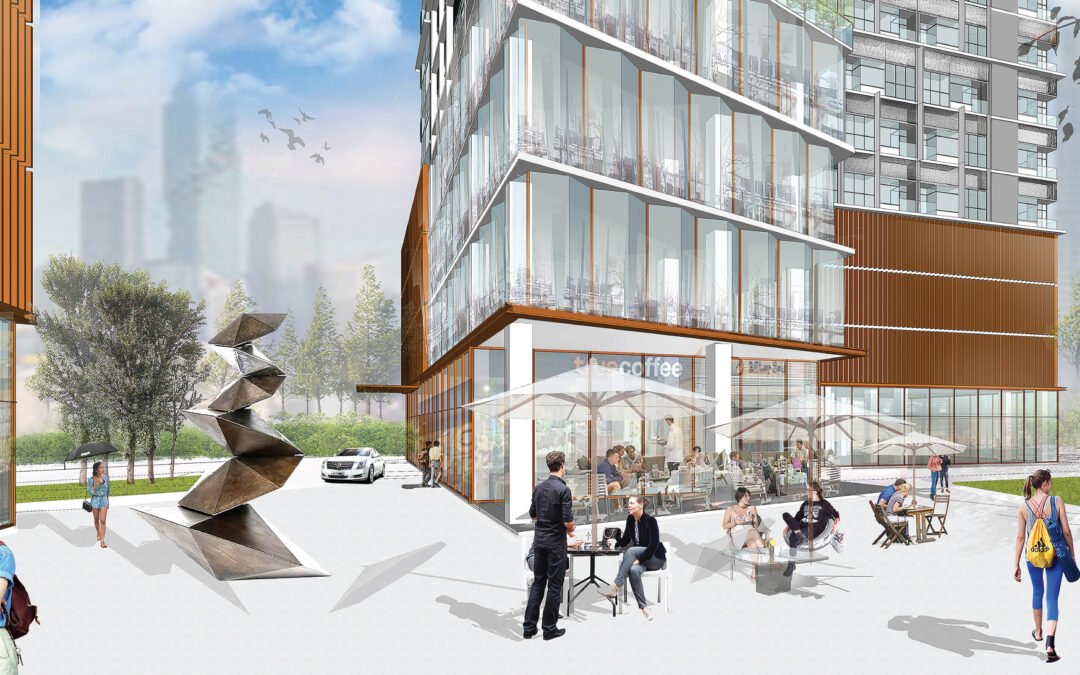
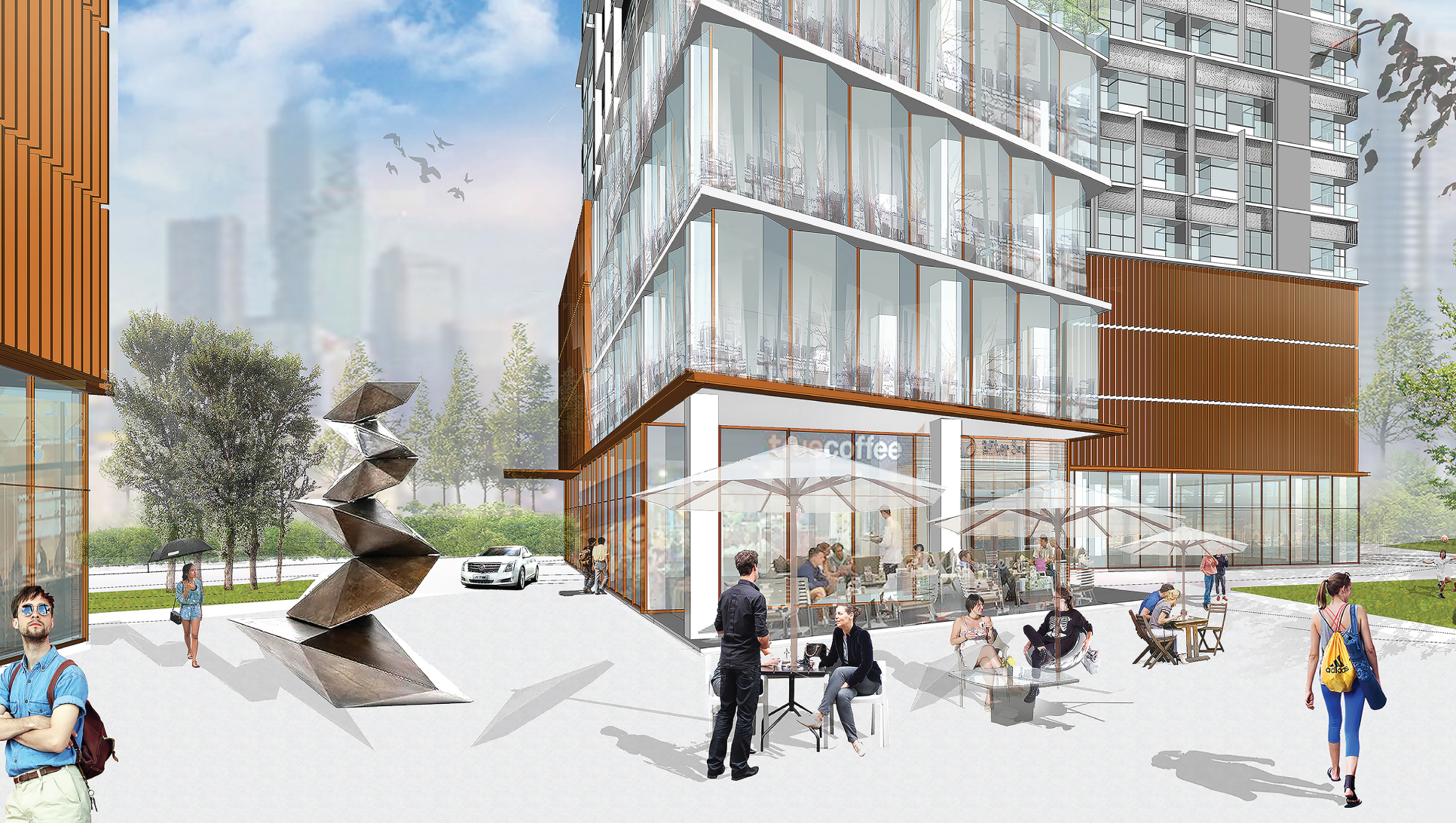
Cassia Residences Rama 9 Bangkok gives foreign buyers a useful case study in how branded residences are moving beyond the traditional riverside and Sukhumvit luxury addresses. The project combines a Bangkok new-CBD location, hotel-style service language and the Cassia brand under Banyan Group.
Cassia Residences Rama 9 positions branded living within Bangkok’s Rama 9 growth corridor.
The official Cassia Residences Rama 9 website describes the project as a collaboration between Siamese Asset PLC and Cassia, a brand associated with Banyan Group. The project material presents concierge service, residence management, room service, parking assistance and owner privileges as part of the branded residence proposition. For foreign buyers, the appeal is clear: a condo that feels easier to use, easier to explain to tenants and potentially more distinctive than a standard high-rise unit.
That does not mean every branded residence should be bought automatically. The brand is only one part of the investment case. Buyers still need to check title, foreign quota, payment terms, building management, unit layout, common fees, rental rules, transfer process and resale depth. A branded name can help attention, but it cannot replace due diligence.
Why Rama 9 matters
Rama 9 has developed as an office, retail, residential and transport corridor east of the traditional Asoke-Sukhumvit core. The area offers access to MRT Phra Ram 9, Central Rama 9, Fortune Town, office towers and hospital connections. It also sits within a wider Ratchada, Huai Khwang and Rama 9 catchment that can appeal to professionals, business travellers, medical visitors and long-stay residents who do not need to be directly on lower Sukhumvit.
For investors, the district story is important because branded residences often depend on a clear tenant or guest profile. Rama 9’s advantage is not old-money prestige. It is functional centrality: rail access, offices, retail, roads, healthcare and a growing stock of lifestyle services. Buyers should decide whether that practical profile matches their expected tenant better than a more expensive address in Phrom Phong, Thong Lo, Chidlom or riverside Bangkok.
What the Cassia positioning offers
Cassia is generally positioned around stylish, social and extended-stay living rather than ultra-formal luxury. The official Cassia Rama 9 hotel page describes loft-style accommodation, kitchens, connected living areas, fitness, kids facilities, wellness and a rooftop pool. For a condo buyer, that positioning may be useful if the target market includes long-stay guests, relocating professionals, regional visitors or owners who want a serviced-living feel when in Bangkok.
The buyer should still distinguish between marketing language and binding rights. Which services are included in common fees? Which are optional paid services? Are owners able to use the hotel-related benefits as expected? Are there rental programme rules, restrictions or revenue-sharing terms? These questions should be answered in writing before purchase.
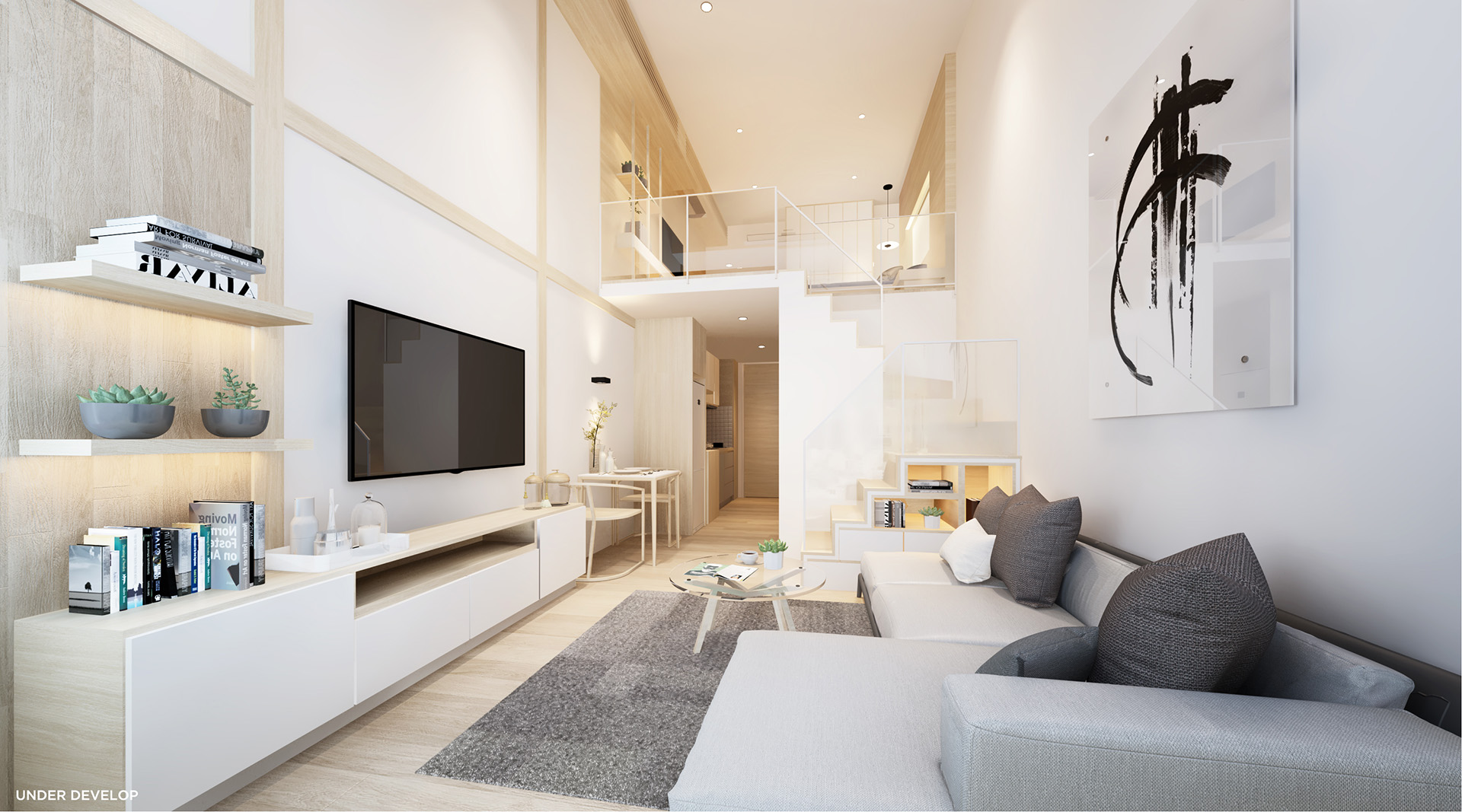
Interior planning and furniture quality should be checked against the buyer’s rental or own-use plan.
Unit layout and rental fit
Branded residence buyers sometimes over-focus on the lobby and under-check the unit. Layout matters because Bangkok tenants compare usable space quickly. A compact unit can work well if storage, light, kitchen, bathroom and work areas are efficient. A larger duplex can appeal to families or longer stays, but only if the rent premium is realistic and the stairs do not reduce the tenant pool.
Foreign buyers should compare unit types against a real use case. Is the unit for personal stays, corporate tenants, medical visitors, students’ parents or short-to-medium stays? Does the building allow the intended rental pattern? Does the furniture package photograph well and withstand turnover? The investment logic should come from the likely occupier, not only from the brand deck.
Management quality is the real test
The long-term value of a branded residence depends heavily on management. A strong operator can maintain service standards, common areas and owner confidence. Weak execution can turn a branded promise into ordinary condominium living with higher costs. Buyers should ask how the residence side is governed, how juristic responsibilities interact with service operations and how future repairs are funded.
Common area fees should be reviewed against the facility package. A building with more service points may cost more to operate. That is acceptable if it supports higher rent, easier occupancy or stronger resale positioning. It is a problem if the costs rise without a matching benefit to owners or tenants.
Branded facilities can help positioning, but operating costs and management delivery matter.
Due diligence questions for foreign buyers
Is the unit available under foreign freehold quota?
What exact services are included, optional or separately charged?
Are rental programme terms available before signing?
How do common fees compare with nearby non-branded condos?
What is the developer’s delivery and after-sales record?
Who is the likely resale buyer in five to seven years?
Cassia Residences Rama 9 may suit buyers who want a branded, service-led product outside the most expensive Sukhumvit and riverside addresses. The project is especially interesting for buyers who believe Rama 9’s business and lifestyle ecosystem will continue to mature. But the right decision still depends on unit price, contract terms, foreign quota availability and the net rental plan.
Buyer takeaway
Branded residences can make Bangkok ownership feel more convenient and recognisable, particularly for overseas buyers. The disciplined approach is to value the brand only after the legal, financial and operational checks are complete.
The Residences at Dusit Central Park occupy one of Bangkok’s most recognisable development stories: the return of Dusit’s landmark address at the Silom-Rama IV intersection, now reimagined as a mixed-use project with hotel, residences, offices, retail and rooftop park space. For foreign buyers comparing prime Bangkok, the appeal is easy to understand. The harder question is whether the specific purchase terms and unit choice justify the premium.
The Residences at Dusit Central Park sit within a landmark mixed-use address opposite Lumpini Park.
Dusit’s official project materials describe the residence component as part of Dusit Central Park, an integrated development across hotel, residences, offices, retail and green space. The official residences site positions the homes as ultra-luxury living in Bangkok’s super core CBD, with panoramic park and city views, facilities and services connected to the Dusit Thani legacy. The broader Dusit announcement identifies two residential concepts: Dusit Residences and Dusit Parkside.
For a foreign buyer, this is a classic Bangkok premium-address case. The project has legacy, location, mixed-use convenience and a service story. Those factors can support both personal-use value and long-term recognition. They do not remove the need to check tenure, quota, payment schedule, ownership documents, common fees, unit orientation and exit audience.
Why the address stands out
The Silom-Rama IV intersection is not an experimental location. It sits between established business districts, embassies, hotels, hospitals, retail, Lumpini Park and mass transit. Dusit’s materials also highlight connectivity to both BTS Sala Daeng and MRT Silom. That combination is unusually legible for foreign buyers who want a Bangkok home that is easy to explain to future tenants or purchasers.
Park adjacency is a major part of the story. In dense central Bangkok, views and daily access to large green space are scarce. A residence overlooking or sitting close to Lumpini Park can offer a different living rhythm from a typical Sukhumvit or Sathorn tower. For owner-occupiers, that may be a lifestyle decision. For investors, it can also help define the unit’s resale narrative.
Foreign buyers should separate the prestige of the address from the specific unit, tenure and resale case.
What foreign buyers should verify
Tenure and transfer route
Official project language and sales documents should be read carefully. Buyers need to confirm whether the unit is available to them under foreign freehold, leasehold or another structure, and how that structure affects resale. If foreign freehold is available, the buyer should still confirm quota, remittance evidence and Land Department transfer requirements.
Unit orientation and view protection
In a park-facing project, orientation is not a detail. A unit’s long-term value may depend on whether the view is genuinely open, partially obstructed, city-facing, park-facing or affected by neighbouring towers. Buyers should request floor plans, view lines, stack information and realistic completed-view expectations.
Service model and common fees
Hospitality-linked residential service can be valuable when it is well executed, but it needs to be paid for. Buyers should understand common fees, sinking fund, service inclusions, optional services, management structure and how costs might change as the project matures. A premium service brand is strongest when the long-term building budget is credible.
Mixed-use convenience and privacy
A mixed-use address can be extremely convenient, but buyers should check how the residential arrival, lifts, parking, deliveries and visitor management are separated from hotel, office and retail traffic. The best version gives residents access to amenities without making the home feel public. This is especially important for families, long-stay owners and tenants who value privacy as much as convenience.
Who the resale buyer might be
The likely resale audience is not the same for every unit. A large park-view residence may appeal to wealthy Thai families, regional buyers, executives or long-stay owners who value address and space. A smaller unit may appeal to a different mix of tenants and investors. Buyers should avoid treating the whole project as one uniform asset class.
Price per square metre matters, but it is not enough. Layout efficiency, ceiling height, storage, lift access, parking, noise, privacy, view, balcony usability and furnishing requirements can all affect the future buyer’s decision. In a premium project, minor compromises can become expensive if they weaken the unit’s resale story.
The location is anchored by Lumpini Park, Silom, Sala Daeng and Bangkok’s established CBD routes.
District fit for daily living
Silom and Rama IV offer a different lifestyle from Thong Lo or Phrom Phong. The area is more business-oriented during the week, with strong park, office, hotel and dining access. For some buyers, that mix is ideal: central, efficient and globally recognisable. For others who want a more residential cafe-and-school routine, another district may feel more natural.
A sensible buyer should walk the district at different times of day. Test the route to BTS and MRT, taxi pick-up, park access, supermarket options, dining, hospital travel and noise levels. Luxury purchase decisions are often made in showrooms, but long-term satisfaction is usually decided by routines.
Foreign buyers comparing this address should also compare completed luxury alternatives nearby. A new landmark can justify a premium when the unit is rare, the service is strong and the view is defensible. If the chosen unit has compromises, a completed resale building may offer better evidence on rent, juristic management and exit liquidity.
Buyer takeaway
The Residences at Dusit Central Park deserve attention because the ingredients are rare: heritage, mixed-use convenience, park adjacency and a central Bangkok address. For foreign buyers, the opportunity is strongest when those macro strengths align with a clean ownership route and a unit that has a clear future audience.
IBP can help buyers compare Dusit Central Park with other prime Bangkok options, including completed resale buildings and new branded residences. Browse our project reviews or contact IBP Real Estate for a project shortlist.
One Bangkok has changed how many foreign buyers read the Rama IV and Lumphini area. The district is no longer only a road between Silom, Sathorn and Sukhumvit. It is becoming a mixed-use centre where offices, retail, hotels, public space, art, dining and residential demand intersect. For buyers comparing luxury condos nearby, that matters.
This does not mean every unit near Rama IV is automatically a strong investment. Large mixed-use anchors can improve convenience and visibility, but the best purchase still depends on building quality, walkability, view protection, traffic, tenant profile and entry price. Foreign buyers should treat One Bangkok as a district catalyst, then test each condominium on its own merits.
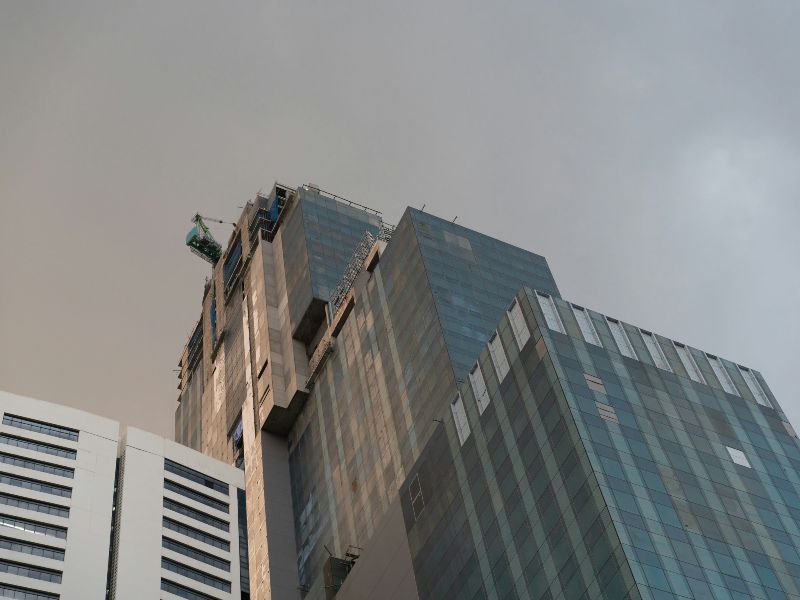
One Bangkok adds a large mixed-use anchor to the Rama IV and Lumphini buyer story.
Why Rama IV is gaining buyer attention
Rama IV sits between several established demand pools. Silom and Sathorn provide office and embassy demand. Lumphini gives access to one of Bangkok’s most important green spaces. Wireless Road and Lang Suan remain prime addresses for luxury hotels, serviced residences and embassies. Sukhumvit and Asoke are close enough to influence tenant expectations, but the area has its own more formal, business-district character.
One Bangkok adds another layer: a large integrated district with workplaces, retail, hospitality, public areas and cultural programming. For overseas buyers, this helps explain why nearby condos can appeal to executives, diplomats, consultants, regional managers and long-stay residents who want central access without living deep inside nightlife-heavy sois.
The transport question
Foreign buyers should look carefully at actual daily routes. The area benefits from MRT access around Lumphini and Queen Sirikit National Convention Centre, with BTS connections reachable through Silom, Sala Daeng, Ratchadamri, Chit Lom and Phloen Chit depending on the address. However, Bangkok traffic can change the lived experience from one side of a junction to another.
A condo that looks close on a map may feel inconvenient if the walking route is exposed, interrupted or unpleasant. Buyers should test the path at weekday rush hour, after dark and during rain. For rental demand, a practical walk to MRT, office towers, supermarkets and dining often matters more than a prestigious district label.
District-scale planning, public space and office demand can influence nearby condo appeal.
What type of buyer fits this district
The strongest fit is usually a buyer who values central Bangkok, professional tenant demand and lifestyle infrastructure. A compact one-bedroom may suit a single executive or consultant. A larger two-bedroom may appeal to couples, small families or executives who want a home office. Premium units with park, skyline or open-city views can attract owner-occupiers who are less yield-driven and more focused on quality of life.
Investors should still avoid assuming unlimited rental depth. Luxury tenants compare many options across Lang Suan, Wireless, Sathorn, Silom, Asoke and Phrom Phong. The unit must be well furnished, easy to maintain and priced against real competing stock, not only against developer positioning.
How One Bangkok changes the lifestyle case
Mixed-use districts can make daily life easier. Residents nearby may gain access to stronger dining, shopping, events, wellness, hotels, workspaces and public realm. This can help a district feel more complete, especially for foreigners who want a predictable routine soon after relocation.
The lifestyle effect is not only about convenience. Large destinations can also improve how a neighbourhood is perceived internationally. When visiting buyers can understand the district within one afternoon, the sales story becomes clearer. That can support resale confidence if the building itself is strong.
Retail, dining and daily services are part of the liveability premium for nearby condos.
Risks to check before buying
Rama IV is a major road, so noise, dust and traffic exposure must be assessed unit by unit. Buyers should check balcony usability, glazing, air-conditioning placement and whether future construction could affect views. A beautiful show unit does not answer these questions. Visit the actual unit or appoint someone to inspect it at different times of day.
Also compare common-area fees and sinking funds carefully. Luxury buildings with extensive amenities can be expensive to operate. The right question is whether the fees support a well-maintained asset and rental premium, not whether they are simply high or low.
Resale and rental positioning
For resale, the most defensible units are usually in completed, well-managed buildings with recognisable addresses, efficient layouts, good ceiling heights and a view or daily convenience advantage. For rentals, owners should think like tenants: commute, supermarket, gym, food, hospital access, guest parking and easy taxi pickup all matter.
Foreign buyers who want new-launch exposure should compare payment terms, developer track record, expected completion risk and future competing supply. Buyers who prefer lower execution risk may find completed resale units easier to evaluate because rent, management and building condition can be verified.
Buyer takeaway
One Bangkok strengthens the Rama IV-Lumphini story, but it does not replace due diligence. The district is attractive because it connects business, lifestyle, transport and green-space access in a way that feels increasingly global. The best condo purchase will still be specific: right building, right unit, right price and right holding plan.
Explore more IBP district and BTS/MRT guides if you are comparing central Bangkok locations. Invest Bangkok Property can help you compare buildings, check documents and connect Bangkok market themes with unit-level due diligence before you commit capital.
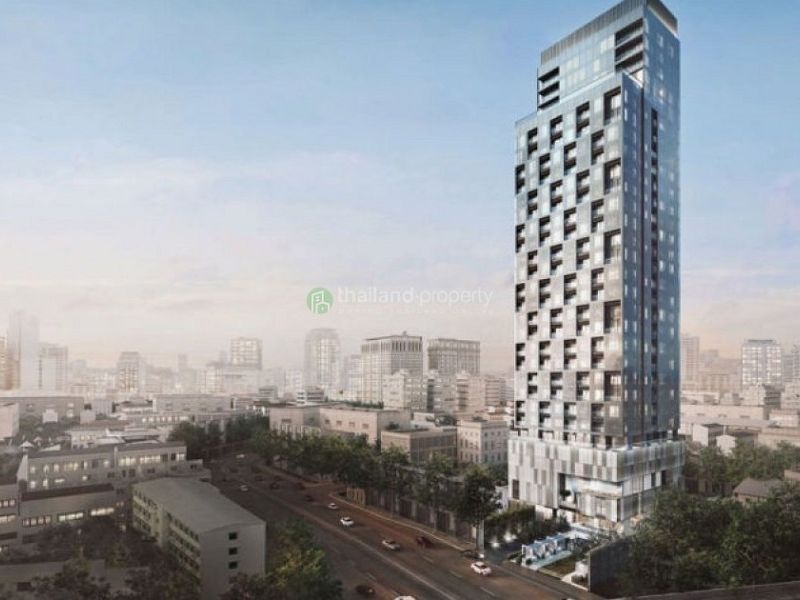
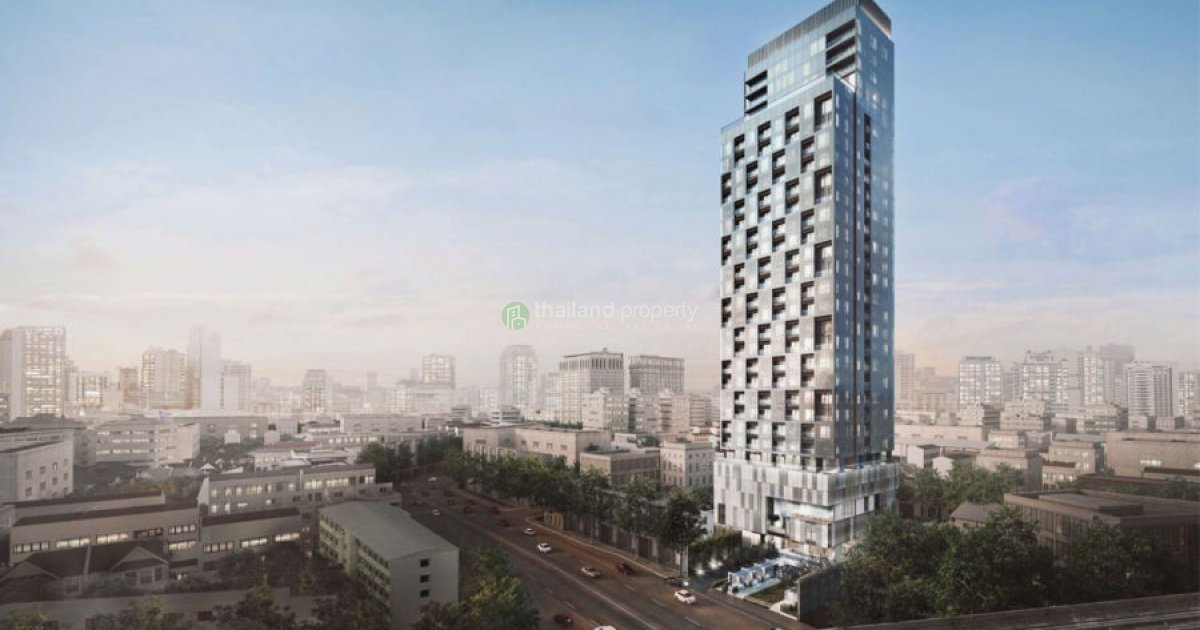
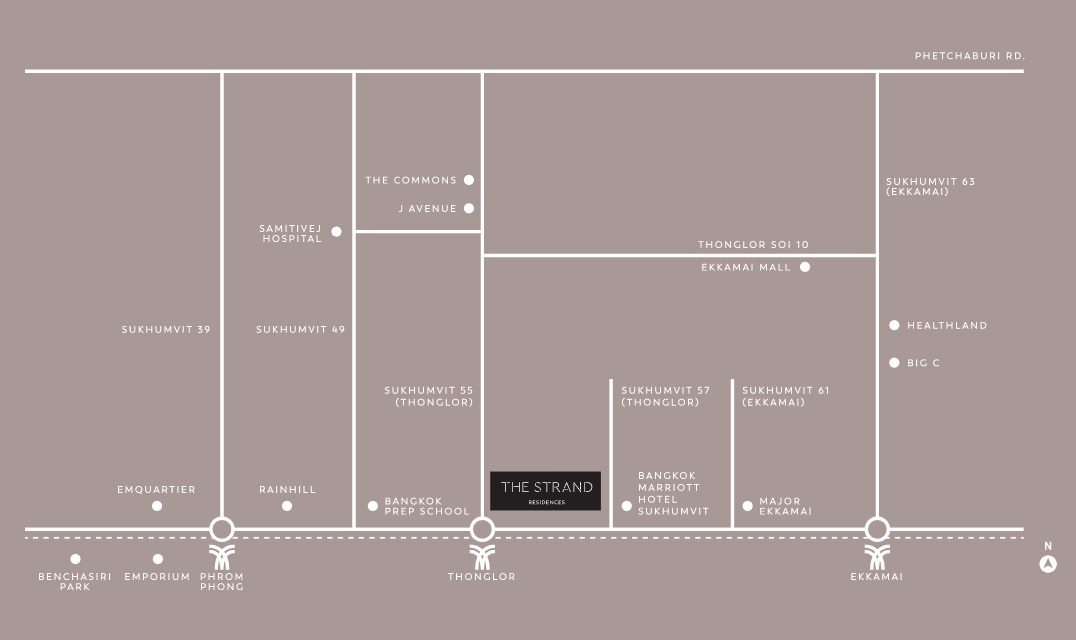
The Strand Thonglor is the kind of Bangkok condominium foreign buyers often shortlist for a simple reason: it is easy to understand. It sits close to BTS Thong Lo, within one of Bangkok’s best-known expatriate and lifestyle districts, and offers a completed luxury product rather than a future promise. That does not make it automatically suitable for every investor, but it does make the project a useful case study in how to judge prime Sukhumvit condominiums in 2026.
The Strand Thonglor is positioned as a low-density luxury residence at the front of Soi Thonglor.
The strongest luxury-condo decisions are not based only on finishes. They are based on whether the building has a durable location story, a clear tenant profile, sensible unit sizes and resale evidence that can be explained to the next buyer. The Strand Thonglor checks several of those boxes, but foreign buyers still need to compare price, rent and liquidity carefully before treating it as a passive investment.
Project positioning in plain English
The project is commonly presented as a freehold luxury condominium at the entrance of Thonglor, with direct appeal to buyers who want a central Sukhumvit base without moving into a very large mass-market tower. Public project materials and market listings describe a 30-storey residential building completed in 2021, with a limited unit count and a mixed-use element at street level. The key point for buyers is not the marketing vocabulary; it is that the completed building can be inspected, measured against rents, and compared with other high-end Sukhumvit options.
For overseas buyers, completed status reduces several uncertainties. You can inspect the lobby, lifts, parking, pool, gym, corridors, surrounding street, noise level and actual unit outlook. You can also review how the building has aged since completion. In luxury Bangkok property, maintenance discipline is a major part of value retention.
Why Thonglor remains a premium buyer address
Thonglor has long been one of Bangkok’s most recognisable lifestyle addresses. It combines restaurants, private clinics, Japanese and Korean tenant demand, boutique offices, nightlife, supermarkets, salons, cafes and quick access to Phrom Phong, Ekkamai and the wider Sukhumvit line. For foreign owners, this matters because tenants often choose convenience and neighbourhood identity before they compare technical building specifications.
A unit close to BTS Thong Lo can suit several user groups: a regional executive who wants a low-friction commute, a couple relocating from Singapore or Hong Kong, a family member studying or working in Bangkok, or an owner who wants a part-time Bangkok base. That breadth is useful for rentability and resale, provided the entry price is not too aggressive.
For foreign buyers, the appeal lies in the combination of station access, lifestyle address and completed-building evidence.
What to inspect before buying
Building condition
Luxury buildings must feel well managed every day, not only in photographs. Check lift wait times, corridor scent and lighting, staff responsiveness, water pressure, air-conditioning condition, pool maintenance, gym usability, car-parking process and the way deliveries are handled. A premium tenant will notice these details quickly.
Unit plan
Thonglor buyers often pay for quality of living, so layout efficiency matters. Watch for awkward columns, limited wardrobe space, bedrooms that cannot take proper furniture, or kitchens that look good but are difficult for long-stay tenants. A beautiful unit that photographs well but lives poorly can disappoint in rental renewal and resale.
Noise and access
Being at the front of Thonglor is convenient, but buyers should inspect at different times of day. Test traffic, nightlife noise, ambulance routes, taxi access and the experience of walking to the BTS station. A genuine one-minute or two-minute daily walk is valuable only if it feels comfortable in real use.
Investment logic for foreign buyers
The Strand Thonglor is more likely to suit buyers who prioritise capital preservation, personal use and premium tenant demand over the highest headline yield. Luxury freehold buildings in established districts rarely compete with outer-Bangkok units on gross yield. Their case is different: better address recognition, a more international tenant pool, and the possibility of cleaner resale if the unit is bought well and maintained properly.
Investors should benchmark three numbers before proceeding: realistic rent after vacancy, comparable resale asking prices in the building, and replacement cost in nearby completed luxury projects. If the numbers only work by assuming unusually high rent or instant resale, the purchase needs to be renegotiated or rejected.
Location should be tested against daily use: BTS access, taxi routing, retail, hospitals and tenant demand.
Who should consider it
Buyers who want a completed luxury unit in a proven Sukhumvit lifestyle district.
Foreign owners who may use the unit personally between tenancies.
Investors targeting executives or long-stay tenants who value BTS access and neighbourhood amenities.
Buyers who prefer a more boutique-feeling building over very large towers.
Who should be cautious
Yield-first buyers may find better numbers in less prime districts or in smaller-ticket resale units. Buyers who need very large family layouts should compare supply carefully, because the tenant pool becomes narrower as unit size and rent rise. Remote buyers should also avoid relying solely on marketing images; a video call is helpful, but a trusted physical inspection remains better.
Buyer takeaway
The Strand Thonglor is a credible luxury-condo option because its story is coherent: Thonglor address, BTS convenience, completed product and premium positioning. The buyer’s job is to make sure the price is equally coherent. For a foreign investor, the right unit should rent to a defined tenant, remain attractive after normal wear, and make sense to a future resale buyer without a long explanation.
If you are comparing The Strand Thonglor with other Sukhumvit luxury condominiums, contact IBP Real Estate. We can prepare a shortlist using actual unit condition, rent evidence and foreign-buyer exit logic rather than sales-gallery claims.
Wireless Road has long been one of Bangkok’s clearest luxury addresses. It sits between embassies, Lumphini Park, major hotels, central retail, offices and the established Langsuan-Chidlom lifestyle zone. The announcement of Upper House Residences Bangkok and The Wireless Residences by Upper House adds a new branded-residence layer to that address story, and foreign buyers should read it carefully rather than simply as another luxury launch.
Upper House Residences Bangkok and The Wireless Residences by Upper House are planned for Wireless Road, one of Bangkok's most established prime addresses.
According to Swire Properties, City Dynamic, a joint venture between City Realty and Swire Properties, together with Swire Hotels, has introduced two ultra-luxury freehold residential towers on Wireless Road. The projects are named Upper House Residences Bangkok and The Wireless Residences by Upper House. Construction was stated to have commenced in April 2025, with completion expected by 2030. For buyers, that long timeline means the decision should be based on developer credibility, location scarcity, brand logic and future exit depth rather than short-term rental yield.
What Has Been Announced
The official announcement describes Upper House Residences Bangkok as a 52-storey tower with 156 units, offering a full Upper House brand experience. The Wireless Residences by Upper House is described as a 71-storey tower with 239 units, with front-of-house services managed by Upper House. The two towers are positioned on Wireless Road with panoramic views towards Lumphini Park and Benjakitti Park, and with access to shopping, hotels, international schools and embassies.
The design team is also part of the buyer story. Swire’s announcement refers to Foster + Partners through F&P (Thailand) Ltd. for architecture, PLandscape for gardens and sky terraces, BAR Studio for Upper House Residences interiors, PIA Interior for The Wireless Residences, and GOCO for wellness facilities. These details matter because branded residences compete not only on location, but on whether the service, design and management system feel coherent over time.
The project combines freehold residential ownership with Upper House hospitality-style service and design positioning.
Why Wireless Road Matters
Foreign buyers sometimes compare Bangkok luxury condos by price per square metre and amenity list. On Wireless Road, the location itself does much of the work. It is one of the few central Bangkok corridors where embassies, mature trees, park access, five-star hotels and high-end residential buildings sit close together. That gives the address a different rhythm from busier nightlife-led parts of Sukhumvit.
For end users, Wireless Road offers prestige and calm without leaving the centre. For investors, the appeal is scarcity. There are only so many freehold opportunities in this part of the city, and buyers looking for park adjacency, diplomatic-district context and international service standards tend to compare a small set of buildings. Scarcity does not remove pricing risk, but it can support long-term desirability when the product is properly executed.
How To Think About The Brand Premium
Branded residences usually ask buyers to pay for more than the physical unit. The premium may reflect design, hospitality services, management standards, global recognition, owner privileges and the confidence that a respected operator will protect the living environment. In Bangkok, that premium must still be tested against resale evidence, common-area costs and whether the brand genuinely improves daily life.
Upper House is associated with a quiet, service-led hospitality identity rather than a loud resort concept. That can fit Wireless Road if the final residences deliver privacy, service discipline and understated design. Foreign buyers should ask how services will be charged, what is included in common fees, which services are optional, how rentals are handled, whether short-term letting is restricted and how the branded standards are protected after completion.
City Dynamic, Swire Properties and Swire Hotels announced the Upper House branded residences partnership for Bangkok.
Who The Project May Suit
The project is likely to suit buyers who want a Bangkok base with long-term personal use value: regional families, executives, high-net-worth residents, collectors of branded residences and buyers who prioritise privacy over immediate yield. It may also suit investors who want exposure to a scarce luxury address, provided they are comfortable with a long completion period and a premium entry price.
It is less likely to suit buyers seeking simple rental yield. Ultra-luxury units can rent well when the tenant pool is strong, but yields are often lower than in smaller mid-market units because the purchase price is high. The investment case is more likely to depend on long-term scarcity, brand quality, foreign-buyer recognition and the depth of wealthy end-user demand.
Due Diligence Questions For Foreign Buyers
Is the unit being purchased under foreign freehold quota, and how will quota be reserved until transfer?
What exactly is covered by the branded residence management agreement?
How are common-area fees, sinking fund and service charges calculated?
Are rentals permitted, and are there restrictions on lease length or tenant use?
What completion protections, payment milestones and defect procedures apply?
How will views, neighbouring development and access routes be protected or disclosed?
What comparable completed buildings support the proposed pricing?
The Buyer Takeaway
Upper House Residences Bangkok is important because it reinforces Bangkok’s move into the global branded-residence conversation. The city already offers luxury condominiums, strong hospitality, healthcare, dining and regional connectivity. A project like this adds a more internationally legible ownership format for buyers who understand hotel-style service and long-term branded management.
The right buyer should still be disciplined. Brand, address and renderings are not substitutes for contract review, payment planning, foreign-quota confirmation and realistic exit analysis. For a foreign buyer, the opportunity is to own into a rare Wireless Road story. The responsibility is to underwrite that story with numbers, documents and a clear holding period.
For help comparing luxury and branded residences, review IBP’s new project previews and request a building-by-building comparison before making a reservation.
Dusit Central Park is one of Bangkok’s most visible mixed-use redevelopments: a reimagining of the former Dusit Thani Bangkok site at the Silom-Rama IV intersection, opposite Lumpini Park and close to both BTS and MRT access. For foreign buyers, the project is not just another luxury condominium story. It is a test case for how hotel heritage, branded residential service, office demand, retail convenience and public green space can combine in a single address.
The appeal is clear, but so are the questions. A premium project needs to be evaluated beyond name recognition. Buyers should understand the residential concept, the surrounding district, service costs, expected owner profile, lease or ownership structure where relevant, and the depth of future resale demand.
Dusit Central Park brings hotel, residence, retail, office and green-space uses into one central Bangkok address.
What Makes The Project Different
Official project materials describe Dusit Central Park as a mixed-use development with a five-star hotel, ultra-luxury residences, premium offices, a luxury shopping centre and a roof park. That mix matters because residents are not relying solely on a private condominium facility deck. They are buying into a broader ecosystem of hospitality, retail, workplace and green public realm.
The location is unusually legible for foreign buyers. Silom, Sathorn, Rama IV and Lumpini are already established Bangkok reference points. A buyer who is new to the city can understand the value of being near a major park, a CBD, embassies, hospitals, hotels, restaurants and two rail systems more easily than a speculative suburban growth corridor.
The brand element also changes expectations. Buyers will expect service discipline, building presentation and guest experience to match the Dusit name. That can support rental and resale appeal, but it also raises the standard for management. A branded residence can disappoint if the service proposition is unclear or if ongoing costs are not matched by visible value.
Why The Silom-Rama IV Address Matters
Silom and Sathorn have long been associated with finance, professional services, embassies and established expat routines. Rama IV has been changing quickly as mixed-use projects, convention demand and new lifestyle assets reshape the corridor between Lumpini, Queen Sirikit and Khlong Toei. Dusit Central Park sits at the western edge of that evolving story.
For owner-occupiers, the district offers a practical version of prestige. It is not only about views or hotel services; it is about being able to reach offices, parks, restaurants, hospitals, schools and transport without building everyday life around long car journeys. That is particularly important for foreign residents who may not drive in Bangkok.
For investors, the district gives multiple demand channels. Potential tenants may include executives, diplomats, regional office staff, downsizers, long-stay visitors and families that value park access. The buyer still needs to test rent against comparable stock, but the location is less dependent on one narrow demand source.
The project’s location opposite Lumpini Park is central to its luxury positioning and long-term lifestyle appeal.
How To Read The Sales Momentum
A 2025 official announcement from Dusit Central Park said The Residences at Dusit Central Park had achieved over 95 percent sales, while highlighting the project’s components and residential standards. Strong sales momentum can be a positive signal: it suggests market acceptance, reduces developer inventory risk and may support pricing discipline.
However, sold percentage should not be treated as the whole investment case. Buyers still need to know which units remain, how those units compare by view, floor, layout and price, and whether the remaining stock suits their intended use. Late-stage availability may be limited, and scarcity can work for or against a buyer depending on the exact unit.
Resale buyers should go further. If purchasing after handover, inspect the actual common areas, lifts, access control, parking, noise, views and management practice. A completed building gives better evidence than a brochure, and that evidence should be used.
Branded Residence Value Versus Running Cost
Branded residences can justify a premium when the service is tangible: reliable concierge, hotel-grade arrival, high maintenance standards, privacy, strong security and access to amenities that residents actually use. Foreign buyers should ask what is included, what is optional, what can change and how costs are approved over time.
The common fee and sinking fund structure should be compared with other ultra-luxury Bangkok buildings, but not mechanically. A cheaper fee is not always better if the building cannot maintain its standard. A higher fee is acceptable only when it protects the asset and supports the owner experience.
Short-term rental restrictions, hotel relationship rules and resident privacy policies should also be understood. Luxury buyers often value discretion and order. If leasing is part of the plan, make sure the intended rental model fits the building rules before assuming income.
Foreign buyers should compare branded-residence service value with tenure, running costs and resale evidence.
Who Should Consider It
Dusit Central Park is best suited to buyers who value a prime central address, hospitality-led management, park proximity and a mixed-use environment. It may appeal to internationally mobile families, executives who divide time between Bangkok and another city, and investors seeking a trophy-quality asset with a clear narrative.
It may be less suitable for buyers whose main priority is high headline yield. Premium branded residences often carry higher entry prices and running costs. The investment logic is usually capital preservation, scarcity, lifestyle value and long-term resale appeal rather than maximising annual income.
Before committing, compare at least three alternatives: an established freehold building in Sathorn or Wireless, a newer luxury building around Lumpini or Rama IV, and a serviced or branded residence in another prime district. The right choice will depend on use pattern, tenure preference, budget and tolerance for ongoing costs.
Buyer Takeaway
Dusit Central Park deserves attention because it combines a recognisable Bangkok site with hospitality, offices, retail and park access. It still needs conventional due diligence: unit inspection, contract review, quota or tenure checks, cost modelling and resale comparison. IBP can help foreign buyers benchmark it against other prime Bangkok residences before making a decision.
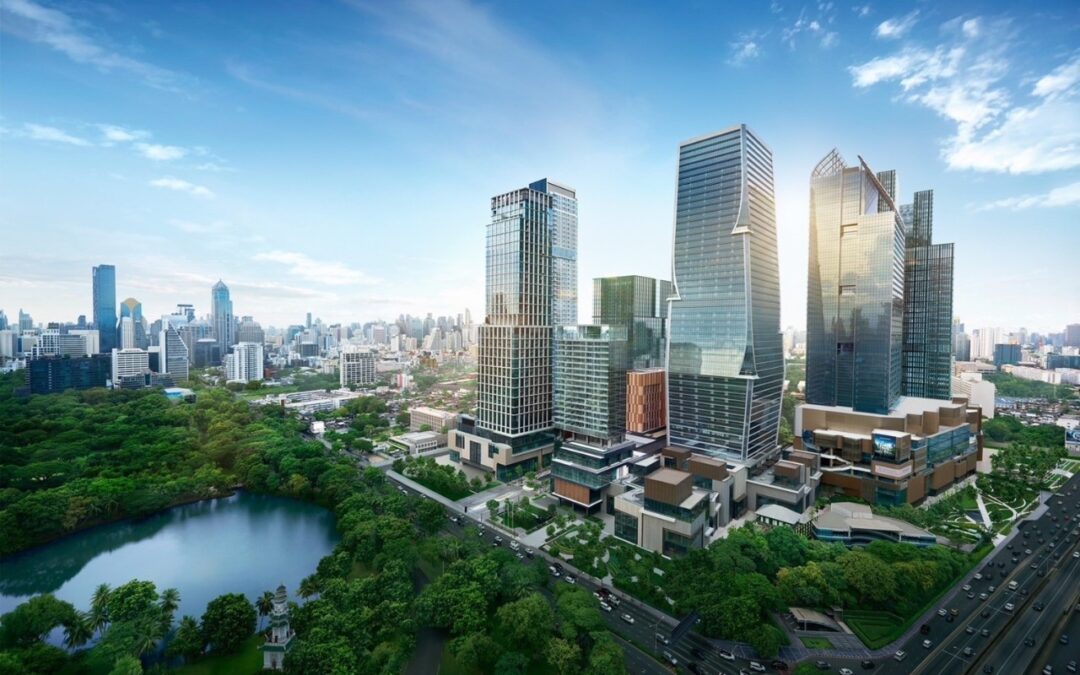
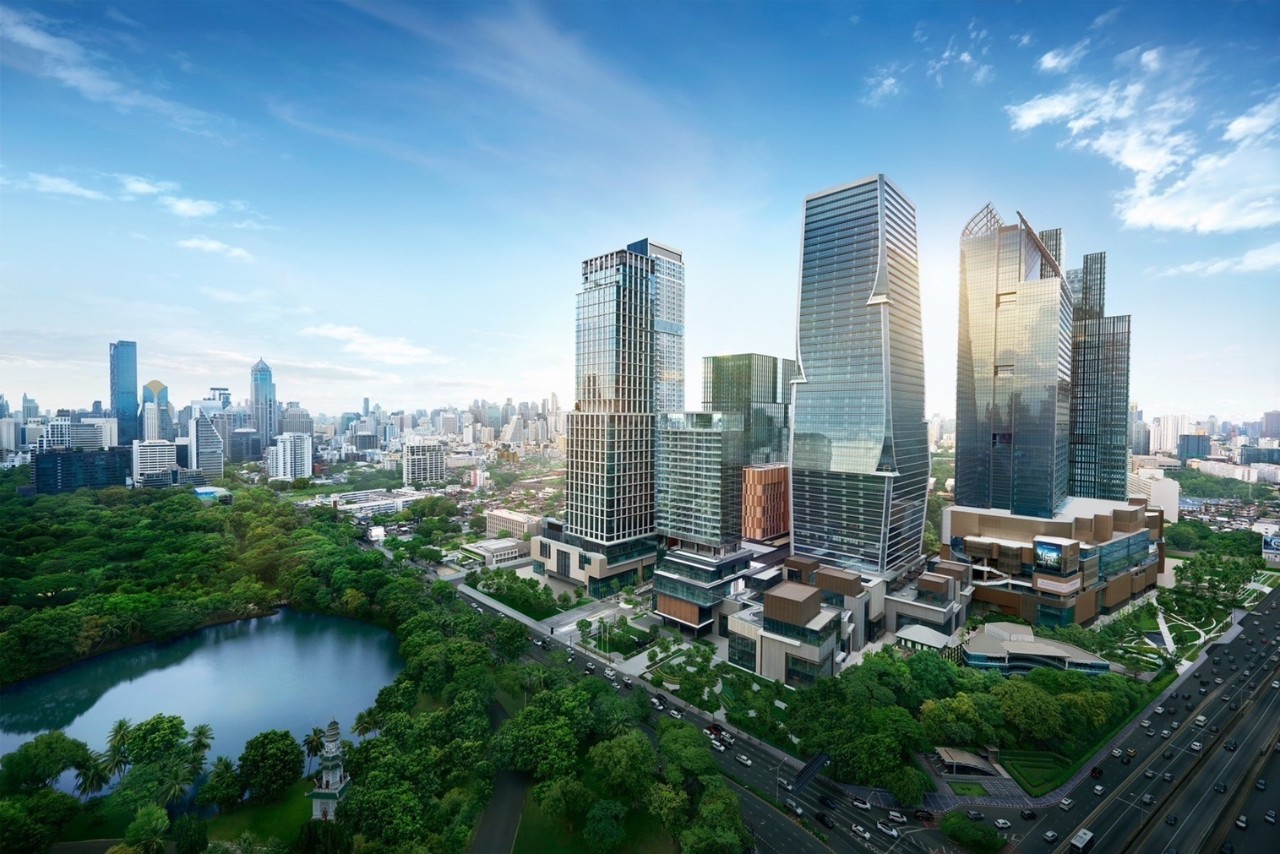
One Bangkok is not a condominium project in isolation. It is a district-scale mixed-use development that changes how foreign buyers should read Rama IV, Lumphini, Wireless Road, Sathorn and nearby central Bangkok neighbourhoods.
For luxury condominium buyers, the most important question is not simply whether One Bangkok is impressive. It is whether the district creates durable daily-use demand: offices that bring senior employees, retail that supports weekend life, hotels that lift service expectations, public spaces that improve walkability, and a stronger identity for an area that sits between several established prime zones.
This One Bangkok district guide looks at the development from a foreign-buyer perspective. It focuses on what can support property confidence, what should still be checked carefully, and how to think about nearby condominium choices without being carried away by the scale of a single landmark.
One Bangkok opened as a large mixed-use district connecting Rama IV with the Silom and Sathorn business areas. Image: One Bangkok.
Why One Bangkok matters to the central map
Bangkok has several recognised prime addresses: Sukhumvit, Chidlom, Langsuan, Wireless Road, Sathorn, Silom and the riverside. Rama IV has always had strong geography, sitting beside Lumphini Park and close to multiple business districts, but parts of it lacked the polished pedestrian environment and lifestyle identity that foreign buyers often expect from a premium address.
One Bangkok helps close that gap. Its official opening announcement described a mixed-use neighbourhood with retail, work, leisure, hotels and residential towers. For buyers nearby, the potential benefit is not only visual. A district with offices, dining, retail and events can make daily life easier and can help tenants understand why they might choose this side of town.
The strongest property impact is likely to be felt in buildings that already have good fundamentals: freehold tenure, sensible layouts, strong management, easy access to MRT or BTS links, and a walkable relationship to Lumphini, Silom, Sathorn or Wireless Road.
Foreign buyers should also remember that district change takes time to price properly. Some nearby owners may immediately raise expectations, while tenants and resale buyers may wait until the retail, office, hotel and public-realm pattern is fully settled. That gap can create both opportunity and overpricing.
Office demand is part of the residential story
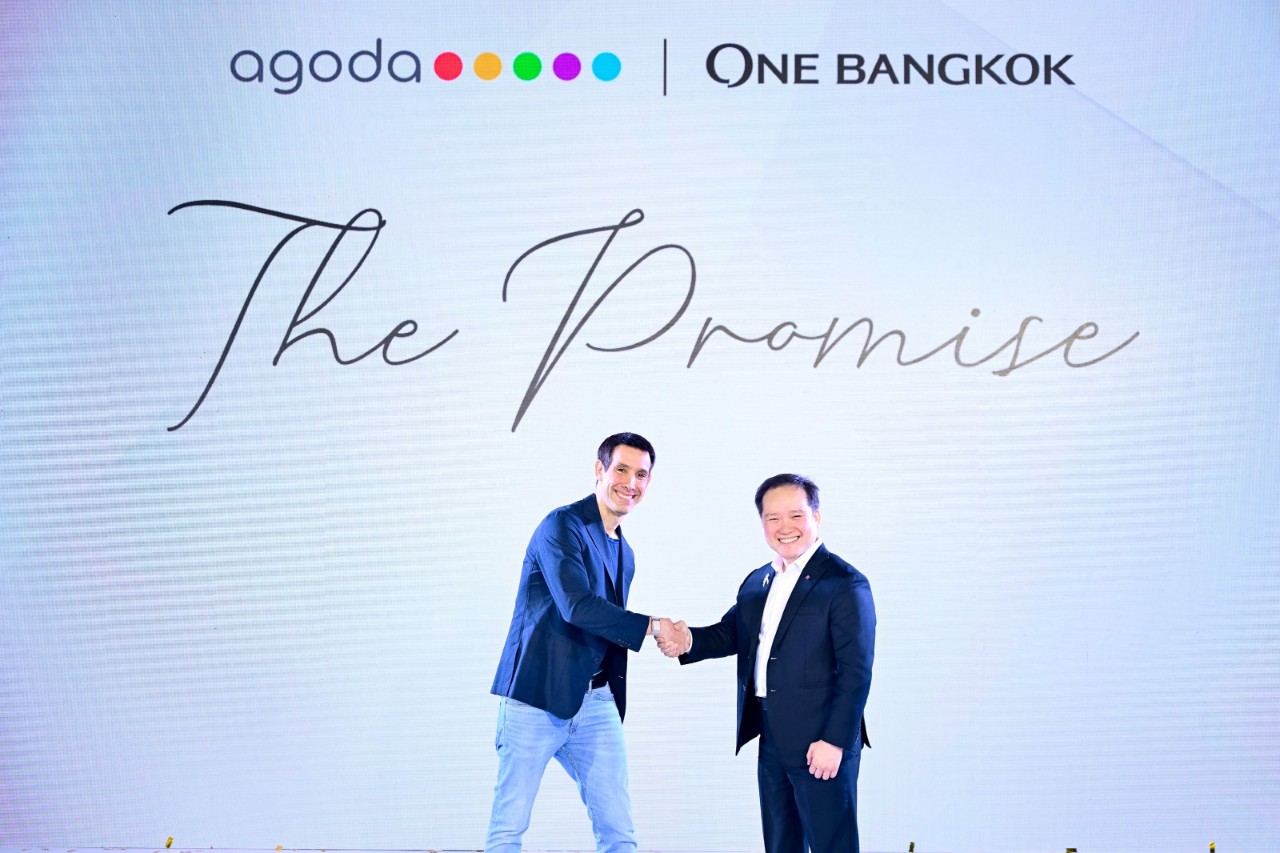
A mixed-use district becomes more relevant to condominiums when it attracts real occupiers. One Bangkok announced in December 2025 that Agoda would relocate its Thailand operations to One Bangkok Tower 5, occupying more than 26,000 square metres across seven floors in the first phase, with the move slated for April 2026.
For foreign buyers, this kind of office commitment matters because residential demand often follows employment quality. International companies bring expatriate staff, regional managers, visiting executives and suppliers. Even when employees do not live next door, they add spending power and visibility to the district.
That does not guarantee rental returns. It simply improves the logic for nearby housing demand, particularly for units that suit professionals who want a short commute, premium facilities and access to central Bangkok amenities without relying on a car for every errand.
One Bangkoks district-scale public realm and mixed-use setting support the Rama IV-Lumphini lifestyle story. Image: One Bangkok.
Retail and public space can change weekend behaviour
The retail component is also important. One Bangkok positions its retail offer around multiple precincts, dining, shopping and lifestyle experiences. In a city where mall access, restaurants and air-conditioned walkability influence where tenants choose to live, this is not a minor detail.
Foreign residents often compare Bangkok districts by weekend convenience. Can they walk to dinner, groceries, coffee, fitness, a park and transport? Can guests find the building easily? Are there enough destinations nearby to make the area feel active after office hours? One Bangkok strengthens the answer for the Rama IV-Lumphini area.
Buyers should still check the exact walking route from any condominium under consideration. Bangkok distances can be misleading. A building that is close on a map may be less comfortable on foot because of road crossings, heat, construction, pavement quality or station access.
How to compare nearby condominiums
A One Bangkok effect should never replace building-level due diligence. Compare nearby condominiums by age, tenure, ceiling height, unit efficiency, parking ratio, facilities, common fees, sinking fund, juristic management and foreign quota. Then compare rent evidence and resale listings in the same building and nearby competitors.
New luxury launches around the district may command a premium because they sell a future lifestyle story. Completed resale buildings may offer more visible evidence: actual maintenance quality, current rents, real owner behaviour and established juristic management. Neither route is automatically better.
If buying for own use, prioritise the route you will actually walk and the amenities you will actually use. If buying for investment, prioritise tenant depth, furnishing standard and exit liquidity. A beautiful address that is difficult to rent at the required price is not a defensive investment.
The best shortlists usually include at least one completed resale building and one new or recently completed project. That comparison keeps the buyer anchored: one option shows proven operations, while the other shows current specification and future district pricing.
Agodas announced relocation to One Bangkok Tower 5 underlines the office-demand role of the district. Image: One Bangkok.
The buyer takeaway
One Bangkok raises the profile of Rama IV and reinforces the centrality of the Lumphini-Silom-Sathorn-Wireless Road corridor. Its office commitments, retail scale and public-space strategy make the district more legible to foreign residents and corporate tenants.
The opportunity is selective. Buyers should look for buildings that benefit from the improved district without overpaying for vague proximity. The best purchases will still be the ones with clear legal structure, liveable layouts, sensible pricing and a realistic rental or resale audience.
If you are evaluating condominiums near One Bangkok, Invest Bangkok Property can help compare completed buildings, new launches, foreign quota and rental evidence before you decide whether the district premium is justified.
Economic Uncertainty, Unsold Inventory, and High Household Debt Weigh on Market
The launch of new residential projects in Greater Bangkok is projected to decline for the third consecutive year in 2025, driven by a growing backlog of unsold units from 2024, economic uncertainty, and elevated household debt, according to Kasikorn Research Centre.
Last week, the research centre forecasted a 0.7% year-on-year decline in new residential supply for 2025, following approximately 61,450 units launched in 2024. This continues a downward trend, as 2024 saw a 39.5% drop from around 102,000 units in 2023, which had already decreased by 5.2% from 107,000 units in 2022. Notably, the 2022 figure represented a 77% surge from the pandemic-era low of 60,000 units in 2021.
In 2024, all housing categories experienced a decline in new supply, with condominiums seeing the steepest drop at 43%, followed by townhouses (41.5%) and single detached houses (20.8%).
Despite the sharp reduction in new project launches, unsold inventory remains high. The centre anticipates that the total number of unsold units will exceed 230,000 units, surpassing the level recorded at the end of 2023.
Weakened Demand Due to Economic Factors
Prasert Taedullayasatit, President of the Thai Condominium Association, highlighted that poor market sentiment throughout 2024 was driven by weakened purchasing power, slow economic growth, and high household debt.
Additional challenges such as geopolitical conflicts, high interest rates, and stringent mortgage lending policies carried over from 2023, making homeownership more difficult. Lending curbs and high mortgage rejection rates further constrained market activity, leading many developers to postpone new project launches.
“The market was further impacted by political transitions in Q3 and widespread flooding in Q4,” said Mr. Prasert. “Additionally, weak investor confidence in the debenture market led several developers to delay their projects.”
Developers Respond by Scaling Back New Projects
Over the past three weeks, five major SET-listed developers—Land & Houses, Supalai, Sansiri, Frasers Property Thailand, and AssetWise—announced plans to launch a total of 85 new residential projects worth 140.9 billion baht in 2025.
These figures represent a 26% decline in the number of projects and a 20% drop in total value compared to 115 projects worth 175.9 billion baht launched in 2024.
Most developers are scaling back their new launches, while some are shifting toward the upper-end market, where purchasing power remains stronger than in the lower-end segment.
Middle- to Lower-Income Groups Struggle with Homeownership
“Thai middle- and lower-income groups are losing the ability to afford homes due to rising living costs and economic pressures,” Mr. Prasert explained. “High interest rates have further weakened purchasing power, while the loan-to-value (LTV) policy has made it more difficult for buyers to secure financing.”
According to Mr. Prasert, Q3 2024 marked the lowest point for the residential market in 13 years, with presales in Greater Bangkok hitting 59.5 billion baht—the lowest level since Q4 2011, during the Great Floods.
Declining Presales Across All Price Segments
By price segment, the sharpest year-on-year decline in presales occurred in units priced below 3 million baht, which plummeted 59%, followed by units priced between 3–5 million baht, down 55%.
Higher price segments also saw declines, including:
7–10 million baht units: Down 33%
5–7 million baht units: Down 24%
10+ million baht units: Down 16-22%
10–20 million baht units: Down 16%
20–50 million baht units: Down 17%
50+ million baht units: Down 22%
Despite ongoing challenges, developers are adjusting their strategies by targeting premium segments, reducing overall project launches, and focusing on projects with higher-value sales potential. However, market recovery remains uncertain, given persistent economic headwinds and financial constraints affecting homebuyers.
With high unsold inventory, subdued demand, and a challenging financing environment, the Greater Bangkok real estate sector faces another tough year ahead in 2025.
The developer sentiment index for Greater Bangkok’s housing market fell for the second consecutive quarter in Q3, hitting its lowest level since Q3 2020.
Kamonpop Veerapala, president of Government Housing Bank and acting director-general of the Real Estate Information Centre (REIC), reported the current situation index at 45.1, a 4.6-point drop year-on-year and 0.1 points lower than in Q2.
“The index has remained below the neutral threshold of 50 for seven consecutive quarters, signaling a continued decline in developer confidence in the residential sector,” he said.
The last time the index was this low was in Q3 2020, at 42.8 points, before rising to 46.3 in Q4 2020.
In Q3 2024, the most significant quarter-on-quarter decline was seen in sales sentiment, which dropped 6.6 points to 40.7, followed by a 0.2-point dip in investment sentiment, bringing it to 47.4.
Notably, revenue sentiment rose by 2.5 points to 42.0, and sentiment for new project launches increased by 1.6 points to 50.7.
Development costs sentiment increased 1.5 points to 40.4, while employment sentiment rose by 0.9 points to 49.6. However, except for new project launches, all other components remained below the neutral 50 mark.
The sentiment index for listed developers declined to 47.9, down from 52.2 in Q2 2024, reflecting reduced confidence and heightened concerns among listed firms, according to REIC.
Sales sentiment for listed developers saw the largest drop, falling 15.8 points to 43.8. Investment and new project launch sentiment both declined by 5.6 points to 52.1, while revenue sentiment decreased by 2.3 points to 47.7.
On the positive side, development costs sentiment rose by 3.1 points to 39.6, and employment sentiment edged up by 0.2 points to 52.1.
Looking ahead, the expectations index for the next six months rose to 51.6, slightly up from 51.4 in Q2 2024, signaling a positive outlook from developers for the near future.
The biggest improvement was seen in sales sentiment, which increased by 3.4 points to 57.8, followed by development costs, which rose by 2.9 points to 37.5.
Employment sentiment increased by 2.2 points to 52.4, and revenue sentiment grew by 2.0 points to 53.0.
However, there were declines in sentiment for new launches, which dropped by 6.3 points to 58.1, and investment, which decreased by 3.1 points to 51.0.
Vimarn Suriya Co, the developer behind the luxury mixed-use Dusit Central Park project, remains unfazed by rising interest rates and a strengthening baht, as the branded residential development primarily targets affluent Thai buyers.
CEO La-ead Kovavisaruch noted that elevated mortgage rates have a minimal effect on luxury homebuyers compared to those in the mass market.
“Demand in the luxury segment remains robust, while supply, particularly in prime locations, is quite limited,” she commented.
Currently, 80% of The Residences at Dusit Central Park, valued at 11.5 billion baht, have been sold. The company anticipates reaching 85% by year-end.
The project comprises 406 units, starting at 55 square meters, with an average price of 380,000-390,000 baht per square meter.
There will be seven penthouses, including six units of 450 square meters and one expansive 900-square-meter unit. Two 450-square-meter penthouses and the 900-square-meter unit are still available.
“The 900-square-meter penthouse offers customization options, allowing buyers to tailor the number of bedrooms,” said Ms. La-ead.
“We are in the process of selecting a luxury brand to collaborate on marketing this unit.”
She added that the recent strength of the baht would not affect sales, as 80% of buyers are Thai nationals.
“The baht has fluctuated between 32 and 37 baht to the US dollar over the last two to three years, so the current rate hasn’t impacted our project,” said Ms. La-ead.
“Our key customer base is Thai, which means currency fluctuations affect us less compared to foreign buyers.”
The company expects the project to be fully sold by 2025, with construction scheduled for completion by the end of that year.
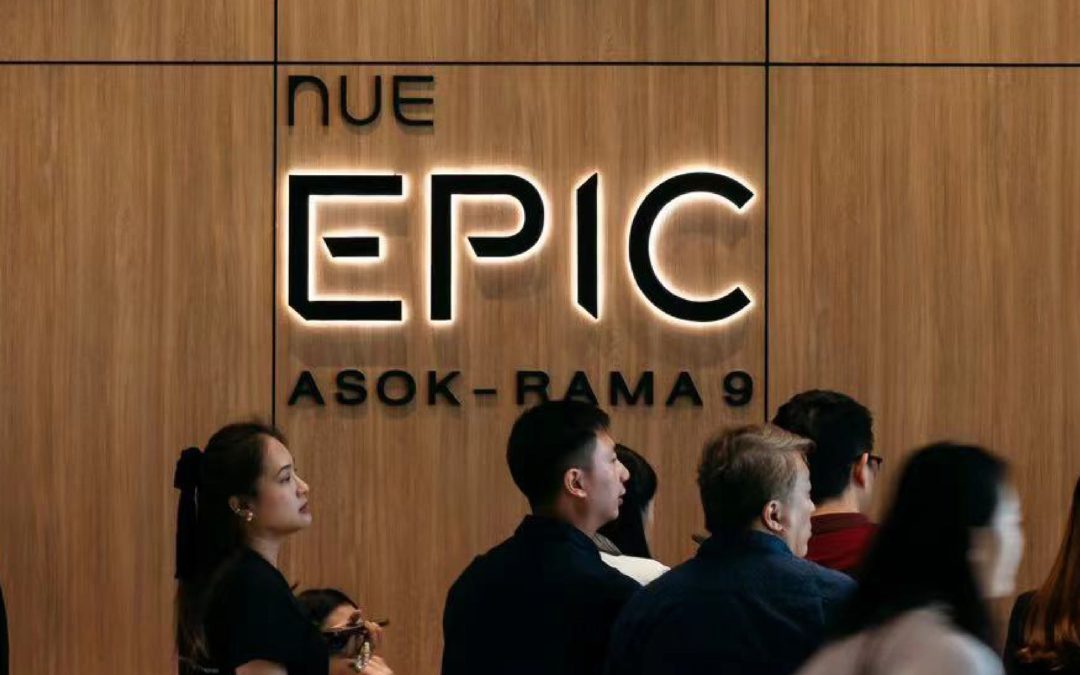
Nue Epic Asok-Rama 9 launched over the weekend that just passed. This project was hotly anticipated. It is located in the very popular Rama 9 business district. It is walking distance to the Phra Ram 9 MRT station.
Before this launch event, there were pre-launch sales. These sales were only to clients of certain agencies. Even then, sales were strong due to the good location and attractive pricing. Imagine a freehold condominium in the Rama 9 area for about THB 3.xx million.
Here are some pictures of the launch event.
More than 100 units were sold over the weekend! There are still some available launch units available. If you are interested in a unit, do contact the IBP Real Estate Sales Team at +66 66 112 8862 (WhatsApp) or email [email protected].