Foreign buyers often enter Bangkok with a purchase question: which condominium should I buy? A safer starting point is the exit question: who is likely to buy or rent this unit from me later, and why would they choose it over the alternatives? That is resale liquidity. It does not mean a unit will sell instantly. It means the asset has a credible future audience, enough comparable evidence and a story that remains clear when market conditions are less forgiving.
Resale liquidity starts with a location that future buyers can understand quickly.
Bangkok has many attractive condominium buildings, but not all are equally easy to exit. Some units look strong in a presentation but depend on a narrow buyer group. Others are less dramatic but sit in districts with proven transport, office, healthcare, school, retail or lifestyle demand. For overseas owners, liquidity deserves special attention because they may not be in Bangkok to manage a long resale campaign, repeated viewings or difficult negotiations.
The discipline is to judge a unit from the next buyer’s perspective. A foreign investor may accept a longer holding period, but the eventual buyer will still ask practical questions about price, building age, view, maintenance, foreign quota, transfer costs, rentability and daily convenience. The more easily those questions can be answered, the stronger the resale case becomes.
What liquidity means in Bangkok condos
Liquidity is not only about discounting. A cheap unit in a weak building can remain illiquid if buyers worry about maintenance, location, oversupply or poor layouts. A premium unit can be liquid if the buyer pool is deep enough and the price is supported by recent evidence. In Bangkok, liquidity is usually strongest where several demand groups overlap: Thai owner-occupiers, foreign buyers, local investors, expatriate tenants and corporate tenants.
That overlap is why central mass-transit districts, hospital corridors, international-school routes, office clusters and established lifestyle zones often remain easier to explain. A buyer does not need every demand driver in one address, but the unit should not depend on only one fragile reason. If the only story is future capital gain, the resale case is too thin.
Start with the future buyer pool
Before reserving a unit, list the realistic buyer groups. A compact one-bedroom near a BTS station may appeal to landlords and younger professionals. A larger family unit may need school access, parking, storage and a quieter building. A branded residence may appeal to high-net-worth buyers who value service and scarcity, but the common fees and service model must match that audience. A riverside unit may need a buyer who values views and destination living more than a short walk to office towers.
This exercise prevents a common mistake: buying a unit because it suits the first buyer’s holiday pattern but not the next buyer’s daily routine. The stronger test is whether the future audience can see the value in less than ten minutes. If the agent must explain too many compromises, liquidity is weaker.
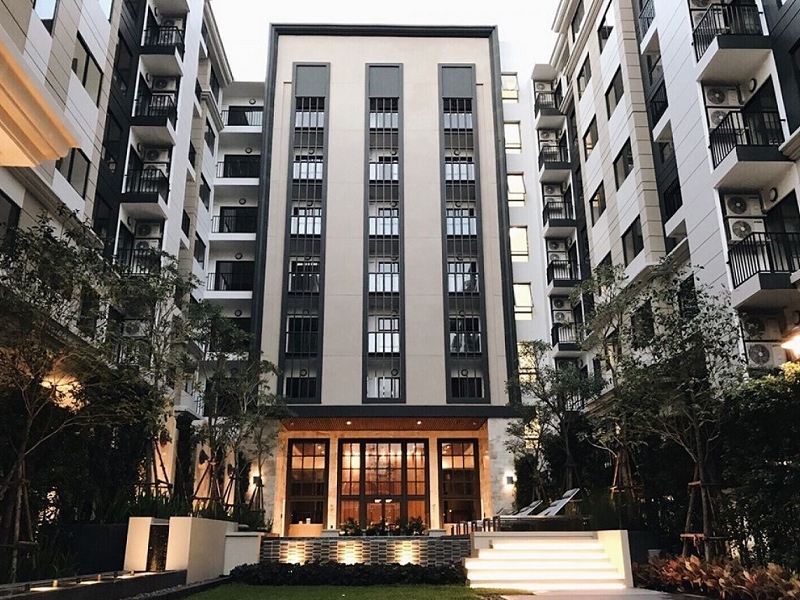
Completed buildings reveal management quality, maintenance standards and actual buyer depth.
Compare the building, not only the district
District quality can support resale, but the building still matters. Buyers should check lobby condition, lift waiting times, common-area upkeep, parking, access control, juristic communication, sinking fund history, owner mix and rules on short stays or pets where relevant. These details affect tenant satisfaction and buyer confidence after the first impression fades.
Completed buildings give the clearest evidence. A buyer can inspect corridors, noise, views, facilities, repairs and tenant profile. Off-plan purchases require more caution because the future building condition is still an assumption. For off-plan units, buyers should focus on developer track record, payment schedule, foreign quota, construction progress, comparable completed projects and how many similar units may compete at completion.
Read comparable evidence carefully
A resale asking price is not the same as a resale value. Buyers should ask for recent transactions where available, competing listings in the same building, nearby alternatives and rental evidence after vacancy and agent fees. The most useful comparisons are similar unit sizes, floors, views, furnishing quality and transfer status. A high-floor corner unit should not be judged against a lower-floor unit with a blocked view unless the price difference is clear.
Foreign buyers should also check whether the building has an active resale market or only a few stale listings. A building with many owners trying to exit at similar prices can create negotiation pressure. A building with almost no comparable evidence can be attractive, but it also makes valuation harder. The right answer depends on why supply is available and whether demand is visible.
A practical liquidity checklist
Can the location be explained through transport, work, healthcare, school, retail or lifestyle demand?
Does the unit plan suit a clear buyer or tenant group?
Are there credible comparable sales or rentals rather than only asking prices?
Is the building well maintained and easy to inspect?
Will common fees, sinking funds and transfer costs be acceptable to the future buyer pool?
Is foreign quota available now, and likely to be relevant at resale?
Could the unit still compete if rent or resale pricing softens?
A strong exit case is usually built at purchase, before the buyer signs the contract.
Where buyers make liquidity harder
The biggest liquidity errors are usually made at purchase. Buyers overpay for furniture, choose an awkward layout, ignore a weak view, accept an inconvenient walk, buy in a building with poor upkeep or assume that a future infrastructure story will solve every issue. These errors may not matter during a holiday stay, but they matter when a tenant compares alternatives or a resale buyer asks for a discount.
Another error is buying too personally. Bangkok can be highly liveable, and personal enjoyment is a valid reason to own. But if the property is also an investment, personal preference should be balanced against future market logic. A unit can be beautiful and still have a narrow resale audience. A unit can be understated and still be easier to exit.
Buyer takeaway
Resale liquidity is a practical risk-control tool for foreign buyers. It forces the purchase decision to account for the next buyer, the next tenant and the next market cycle. In Bangkok, the best liquidity cases combine clear location logic, credible building management, usable layouts, comparable evidence and conservative pricing.
IBP can help overseas buyers compare Bangkok condos by exit demand, rental evidence and building-level risk before they reserve. Read our resale and exit strategy guides or contact IBP Real Estate for a disciplined buyer shortlist.
A foreign buyer should decide how a Bangkok condominium can be resold before deciding whether it should be bought. That sounds defensive, but it is a practical investment discipline in 2026. The Bank of Thailand’s 29 April 2026 Monetary Policy Committee statement kept the policy rate at 1.00 percent, while also warning that credit growth is projected to remain subdued and that financial institutions are still cautious with higher-risk borrowers. For property investors, the message is clear: liquidity has value.
A slower credit market rewards buyers who think about resale before they buy.
Bangkok remains one of Thailand’s most understandable markets for foreign condominium ownership. It has depth, international services, major hospitals, schools, offices, transport infrastructure and a large tenant base. But a deep market is not the same as an easy market. When buyers face stricter finance, higher living costs and uncertain global conditions, they become more selective. Units that were easy to sell in a momentum market may need sharper pricing and a better story in a slower one.
Why resale strategy belongs at the start
Many overseas buyers focus first on view, discount, furniture package or projected rent. Those details matter, but they should sit inside a wider exit plan. A sensible resale plan answers three questions. Who is the likely next buyer? What evidence would persuade that buyer? How much time and price flexibility might be needed if the market is quiet?
In Bangkok, the next buyer may be a Thai end-user, a foreign investor, an expatriate already living in the city, a family buying for a student or relative, or an owner-occupier upgrading within a preferred district. A unit with only one possible buyer group is more fragile. A unit that can work for several groups has more ways out. That is especially important when domestic mortgage approvals are selective and some Thai buyers are slower to commit.
What the current credit backdrop changes
Lower policy rates do not automatically translate into easy property liquidity. The BOT statement specifically noted subdued credit growth and continued caution by financial institutions. That means foreign buyers should avoid assuming that a future domestic buyer will easily obtain finance at the price the seller wants. If local mortgage buyers are constrained, cash buyers and foreign buyers gain bargaining power, but sellers also need to be realistic.
For investors, this encourages conservative underwriting. Do not buy a unit that only works if the resale price rises quickly. Model a longer holding period, normal vacancy, furnishing refresh, agency fees, common fees, tax exposure and a negotiable resale price. If the purchase still makes sense, it is a stronger candidate. If it only works under optimistic appreciation, it is not really an investment plan.
Building depth, completed condition and realistic pricing matter more when lenders and buyers are cautious.
Five resale checks before buying
1. Comparable sales and listings
Ask how many similar units in the same building are listed and where they are priced. A single asking price proves little. A cluster of comparable units shows the seller competition a future owner may face. If many identical layouts are on the market, the buyer should demand a stronger entry price or a better unit position.
2. Tenant profile
A good resale unit normally has a rental story as well as an ownership story. Future buyers often ask what the unit can rent for, even if they intend to use it personally. Evidence from recent leases in the same building is more useful than district-wide yield claims.
3. Building management
Resale buyers notice ageing common areas quickly. Lobbies, lifts, corridors, pool decks, gyms, parking systems and juristic office responsiveness influence buyer confidence. A tired building can force the seller to discount even when the unit interior is attractive.
4. Layout durability
Fashionable finishes age, but good proportions last. Units with usable bedrooms, proper storage, sensible kitchens and flexible work space are easier to sell into different market cycles. Very small or awkward units need a clearer price advantage.
5. District demand
Resale value is supported when a district has multiple demand drivers: transport, offices, hospitals, schools, retail, green space, embassies or lifestyle depth. A single catalyst can disappoint; a layered district gives future buyers more reasons to consider the unit.
Where foreign buyers should be careful
The most common mistake is overpaying for a discount story. A launch discount, furniture promotion or guaranteed-looking rental projection can distract from weak resale depth. Buyers should also be careful with very large luxury units unless they understand the narrower buyer pool and longer selling period. High-end units can be excellent lifestyle assets, but they require patient capital and careful building selection.
Another risk is buying too deep into an emerging location before rental demand has caught up. Emerging districts can offer better entry pricing, but investors need to know what will support rent during the first few years. Transport promises, future malls and office pipelines should be treated as upside, not as the only reason the numbers work.
The best exit story is usually tied to a district with several sources of end-user and tenant demand.
A practical 2026 buyer framework
Start with the resale audience, then work backwards. If the future buyer is likely to be a Thai professional, check local finance affordability and building reputation. If the future buyer is likely to be another foreign investor, check foreign quota, rental evidence and whether the unit is easy to manage from overseas. If the future buyer is likely to be an end-user, prioritise liveability over maximum theoretical yield.
Bangkok property can still be attractive for foreign buyers, but the strongest purchases are specific rather than broad. They have a believable tenant, an explainable exit, a building that will age well and an entry price that leaves room for market noise. In a slower credit market, discipline is not pessimism. It is what gives the buyer optionality.
IBP can help overseas buyers compare resale evidence, rental demand and exit risk before committing to a Bangkok condo. Review our resale and exit strategy guides or contact IBP Real Estate for a unit-specific shortlist.