by Daryl Lum | Jan 29, 2019 | Bangkok Property Market Updates, Expat Living & Relocation, Investment Analysis
On the 28th of January, the Business Times ran a report entitled “Thai property can stay hot in chillier times”. It narrated the demand that is expected to come from the Chinese and how as the Chinese middle class continues to grow and accumulate wealth, the demand for property investments in Thailand will remain strong. These are the factors that will encourage the Chinese to invest in properties in Thailand, mainly Bangkok.
1) Thailand is considered a safe haven
In an era with great turmoil around the world and with the US and China embroiled in a trade war, Thailand is seen as a safe place to park their monies. The Thai Baht has proven to be very resilient over the past decade.
2) Benchmark interest rates are still low
Thailand’s benchmark interest rate is at 1.75 per cent and inflation is at about 0.4 per cent. This means that lending cost is low and this is a huge benefit for the construction industry. Mortgage rates for locals are very attractive. So much so that the Thai government needed to step in to regulate excessive risk-taking in the property market.
3) Tourism is still a very strong driver of the economy
Tourism contributes about one-fifth of Thailand’s Gross Domestic Product (GDP). Bangkok is still the world’s most visited city in the world, even ahead of cities like London.
4) The Thai government is expanding its visa-free entry policy for the Chinese
In a bid to entice the Chinese to visit Thailand, the Thai government implemented a visa-free entry policy for the Chinese. Now they are extending this policy till 30th April 2019. This waiver alone is expected to boost tourism by 30 per cent.
To read the full Business Times article, visit this link:
https://www.businesstimes.com.sg/real-estate/thai-property-can-stay-hot-in-chillier-times
The team at Invest Bangkok Property is positive of price growth in the medium to long term. In the short term, due to external factors like a slowing global recession and repercussions of a trade war between the two largest economies in the world, we would recommend clients make property investments with a longer horizon. The elections should go along smoothly but if it does not, there is a chance that it will adversely affect the Thai economy. The Thai economy and correspondingly, the Thai Baht has been the standout performer in South East Asia in the past decade. For a narration of how strong the Thai Baht has been, you may refer to this article: My views on the Singapore and Bangkok property markets.
Yours Sincerely,
The Invest Bangkok Property editorial team

by kevinyeo | Apr 30, 2018 | Bangkok Property Market Updates, Expat Living & Relocation
TOURISM experts and online travel platforms are welcoming the collaboration between e-commerce giant Alibaba and Thai tourism authorities to develop smart and digital tourism, although there are concerns over possible negative impacts.
Critics voiced concerns over a potential monopoly following a deal between Alibaba Group and Thai state agencies covering a number of areas, including tourism. Some also suggested the authorities needed measures to protect tourist attractions from an expected influx of foreign visitors.
Under a partnership deal on tourism, the Tourism Authority of Thailand (TAT) will expand cooperation with Fliggy, Alibaba’s online travel business and China’s leading online travel service provider, to focus on support for smart and digital tourism in Thailand. As an official strategic partner of TAT, Fliggy will work with the agency to offer smart technological experiences at multiple facilities and tourist attractions across Thailand for the convenience of visitors – ranging from online tour guides to electronic ticketing systems.
“In any case, like it or not, we cannot bar Alibaba from entering Thailand. So the best approach is to ensure local tour operators are well prepared for increased competition,” said former TAT governor Pradech Phayakvichien. “They should adjust their approach and work out how they could get the most benefits out of the collaboration,” he suggested. “In the digital era, we need technology to help connect us to the world and potential customers.”
“But the most important thing for Thailand is that we preserve and protect our tourist attractions,” Pradech said.
“We have to maintain or improve the standard of our [tourist attractions]. If we leave our beaches damaged, how could the Alibaba travel platform help us sell them?” he asked.
Prominent marine ecologist Thon Thamrongnawasawat said he expected the collaboration to bring changes in the proportion of Chinese tourists coming to Thailand. Whereas most Chinese now tour the Kingdom in groups, there is potential to also attract many more couples and individuals. That would make it easier to cope with the arrivals and better distribute income to local vendors. Thon said boosting the number of Chinese tourists or their spending here should not be the main objective for the partnership, as the figures are already high.
Statistics show Thai tourism relies heavily on Chinese visitors. As of April, 30 percent of all foreign tourists arriving in Thailand this year were Chinese, according to Thon, who is a member of the National Policy Committee for Tourism. Estimates are that tourism this year will generate about THB 3 trillion in revenues – a third of which is expected to come from Chinese tourists, he said. However, there is still concern over a possible surge in Chinese tourists following the collaboration. Pradech said authorities need to put measures in place to restrict the number of tourists at attractions where there are risks of damage.
Thon, who sits on the committee drafting the national strategy on environmental issues, said the draft plan would limit the number of foreign visitors to national marine parks to six million a year, to help protect marine resources from swift deterioration brought by heavy tourism traffic. Out of the six million visitors, four million are expected to be from China. “We are already in a ‘tourism trap’. Around 10 million Chinese tourists visit Thailand every year and generate around THB 1 trillion. If they are dissatisfied with us, what will happen” to Thailand’s tourism industry?” asked Thon.
Partnering with Alibaba
Yuthasak Supasorn, TAT governor, said in a recent press release that the agency would partner with Alibaba for tourism marketing activities through the giant’s online platforms, as well as connect with Alibaba’s other marketing channels to develop “big data” for the Thai tourism industry.
The partnership would help increase the competitiveness of small and medium-sized tourism companies in terms of the development of new products and services that will attract more Chinese tourists to the country, he added. “We hope it will also help both new arrivals and return visitors from China discover emerging secondary destinations, so it is a ‘win-win’ situation for both parties,” he added.
Some critics voiced concern that Fliggy might monopolize the Chinese tourist market and affect local online travel agencies.
But others see a partnership with the giant firm in more positive terms, as an opportunity to expand the market. Amornched Jinda-apiraksa, CEO, and co-founder of TakeMeTour, the largest marketplace for local tours in Thailand, said the collaboration would benefit Thai tourism in terms of getting more Chinese tourists into the country.
He said operating the travel business in the Chinese market is very challenging due to the language barrier and because Chinese tourists have specific behaviours and characteristics.
Amornched added that TakeMeTour this year planned to focus more on Chinese tourists, and that presents a good opportunity for Thai travel operators to offer their services and products directly to Chinese consumers on the Chinese platform.
The TAT has yet to give further details about the collaboration. Amornched said the format could be the opening of a Thai tourism shop or a flagship store on Fliggy.
TakeMeTour was one of six Thai start-ups and 37 Asian entrepreneurs joining the eFounders Fellowship Programme at Alibaba headquarters in Hangzhou, China, in March. Amornched said Alibaba has a strong ecosystem and his firm is willing to join the platform.
As a community-based online tourism platform that provides travel experiences in local communities around Southeast Asia, Somsak Boonkam, founder and chief executive of Local Alike, said his business may not be affected. That’s because the average Chinese tourist has no interest in community tours and only a small number have the taste for eco-friendly tourism.
Thon agreed. “You do not have to fear [about the Chinese platform snatching away customers.] The Chinese tend to buy Chinese goods, anyway,” Thon said.
As part of the collaboration, Fliggy and Ant Financial, Alibaba Group’s affiliate and operator of Alipay, are also in active discussions with various related government agencies to drive a digital transformation of Thai tourism.
Alipay, operated by Ant Financial, is China’s largest online payments and money transfer system, with more than 500 million active users. Thailand is among Alipay’s top three overseas-transaction hubs.
Somsak said using Alipay would help facilitate convenience to Chinese tourists with a familiar payment option when they traveled abroad. However, he urged the government to look into this matter carefully as there are concerns the system could allow massive outflows of money from the country.
Varithorn Sirisattayawong, research head for Kasikorn Research Centre, said Fliggy will help increase the number of Chinese tourists who choose Thailand through booking on the platform. It would benefit Thai banks and non-banks that offer international money transfers, payments, and exchange, as they would receive additional transaction fees as the number of transactions increased.
Varithorn said the use of Alipay to arrange a visa on arrival and tourist tax refunds for Chinese tourists would not directly impact the business of Thai banks and non-banks.
by kevinyeo | Jan 30, 2018 | Bangkok Property Market Updates, Expat Living & Relocation, Investment Analysis
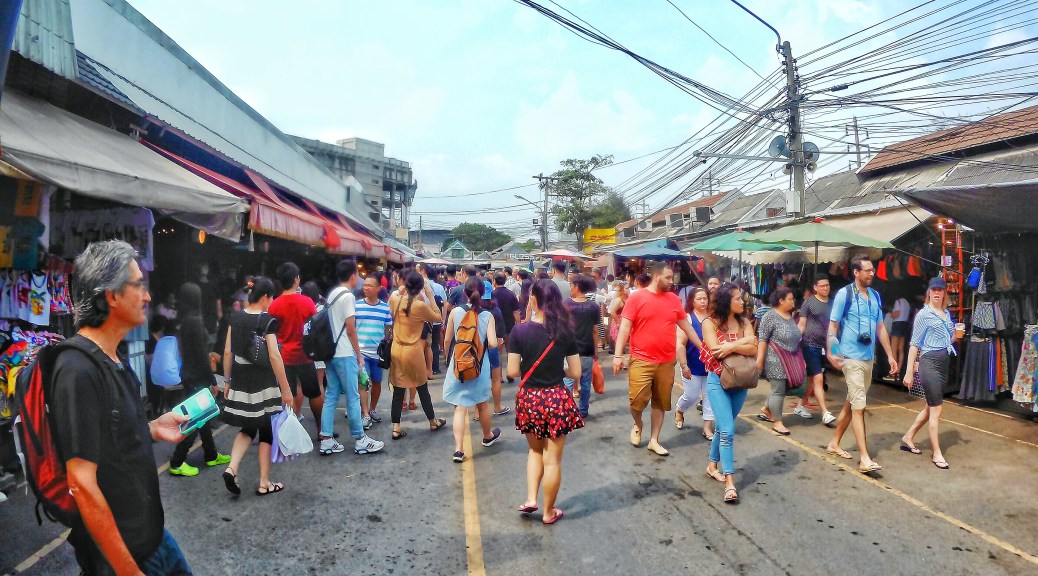
Tourists heading to one of Bangkok’s most popular shopping destinations, the Chatuchak market, could do away with cash payments by June, as part of several upgrades that will be made available later this year.
The Bangkok Post on Friday (Jan 26) reported that the State Railway of Thailand (SRT), which manages Chatuchak, aims to begin turning the weekend market into a cashless commercial area by June.
Shoppers will pay for items through using a single card for their purchases or by QR code, said the SRT’s director for land development Siripong Preutthipan.
Occupying an area of nearly 11ha in the city’s north end, Chatuchak is said to be one of the world’s largest weekend markets with more than 1,000 stalls divided into 27 sections selling everything from plants to antiques, clothes, books, food, home products and pets.
Thousands of shoppers head to the market every Saturday and Sunday and the market is a main draw for tourists to the city.
The SRT will spend more than 100 million baht (SGD 4.2 million) on developing the market this year, Dr Siripong said.
First on the agenda, are automated parking lots which will be available by the end of the year, he said.
Costing around cost around 40 million baht to build, each lot will accommodate 100 cars.
“The systems will comprise automated ticket dispensaries given out to vehicles as they enter,” he was quoted saying by the Bangkok Post. “Bidding for construction will begin mid-year, with the aim of making parking spaces available by year’s end.”
In addition to the two new upgrades, the SRT has also launched the Chatuchak Guide mobile app, a virtual directory that lists the stalls according to their category and ratings, making it easier for shoppers to navigate the market.
In the future, Dr Siripong said the SRT hopes to be able to allow its retailers to export their products abroad.
The market will also have air-conditioned lavatories later this year, with patrons paying 10 baht to use the facilities. The SRT is currently negotiating with private firms for the construction rights for the lavatories.
Presently, the market has eight non-air conditioned lavatories, with patrons being charged 2 baht for their usage. The lavatories will also see a 25-million-baht upgrade, after which patrons will be charged 5 baht for the facilities. The bidding for the project will take place in March.