by Daryl Lum | Oct 17, 2024 | Bangkok Property Market Updates, Investment Analysis
The Thai government is preparing to roll out 55 billion baht (approximately USD 1.66 billion) in soft loans to stimulate the property sector and boost the national economy, according to Deputy Finance Minister Paopoom Rojanasakul.
This proposal will be presented to the cabinet for approval, Rojanasakul stated in a press briefing.
He added that the stimulus package would target both supply and demand within the real estate market, aiming to encourage both property developers and buyers, ensuring a wide-reaching impact.
The Deputy Minister emphasized that fresh stimulus measures are necessary as the current schemes have been fully utilised.
Recently, the Finance Ministry leveraged state financial institutions, including the Government Housing Bank (GH Bank), to support the real estate market. Earlier this year, GH Bank launched a low-interest loan program called “Happy Home,” offering a total of 20 billion baht in loans. This initiative provided flexible loan terms for low-income households, allowing for a maximum loan of 3 million baht per applicant, with a fixed interest rate of 3% for the first five years. However, this program has now reached its funding limit.
by Daryl Lum | Oct 9, 2024 | Bangkok Property Market Updates, Investment Analysis
Rising house prices, driven by increasing construction costs, are having a lesser impact on potential homebuyers than the growing challenges in obtaining mortgage loans, according to property associations.
Pornarit Chounchaisit, President of the Thai Real Estate Association, noted that the surge in costs reflects a global trend, with property prices climbing in major cities worldwide.
“The war and its influence on oil prices are escalating construction costs for new housing projects,” he said. “Moreover, rising labor costs will further drive up housing prices.”
Although selling homes remains difficult, housing prices are expected to increase next year due to the government’s planned wage hikes. However, this policy is likely to benefit foreign workers, who constitute 50-60% of the labor force, more than local labor.
Soonthorn Sathaporn, President of the Housing Business Association, emphasized that the increase in housing prices has not outstripped inflation.
“The real challenge lies in stricter lending criteria, which are preventing many potential buyers from securing mortgages,” he said.
He also pointed out that mortgage rejection rates have surged to 35%, up from the usual 15-20%, with rejection rates reaching 50-60% for homes priced between 2-3 million baht.
Some developers have had to reduce their profit margins to make homes more affordable and are expediting construction to control costs.
To boost demand, Soonthorn urged the government to extend the expiring property measures and introduce income tax deductions for first-time homebuyers. He also suggested that relaxing loan-to-value (LTV) regulations could stimulate second-home purchases, particularly for properties near schools and workplaces.
Prasert Taedullayasatit, President of the Thai Condominium Association, supported the call for temporary relaxation of LTV rules to encourage market growth, proposing that the government withdraw these measures if speculative behaviour is observed.
“A reduction in interest rates would also enhance purchasing power, especially for lower-income buyers, while a weaker baht could boost tourism and attract foreign property buyers,” he added.
To further stimulate demand in Q4, the three associations are organising the House & Condo Expo from October 31 to November 3 at the Queen Sirikit National Convention Centre. Their goal is to sell at least 1,000 units, totaling over 4.5 billion baht in value, and they expect an additional 10 billion baht in sales in the months following the event.

by Daryl Lum | Sep 4, 2024 | Bangkok Property Market Updates, Investment Analysis
Higher debt leverage resulting from double financing is making it more difficult for property companies to secure bank loans, forcing some developers to rely on short-term loans from major shareholders.
Apinant Klewpatinond, chief executive of Kiatnakin Phatra Financial Group, a holding company of Kiatnakin Bank, said the bank continues to apply its existing loan assessment criteria for the property sector.
However, based on economic conditions and a higher debt-to-equity (D/E) ratio, credit risk in the sector has risen, making it challenging for some residential projects to obtain bank financing, he said.
During the recent era of low interest rates, many property companies increased their debt leverage through both bank loans and bond issuances. This double financing further elevated the D/E ratios of some companies.
According to Mr Apinant, the economic slowdown has presented significant challenges for several bond issuers. When approving new loans for the business sector, the bank also takes into account the potential for bond rollovers.
“For cyclical businesses, the bank will evaluate the broader business environment before approving new loans. Given the cyclical nature of the property sector, we are exercising caution in loan offerings amid the heightened risks in the mortgage market,” he said.
In response to these challenges, some residential developers are taking steps to conserve and raise cash.
These measures include avoiding new costs, borrowing short-term loans from major shareholders and selling assets to manage risks in a difficult financial market and limited mortgage loan approvals.
The property business constitutes a significant portion of KKP’s loan portfolio, accounting for 27.7 billion baht out of the bank’s total business loan outstanding of 60.1 billion baht as of June.
Additionally, KKP collaborates with the Bank of Thailand to support sustainable finance under the Financing the Transition programme, with a key focus on the property sector.
Separately, Amporn Supjindavong, UOB Thailand’s head of commercial banking, said the bank continues to offer financial facilities to property clients under a selective strategy.
For new residential investment projects, the bank primarily focuses on homes priced at a minimum of 5 million baht per unit, due to the lower risk associated with post-finance.
“Most large developers do not struggle with residential sales. Instead, they face challenges related to the increasing rejection rates of mortgage loans, stemming from homebuyers’ weakened debt repayment capabilities. As a result, the transfer of home ownership has become a more significant issue for developers than sales,” she said.
Ms Amporn said when approving loans for new residential projects, the bank considers several factors, including house prices, location, project sales and the financial status at both the project and company levels.
The D/E ratio and the company’s ability to manage bond rollovers are also key considerations.
The bank anticipates that mid-sized property companies, in particular, may resort to borrowing short-term loans from shareholders to support cash flow for investment projects. Large developers still report positive financial conditions, she said.

by Daryl Lum | Aug 28, 2024 | Bangkok Property Market Updates, Investment Analysis
In July, exports posted their highest growth in 28 months, surging by 15.2%, as easing inflation and improved purchasing power among key trading partners fueled demand.
Poonpong Naiyanapakorn, director-general of the Trade Policy and Strategy Office (TPSO), reported that exports reached USD 25.7 billion (938 billion baht) in July, largely driven by declining global inflation, which bolstered consumer spending capacity. Excluding gold, oil-related products, and weaponry, real sector exports increased by 9.3%.
Key factors contributing to this growth included rising employment and wage adjustments among major trading partners, particularly in Europe, which led to stronger consumer demand, boosting exports. Major markets showing strong recoveries included the US, China, Southeast Asia, and the European Union.
This trend aligns with the International Monetary Fund’s economic outlook, which points to a lift from China’s export-driven recovery and Europe’s rebound from earlier challenges.
Imports in July rose by 13.1% to USD 27.1 billion, resulting in a trade deficit of USD 1.37 billion. Over the first seven months of 2024, exports grew by 3.8% to USD 171 billion, while imports increased by 4.4% to USD 178 billion, creating a cumulative trade deficit of USD 6.62 billion.
Agricultural and agro-industrial product exports rebounded in July, rising 8.7% year-on-year to USD 4.36 billion, led by strong performance in rubber, rice, poultry, seafood, pet food, and edible oils. However, declines were noted in certain categories, including fruit, tapioca, sugar, and beverages.
Industrial product exports saw a significant year-on-year increase of 15.6% to USD 20.3 billion, recovering from previous declines. Key export drivers included oil-related products, electronics, and air conditioning equipment, while sectors like automobiles and semiconductors experienced decreases.
Mr. Poonpong expects exports to rise by 1-2% in 2024, supported by global economic recovery, industrial production improvements, and growth in the digital economy. However, risks such as geopolitical tensions and uncertainties in economic and trade policies following elections in key countries could weigh on future export performance. The Ministry of Commerce will continue to monitor these risks closely.
Meanwhile, Chaichan Chareonsuk, chairman of the Thai National Shippers’ Council, noted that although sea freight costs have eased, potential baht appreciation in the fourth quarter could pose challenges for exports.
by Daryl Lum | Aug 14, 2024 | Bangkok Property Market Updates, Investment Analysis, New Launches & Project Previews
Clients often ask us whether developers will increase their prices as time passes. The answer in most cases is yes. If you made a purchase during launch, the price which you paid for that development is typically lower than what you would pay if you bought into the development after a few years.
An example of this:
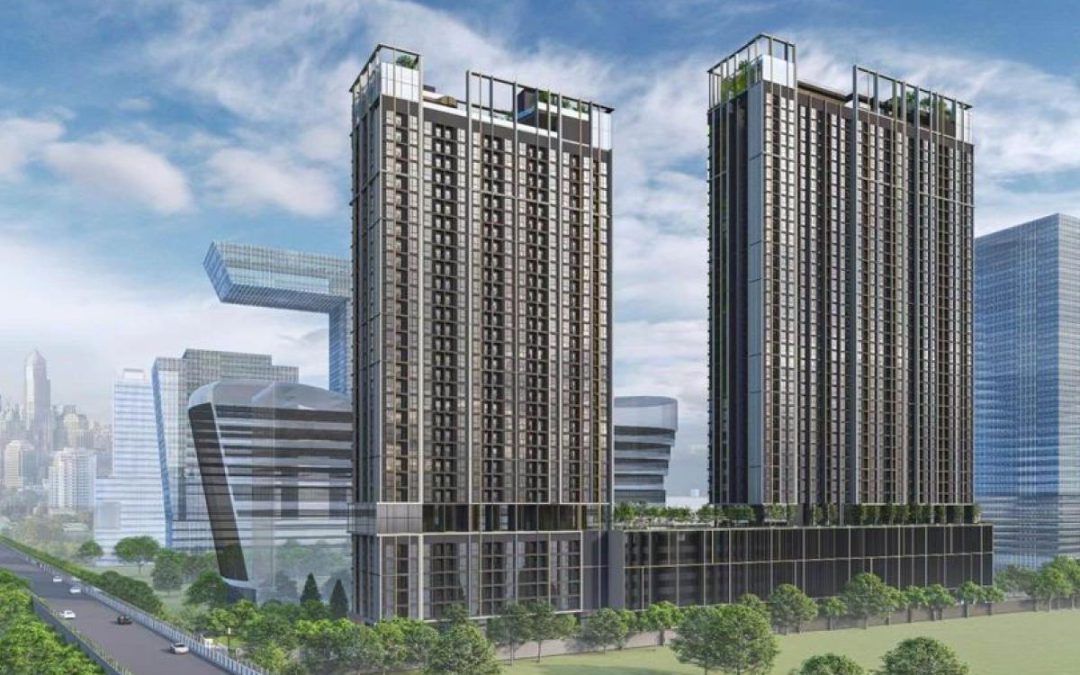
Let us take a look at a very popular project in the Rama 9 area. This project is Nue District R9. It is located next to Jodd Fairs, behind Grand Central Rama 9. This area is often heralded as the second central business district with the Sathorn Financial District being the first. Companies like Unilever and Huawei are in this area. So are the Stock Exchange of Thailand and the Chinese Embassy.
Back in 2022, the per square meter of a unit in Nue District R9 was about THB 130,000 to just above THB 140,000 per square meter.

Fast forward to July 2024.
This is the current pricing for the last eight units in the development. The per square meter pricing, before discount, has gone up to about THB 200,000 per square meter. After the discount, the per square meter pricing is averaging at just under THB 200,000 per square meter.

The increase in pricing is more than 30% from the launch.
We make this comparison because we sold units in Nue District R9 in 2022 and today in 2024, a client wants to purchase a unit in the same development.
To summarise, buying a development during launch is advantageous for two main reasons.
- Prices are cheaper during launch.
- You have more choices when choosing a unit.
To ensure this, may we suggest a few pointers.
- Always buy from a reputable developer.
A large local Thai developer that is listed on the Stock Exchange of Thailand. Such developers have holding power and have reputations to maintain. They will not slash prices and will gradually sell units at higher prices over time. There is no time limit for Thai developers to sell out their stock. Nue District R9 is by Noble Development. Noble Development was the developer behind Noble Ploenchit. Noble Ploenchit was completed in 2016. The development was sold out only this year. The developer took their time selling their unsold stock.
- Buy a development in a prime location.
The reason why Nue District R9’s pricing increased is because it is located in the Rama 9 financial district. It is within walking distance of Phra Ram 9 MRT Station. There are development plans in the area moving forward. The land that Jodd Fairs is sitting on will eventually become a mixed development with offices and hotels. Yes, we agree that there is a lot of vacant land in Thailand. However, land is extremely limited in the core regions of Bangkok like Siam, Ratchathewi, Ploenchit, Rama 9, Sathorn, Silom, Thong Lor and Ekkamai.
There is a new development in the Rama 9 area called Nue Epic Asok-Rama 9. Prices start from about THB125,000 per square meter. This is significantly lower than the current price of Nue District R9.
Here is a review of Nue Epic Asok-Rama 9: https://daryllum.com/my-review-of-nue-epic-asok-rama-9/

by Daryl Lum | Jul 18, 2024 | Bangkok Property Market Updates, Developer Watch, Investment Analysis
SET-listed developer Sansiri is preparing for a challenging market in the second half of the year by securing bank loans totaling 15 billion baht, aiming to boost foreign demand and launch high-end projects.
Uthai Uthaisangsuk, president of Sansiri, noted a slowdown in the residential market as demand in the middle to low-end segments weakened due to various negative factors affecting mortgage approvals.
“Developers should be more cautious about their financial status in the second half as this trend continues,” he said. “While GDP is expected to grow by 2.5% in the next six months, its positive impact on the residential market will be seen 6-12 months later.”
Mr. Uthai announced that the company has secured 15 billion baht in bank loans, including 10 billion from Siam Commercial Bank and 5 billion from Kasikornbank (KBank), for new projects this year without needing to show the project’s presales rate.
KBank is supporting new projects in Pattaya, Charoen Nakhon, and Pathum Thani.
This year, Sansiri plans to launch 46 new projects worth a combined 61 billion baht, the largest in the industry. In the first half, it launched 20 projects worth over 22 billion baht and recorded 25 billion baht in presales.
Of the first-half presales, 4 billion baht came from foreign buyers, primarily Chinese. The company aims to achieve 7 billion baht in presales by year-end, up from 6.1 billion in 2023. The overseas market, especially Chinese buyers, will be the company’s focus for the remainder of the year.
In the second half, 26 new projects worth 38 billion baht are set to launch, targeting 27 billion baht in presales for an annual total of 52 billion, up from 49 billion baht in 2023. Of the new launches, 20 projects worth 34 billion baht will cater to the middle to upper-end segments, while six projects worth 4.5 billion baht will target the lower-priced segments.
Fourteen projects will be single detached houses and mixed products with duplexes and townhouses, while 12 will be condo projects. No single project will consist solely of townhouses, Mr. Uthai said.
“Buyers in the luxury segment have no issues with borrowing or purchasing, but given the current sentiment, they may delay making decisions,” said Sriamphai Rattanamayoon, chief marketing officer. She added that the market was competitive in the first half, but the company met its sales targets.
In challenging market conditions, homebuyers typically prefer reliable brands with excellent after-sales services, Ms. Sriamphai said. Other strategies to attract homebuyers include offering attractive clubhouse and home features, as well as special-focus projects like pet-friendly condos or low-rise houses with larger outdoor spaces and pet parks in common areas.

by Daryl Lum | 27 May 2024 | Bangkok Property Market Updates, Investment Analysis
In the first quarter of 2024, foreign buyers took the lead in the condominium market, with new projects primarily targeting major tourist destinations, resulting in a total investment of over 56.6 billion baht.
Phattarachai Taweewong, Director of the Research Department at property consultancy Colliers Thailand, noted this quarter as the first instance where more condo projects were launched in key tourist areas than in Bangkok.
“We have never seen such a large volume of new condo supply outside Bangkok before,” he commented. “The primary driver of this trend was the demand from foreign buyers, especially from China and Russia.”
Pattaya topped the list with 4,493 new units valued at 16 billion baht, a significant increase from the previous year’s 3,302 units—a 132% rise from 2022.
These launches were predominantly from large-scale projects by publicly listed developers such as AssetWise and Origin Property.
Colliers anticipates that the remaining quarters of 2024 will see new condo launches mainly from local developers.
“The substantial volume in the first quarter was driven by strong demand, both for personal use and investment,” Phattarachai explained. “Some Chinese and Russian investors even purchased entire blocks of new projects to lease them to their compatriots.”
By the end of 2024, Colliers expects new condo launches in Pattaya to reach 7,000 units.
However, Phattarachai cautioned that a sustainable market volume should be between 3,000 and 5,000 units annually. “Exceeding this range could lead to an oversupply, similar to the 2013-14 period when over 10,000 units were launched annually, resulting in years to absorb the excess.”
The oversupply from that period had significant repercussions, with 27 projects, comprising about 9,000 units, halting sales activities until now. Colliers is monitoring whether these projects will return to the market.
Following Pattaya, Phuket saw the second highest number of new condo units, with 3,338 units from 12 projects valued at 25 billion baht.
This follows a record high of 8,743 units launched last year, a more than sixfold increase from 1,419 units in 2022, and surpassing the previous peak of 6,429 units in 2012.
Phuket is projected to launch 8,500 new condo units by the end of 2024.
“Before the pandemic, condos priced at 120,000 baht or more per square meter were rare in Phuket. Now, prices typically range between 150,000-180,000 baht per square meter,” Phattarachai observed.
In Bangkok, 3,288 new condos were launched in the first quarter of 2024, a 33% decrease from the same period last year, marking the lowest figure in 15 years.
“The Bangkok condo market has slowed since the third quarter of 2023, with developers adopting a conservative approach,” said Supasit Vitooraporn, a property analyst at Colliers’ advisory services department.
Supasit highlighted that a key issue is the high mortgage rejection rate, particularly in the lower-priced segments of 3 million baht or less, which saw a 70% rejection rate.

by Daryl Lum | 21 May 2024 | Bangkok Property Market Updates, Developer Watch, Investment Analysis
Frasers Property Home (Thailand), a leading residential developer, plans to launch three new condominium projects annually, each valued at over 1 billion baht, to diversify its portfolio and cover all market segments.
Apichart Hengwanich, Senior Executive Vice-President of Condominium Project Development and Operations Support, noted that Frasers Property Thailand Plc, the parent company, was previously the only top 10 developer in Thailand without condominiums in its portfolio.
“The Bangkok condo market experienced a slowdown during the pandemic but rebounded swiftly last year due to a lack of new supply in recent years,” Hengwanich explained. “This makes it an opportune time for us to launch our first condo project this year.”
Several factors are driving increased condo demand, including the government’s budget to boost purchasing power, a downward trend in interest rates, and the potential removal of certain individuals from the National Credit Bureau’s blacklist.
“Many individuals blacklisted by the National Credit Bureau have minor issues,” Hengwanich said. “Removing them from the blacklist would significantly increase the number of potential homebuyers, particularly for condominiums.”
On May 25, Frasers Property Home will begin bookings for Klos Ratchada 7, a low-rise condo project valued at 426 million baht. This marks the company’s first condo project for sale, excluding the leasehold Triple Y Residence in the Samyan Mitrtown mixed-use development.
Situated on a 314.5-square-wah plot on Ratchadaphisek Soi 7, Klos Ratchada 7 will feature an eight-story tower with 111 units, ranging from 26 to 36.4 square meters, priced from 2.99 million baht per unit. The project targets current renters in the Ratchadaphisek area, particularly those paying around 7,000 baht per month.
Frasers expects more than half of the units to be booked within the first two weeks of the launch.
In the first quarter of 2024, Frasers Property Thailand reported a 4.5% increase in revenue from its residential development business, reaching 2.37 billion baht compared to the same period last year.

by Daryl Lum | 20 May 2024 | Bangkok Property Market Updates, Investment Analysis
In the first quarter of this year, ownership of 3,938 condominium units valued at a total of 18.02 billion baht was transferred to foreign buyers.
The Real Estate Information Centre reported on Thursday that both the number of units sold to foreigners and their total value increased by 4.3% and 5.2%, respectively, compared to the same period last year.
Chinese nationals led the foreign buyers, acquiring 1,596 units worth 4.57 billion baht. Myanmar nationals ranked second, with 392 units valued at 2.21 billion baht transferred to them.
Russians were in third place, purchasing 295 condo units worth 924 million baht.
The centre noted that Chinese buyers made up 41% of the foreign market, while Myanmar and Russian buyers represented 10% and 5%, respectively.

by Daryl Lum | 14 May 2024 | Bangkok Property Market Updates, Investment Analysis
Thailand’s GDP is now projected to grow between 2.2% and 2.7% this year, a reduction from the earlier forecast of 2.8% to 3.3%, due to a sluggish export recovery, according to a prominent joint business group on Wednesday.
Exports, a crucial component of Thailand’s economy, are now expected to rise by 0.5% to 1.5% this year, down from the previously anticipated 2% to 3% increase, reported the Joint Standing Committee on Commerce, Industry and Banking, which represents these sectors.
Commerce ministry data revealed that in the first quarter of 2024, exports decreased by 0.2% year-on-year.
Last year, Southeast Asia’s second-largest economy expanded by 1.9%, which was below the 2.5% growth recorded in 2022 and behind other regional economies. The country is grappling with high household debt, increased borrowing costs, and the impact of China’s economic slowdown.
Last week, the finance ministry lowered its 2024 growth forecast to 2.4% from 2.8%, although it noted that growth could reach 3.3% if the government’s 500 billion baht (USD 13.5 billion) household stimulus plan is implemented in the fourth quarter as planned.
The tourism sector, another vital growth driver, is expected to attract 35 million foreign visitors this year, consistent with the previous forecast, the business group stated.
“Tourism is a factor that is clearly recovering,” Kriengkrai Theinnukul, chair of the Federation of Thai Industries, said during a media briefing.
The government aims to achieve a record 40 million foreign visitors this year. From January 1 to May 5, Thailand welcomed approximately 12.6 million foreign visitors, a 39% increase year-on-year, with about 2.5 million Chinese tourists, according to government data.
The business group expressed concerns that a proposed minimum wage hike could negatively impact the economy and investment. They plan to send a letter to the labor ministry requesting reconsideration of this move.
Prime Minister Srettha Thavisin has defended his proposal for a nationwide daily minimum wage of 400 baht (USD 10.8), arguing that it is essential for boosting growth, despite concerns from business groups about the potential rise in wage costs.
by Daryl Lum | 14 May 2024 | Bangkok Property Market Updates, Investment Analysis
Thailand’s economy is facing a “critical situation” that necessitates urgent stimulus measures and a potential rate cut, according to officials from the prime minister’s office on Monday (Mar 4). The country is striving to attract new investments from companies like EV maker Tesla.
Prime Minister Srettha Thavisin, who assumed office last August, is committed to revitalizing Southeast Asia’s second-largest economy, which has been hampered by weak exports and a slower recovery from the pandemic compared to its regional counterparts.
“Our data indicates we are not in good shape,” stated Prommin Lertsuridej, the prime minister’s chief of staff, highlighting issues such as low industrial capacity utilization and rising household debt.
Unexpected economic contraction in the fourth quarter of 2023 and a downgraded growth outlook for this year have intensified pressure on the central bank to heed the prime minister’s frequent calls for an interest rate cut.
Prommin, an experienced political strategist, noted that there is room for rate reductions, which would alleviate the financial burden on households by increasing their disposable income. However, he emphasized that the government would not interfere with the central bank’s decision-making process.
Srettha aims to position Thailand as a regional hub for various sectors, including electric vehicles (EVs), aviation, finance, and the digital economy. He has also urged lawmakers to enhance Thailand’s status in food, wellness, and tourism.
“We are taking all possible measures,” Prommin said, referring to initiatives like visa-free tourism, policies addressing household debt, and support for the vital agriculture sector.
A key election promise to distribute 10,000 Thai baht (USD 279) to 50 million Thais for local community spending is in the works, with implementation expected by late May, he added.
Critics have expressed concerns that the government’s numerous measures, especially the USD 14 billion “digital wallet” handout scheme, may not be fiscally sustainable and could fuel inflation.
Negotiations with Tesla
Thailand is in ongoing discussions with Tesla about potential investments in the country, an official from the prime minister’s office confirmed.
The government has proposed offering Tesla access to 100 percent clean energy for a facility in Thailand that could include EV and battery production.
“The decision now lies with Tesla,” stated Supakorn Congsomjit, without providing additional details.
Late last year, Tesla explored potential locations in Thailand, he added.
Traditionally dominated by Japanese automakers like Toyota and Honda, Thailand has recently attracted significant investments from Chinese EV manufacturers, including BYD and Great Wall Motor, totaling more than USD 1.44 billion.
To attract more foreign investment, Prommin said the government is working on several initiatives, including easing visa regulations, amending laws to improve business operations, and upgrading both physical and digital infrastructure.

by Daryl Lum | 14 May 2024 | Bangkok Property Market Updates, Investment Analysis
In the third quarter, Thailand’s economy expanded at its slowest rate in nearly a year, with experts predicting this sluggish trend will persist.
Official data released on Monday revealed that Thailand’s GDP increased by 1.5% year-on-year for the quarter ending in September. This figure fell short of the 2.4% forecast by economists surveyed by Reuters and was lower than the 1.8% growth recorded in the second quarter.
This marks the second consecutive quarter of slowing economic growth in Thailand.
“Public spending, inventories, and goods exports declined, despite strong private consumption and tourism,” noted Chua Han Teng, an economist at DBS Bank, highlighting that public spending capacity is diminishing due to populist policies.
Following a period of political stalemate and market volatility, Srettha Thavisin was appointed Thailand’s prime minister in late September. Economists foresee long-term economic recovery to be challenging under his leadership.
“The back-to-back quarters of weak GDP growth from the production side indicate an economy that is weaker than market sentiment suggests, despite strong consumption,” analysts at Bank of America Global Research stated in a report.
They also anticipated a more significant impact from tighter monetary policies moving forward.
In its September policy meeting, the Bank of Thailand raised its key interest rate for the eighth consecutive time, expecting economic growth and inflationary pressures to rise next year.
However, analysts at Nomura predict the Thai central bank will pause rate hikes at its upcoming meeting on November 29 and throughout 2024.
“We still see a risk of rate cuts as early as Q2 2024,” Nomura stated. “Importantly, the weak Q3 GDP results will likely strengthen the government’s push for a substantial digital wallet handout, despite uncertainties regarding its financing.”
A prolonged pause or potential rate cuts by the Bank of Thailand could also negatively impact the Thai baht, which has depreciated by 1.3% against the dollar this year and is on track for its fourth consecutive annual decline.
