by kevinyeo | 25 May 2018 | Bangkok Property Market Updates, Investment Analysis
A TOP government think tank has raised its forecast for economic growth to as much as much as 4.7 percent for this year after the report card for the first quarter came within a whisker of that mark.
The National Economic and Social Development Board (NESDB) said it now expects 2018 expansion in the range of 4.2 to 4.7 percent – up from an earlier projection of 3.6 to 4.6 percent – after the economy grew at the fastest pace in 20 years for the three months of the year.
NESDB deputy secretary-general Wichayayuth Boonchit said gross domestic product (GDP) rose 4.8 percent year on year for the quarter, driven by an acceleration in spending by the public and private sectors.
Thailand had suffered GDP contraction of 0.4 percent in the first quarter of 2014, the worst performance for a quarter for the preceding five years.
For opening quarter of 2018, total investment edged up 3.4 percent from the year-earlier period. Public investment increased 4 percent.
Exports expanded 9.9 percent, while tourism-based income jumped 16.8 percent.
With the NESDB’s revised GDP growth forecast of 4.2 to 4.7 percent, the median estimate is 4.5 percent.
The health of the global economy and robust product prices have been cited as factors behind the strong growth performance.
The trend of rising exports is expected to firm up and the nation’s stronger economic base is likely to spur industrial expansion – aided by expenditure flows from the government.
The NESDB expects exports to grow 8.9 percent for 2018, with public spending likely to rise 3 percent and private investment in the order of 3.9 percent. Private consumption is estimated to increase 3.7 per cent. Average headline inflation is projected in a range of 0.7 to 1.7 percent.
Thailand’s current account is forecast to enjoy a surplus that amounts to 8.4 percent of the nation’s GDP.
However, risks to growth loom in the form of increased prices for certain products and crude oil, along with expected rises in interest rates, amid global economic and financial uncertainties
Deputy Prime Minister Somkid Jatusripitak said he drew encouragement from the 4.8 percent GDP marking the fastest growth in five years.
Broad indicators rising
The government had spent most of the past five years driving forward the economy, he said.
All economic indicators, including private investment, exports, and tourism receipts, had improved, he said, adding the prolonged pressures in the agricultural sector had eased.
Somkid said that the strong GDP expansion was likely to raise the confidence of the private sector, increasing the prospects of greater corporate income.
If the scale of investment through public-private partnership (PPP) plans proceeds as planned, businesses in a range of activities will be boosted, with infrastructure and property projects to follow, he said.
Meanwhile, a meeting of the PPP committee chaired by Somkid, yesterday resolved to accelerate the pipeline of such projects. Three big projects are expected this year with an investment of about THB 446.87 billion, according to Prapas Kong-Ied, director-general of State Enterprise Policy Office.
They are the THB 80.6-billion Nakhon Pathom-Cha-am intercity motorway, the THB 128.23 billion Tao Poon-Kanchanaphisek Ring Road mass rapid transit system, and the Purple Line’s THB 238.04-billion eastern and western section MRT project.
The Siam Commercial Bank Economic Intelligence Centre forecasts the economy will grow more than 4 percent this year, citing the 4.8 percent expansion achieved for the first quarter.
The centre’s confidence is based on encouraging signs across all sectors of the economy, as well as a reduction in household debt. These factors will boost consumer spending throughout the rest of the year, it said.
The Bank of Thailand’s senior director for the economy and policy department, Don Nakornthab, said yesterday that the economic expansion for the year’s first three months had exceeded the central bank’s expectations.
Don also highlighted the contributions from investment by the private and state sectors, as well as increased domestic consumption. He said the Bank of Thailand would announce next month a fresh estimate of economic expansion for 2018.
However, Don cautioned that the economy faced a range of risks – both internal and external. The latter included uncertainties over global trade policies and rising oil prices. On the home front is the issue of how well domestic consumption will hold up.
by kevinyeo | 24 May 2018 | Bangkok Property Market Updates, Infrastructure & Urban Development
Neighborhoods along mass-transit lines that offer easy access to the central business district of Bangkok have long been a priority for property developers, especially those specializing in condominiums. Along the BTS, the area north of Victory Monument offers a rich variety of residential neighborhoods, government and business offices, schools and other facilities. One area that stands out is around the Ari BTS station.
A condo building boom in the Ari area prior to 2014 has left little land available to develop, although some projects are in the pipeline for completion this year. The neighborhood is now home to a total of 4,407 condo units, 82% of which were launched before 2014.
With land prices topping 1 million baht per square wah along main roads and at least 400,000 baht along smaller sois, it is becoming very expensive to develop new condominiums in the area. As well, planning regulations limit height and density in narrower sois, making building uneconomical.
Given the limited number of new condo launches in recent years, take-up rates have been very high as the neighborhood remains desirable, leading to the good potential for second-hand sales. The average selling price of older units in the area was around 130,000 baht per square meter and has been rising 7-8% per year. But the average selling price in buildings launched after 2015 is 185,000 baht per sqm. The best-located buildings along Phahon Yothin Road close to the Ari station can fetch prices almost twice as high as those in smaller sois farther from the main road.
There has been some backlash in recent years against further development around Ari, given how densely populated it has become. Complaints about noise, pollution and other problems from big new big residential projects have led to tougher enforcement of planning restrictions.
That leaves the area along Phahon Yothin Road itself, but here land prices are becoming an issue. But developers have launched some new condo projects priced at 220,000 baht per sqm or more and still achieved high sales, suggesting buyers are willing to pay a premium.
by kevinyeo | 22 May 2018 | Bangkok Property Market Updates, Infrastructure & Urban Development
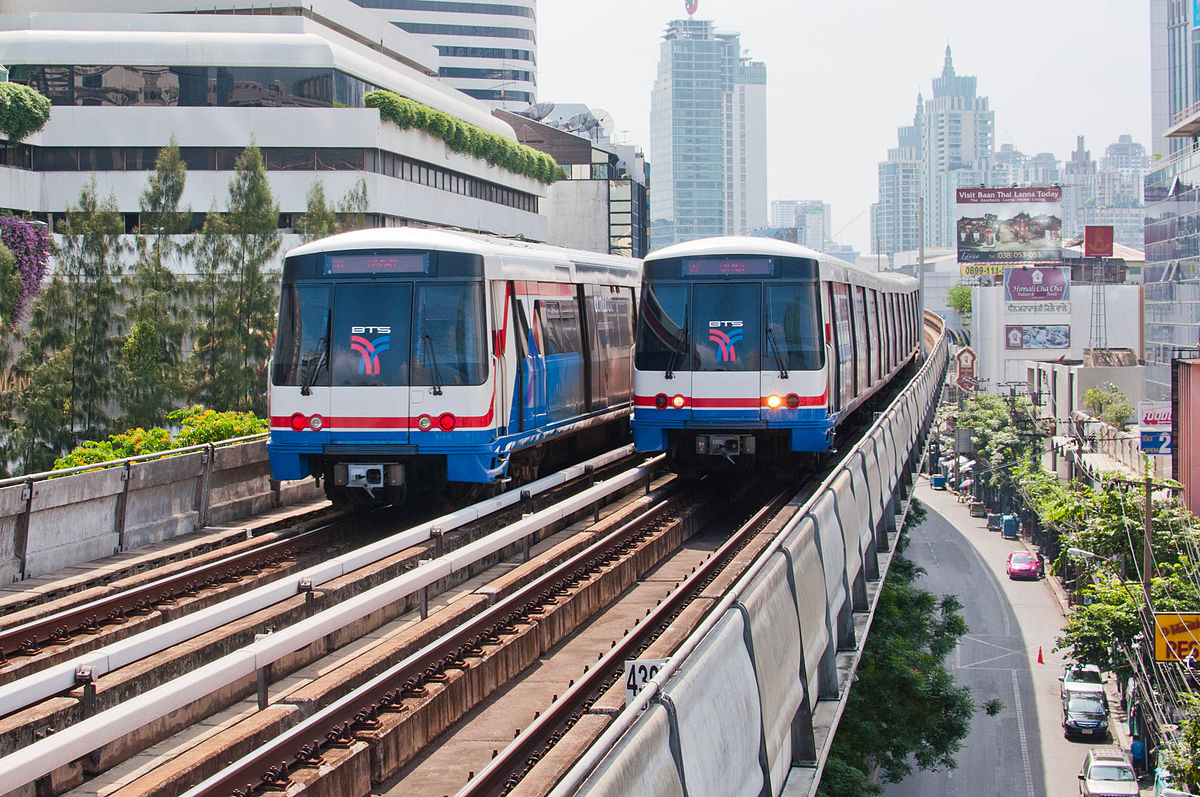
Bangkok’s first mass transit line, the Bangkok Mass Transit System or BTS, was completed in 1999 and represented the start of a change in the way that Bangkok’s residents got around the downtown areas of Bangkok.
The original mass transit light rail train in Bangkok was developed by the BTS Group to run the above ground train along Sukhumvit Road. Not too long after in 2004, an underground subway system was constructed, which was developed and run by another company called Mass Rapid Transit Authority of Thailand (MRTA).
Traditionally, these two trains have been considered separated with the BTS being “the sky train” and the MRT being “the subway”; however massive expansion of both systems have been underway for the past few years and soon the MRT will have both above and below ground lines. By 2025, Bangkok will have more mass transit lines than London if there are no major delays, which is quite impressive considering that it took London almost a century to build up its train network to what it is today. Thailand will have done so in around a third of the time.
Currently, Bangkok has 110 kilometers of mass transit light rail lines encompassing 78 stations in Bangkok. Another 193.2 kilometers is currently under construction which encompasses 126 stations due to be complete by 2020. A planned 147.1 kilometers with 70 stations are in the plan for completion between 2021 and 2025. From 2013 to 2017, the BTS green line had the highest ridership of 744,499 passengers per weekday followed by the MRT blue line at around 349,000 passengers per weekday.
The MRT purple line, linking Tao Poon to Khlong Bang Phai, was recently opened in 2016 to underwhelming ridership numbers. This was due in large part to a lack of connection between the blue line end station of Bang Sue and the purple line starting station of Tao Poon. Last year, they fixed that issue connecting these two stations together and ridership jumped from around 33,130 riders per weekday to 48,992 riders, which is still not as high as they had hoped. Another train system that should be mentioned is the Airport Rail Link (ARL) which can be accessed from around Phaya Thai BTS Station and connects to Suvarnabhumi Airport. This system has been relatively underused since its completion in 2010 carrying only around 67,631 passengers per weekday, most of which are commuters rather than airline passengers going to and from the city to the airport area stations.
The expansion plans for the light rail system in Bangkok and surrounding areas is quite extensive but the blue line is one that is worth highlighting.
As mentioned above, the blue line is part of the MRT system that currently runs from Hua Lamphong to Bang Sue; however, the expansion of this line will create the first full circle route which should create a much more seamless riding experience for passengers resulting in higher ridership than the current blue line.
The blue line is going to extend across the river to Thonburi side out to Bang Khae but also loop north to connect with Tao Poon station with an interchange at Tha Phra. This loop should lead to a significant increase in ridership as the route takes riders through many important locations such as China Town, Hua Lamphong, Lumpini, Sukhumvit, Rama 9, Ratchada, Lat Phrao, Chatuchak and then over across the Chao Phraya River into Thonburi. The Thonburi link is significant as current road routes are often very congested, especially at peak hours. The train will provide a new option that can get travelers to many key areas of Bangkok where they can then connect to other routes or walk to their destinations.
This could lead to a revitalization of the old Chinatown area, especially as a tourist destination.
Apart from this key route, the BTS and MRT line extensions when completed and combined will allow riders of the rail transport system to connect to virtually all the primary downtown and midtown areas of Bangkok. This improvement should also encourage tourists to venture out further from downtown Bangkok since tourists must rely on public transportation. Having a fixed rail route will give them more confidence to explore further out of Bangkok Central Business District (CBD) without the fear of getting lost or stuck. Furthermore, these new routes, especially locations along the blue line loop should make for good opportunities for developers of residential, retail, office, and hotel projects as access to these properties will be superior thanks to extensive connections to the blue line.
Ultimately implementation will be a large driving factor that will affect ridership.
This includes efficiency of payment methods such as the “spider card” that’s been proposed which allows one card to be used on all public transport systems as opposed to the mutually exclusive systems currently used. Safety in terms of security and equipment maintenance and timeliness of the trains will also affect rider trust and usage.
We still have seven years of construction to go just to complete the current planned network, but it is a positive sign to see progress being made on these construction plans which would make Thailand’s light rail system one of the most advanced and comprehensive in the region.
Noted: Writer by Aliwassa Pathnadabutr, Managing Director of CBRE Thailand
![[Commentary] Why Are More And More Chinese Investing In Thailand Real Estate?](https://investbangkokproperty.com/wp-content/uploads/2018/05/sansiri-china.jpg)
by kevinyeo | 22 May 2018 | Foreign Buyer Guides
In recent years, a lot of the Chinese have amassed a fortune from investing in real estate in China.
However, in light of the fear of an imminent bubble, most cities have implemented measures to keep prices down, including eligibility restrictions, increases in required down payments and limits on reselling, for example, no resale of a property within three years of purchase.
In the second-tier cities, the measures have also included price caps on the new property, with local authorities refusing to grant developers sale permits if they deem the prices set for the homes to be too high.
With so much capital controls, what’s next for the Chinese investors?
Individual investors who have been “limited” in China have brought their love of real estate abroad.
The Chinese investors looking for exponential growth would have their sights set on the real estate markets in South-East Asia. Especially Thailand, Malaysia, Cambodia, and Vietnam.
Out of the above mentioned, Thailand would probably be the foremost considered investment destination. Low prices, convenient transportation, beautiful environment, friendship with China, makes Thailand the preferred holiday destination. Thailand also attracts a large influx of foreign population each year.
At the same time, Thailand, as the second largest economy in Southeast Asia and the heart of ASEAN, has a relatively stable political environment and healthy economic exchanges with China.
At present, Thailand has a population of 64 million. Thailand’s foreign exchange reserves rank 13th in the world, reaching 183 billion U.S. dollars, surpassing the economic powers of the United Kingdom, France, and the United States. Thailand has obvious advantages in foreign exchange reserves and can better maintain the stability of the Thai baht.
Thailand is still a developing nation, undergoing a rapid urbanization that was experienced in China during recent years.
In the past two years, China’s investment in Thai real estate has reached an unprecedented high.
Capital Control
China’s capital outflow control has reduced China’s total overseas investment in housing from its high in 2016 to the level in 2015.
Such restrictions have also redirected the capital flow. Markets such as Thailand which is relatively less expensive has attracted a lot of Chinese investors.
This stem mainly from the fact that to invest in Thailand real estate, there is no need for a huge capital outlay. Thus effectively mitigating investment risks as well as creating a low barrier to entry for many.
Of course, it would be good to note that for prime luxury in downtown Bangkok, prices have already passed the THB350,000 per square meter mark, equivalent to approximately 70,000 yuan per square meter.
More importantly for investors, the Thailand housing market is robust and have seen a gradual increase over the years plus being able to give rental returns averaging 5-8% per annum. Such conditions make it favourable and attractive for the Chinese investors.
Benefitting From China’s One Belt One Road Initiative
The Chinese government supports investment in countries that participate in the “Belt and Road Initiative.” These investments are in line with China’s strategy of increasing the number of new infrastructures in China’s neighboring countries and encouraging cross-border trade activities in the region. China’s leading position in the regional economy.
Thailand, with its superior geographical location, has obtained many benefits from regional trade growth, cross-border investment and economic cooperation.
It is worth mentioning about the pan-Asian high-speed rail hub.
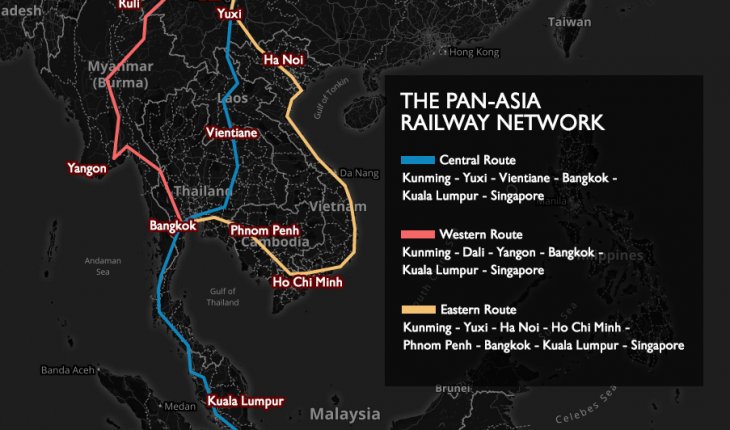
The Trans-Asian Railway is one of the key elements of the economic corridor. Three of the high-speed rail lines will converge in Bangkok.
The convergence of three railways will make Thailand the transport hub of Southeast Asia. For the first time, the high-speed rail link connects Singapore, Malaysia, Vietnam, Laos, Thailand, Cambodia, Myanmar, and of course China with Kunming.
Geographically, Thailand happens to be at the centre of this railway network and will take on the North-South railway line. Other countries connect through the East-West line.
It should be noted that the purchase of commercial and residential real estate is almost the cornerstone of every large project, whether it is a new city, a new manufacturing centre or a railway facility.
Many Chinese believe that investing in the real estate of the “Belt and Road” countries is not only a shrewd move but also a blessing from the government under the upcoming development boom.
The Number Of Chinese Travelling Overseas Is Set To Grow Further
Thailand’s proximity to China, its well-developed tourism infrastructure, reasonable housing prices and acceptable culture have attracted these first-time investors to make their first investment here.
At present, only 9% of Chinese citizens hold passports. This figure will double in 2020 to 240 million people.
Such a low passport holding rate means that many Chinese who have the ability to invest in the international real estate have not yet got into the action yet.
It is not difficult to predict that the number of overseas buyers from overseas will still increase in the next five years.
We expect this group of emerging cross-border investors to flock to markets that are both familiar and relatively low-priced to find investment opportunities. Thailand will undoubtedly be one of the easiest to meet these standards.
The Conditions For Owning Real Estate In Thailand Is Simply Attractive.
Freehold property, no estate tax, no need to pay for the public area, fully renovated apartments and no limits to purchase, not limited to loans, can flip properties, stable economic growth, low taxes and fees.
In Thailand, the Chinese investors get to own freehold properties.
Compared to countries like Singapore, the taxes are not punitive at all.
eg.
Thailand: Deed 2% (50% each for buyers and sellers)
Canada: Transaction Stamp Tax 15%
Singapore: Foreigners need to pay 3% stamp duty and an additional 15% stamp duty on overseas investors for home purchases.
In Thailand, investing in real estate is not just about buying a physical property, but it’s also buying a lifestyle.
Nowadays, Thai developers spare no effort to equipped the property with the best possible facilities. (swimming pool, gym, sauna, tennis court, sky lounge, co-kitchen, etc) It is something that has come to be expected when buying a property in Thailand.
Barring any unexpected economic or regulatory change in the investment environment, the demand for Thai real estate by individual investors in China will be expected to continue to grow.
by kevinyeo | 21 May 2018 | Bangkok Property Market Updates, Investment Analysis
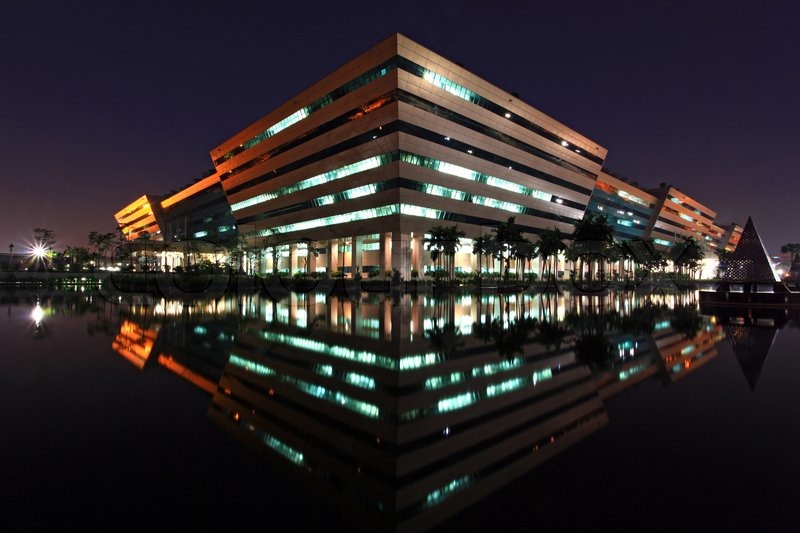
In 2010, Thailand relocated 29 administrative and judicial departments to the Chaeng Watthana Government Complex, and property prices in Chaeng Wattana have risen.
In the past few years, chaeng watthana road has witnessed the opening of Central Chaeng Wattana Mall, Index Living Mall, Big C, Tesco Lotus, and Makro Hypermarket. The resident population has been rising year by year; at the beginning of this year, the Thai government announced that it was connecting the government’s administrative centre to the pink line in the territory of Minh Buri. Construction to commence this year. Wattana Road will welcome an unprecedented golden period of development.
Located in the north of Bangkok, Chaeng Watthana Road is 8 kilometers long and is adjacent to Don Muang Airport on the west. It is adjacent to the Chao Phraya River to the east with three expressways running through it. The government spent 20 billion baht in 2005 to build a 929,800 square meter administrative centre here. Five years later, tens of thousands of civil servants who work here have driven the demand in the local housing market and created many business opportunities. Many shopping malls, hypermarkets, snack bars and massage shops have opened one after another to form a community with good living amenities.
Real estate analysts pointed out that Chaeng Watthana Road is close to the administrative centre of the government and is also close to the Don Muang Airport and Impact venue centre; Don Muang Airport has direct flights to major cities in China and is the gateway for many Chinese tourists to enter and leave the country.
“The surge in Chinese tourists in the past three years has resulted in a higher occupancy rate for hotels in the Chaeng Watthana area. The owners of the apartments that make the apartments into Air BNB rooms have benefited greatly.”
Real estate analysts believe that the MRT pink line, which starts at the Nonthaburi Civic Centre and ends at Min Buri via Watthana Road, is about to start construction and is expected to stimulate housing prices and land prices along the route.
The centre of MRT pink line is at Si Rat Station and Muang Thong Thani Station on Chaeng Watthana Road; Si Rat Station is next to Makro Shopping Mall. Within 2 km radius, there are Central Shopping Centre, Index Living Mall, Tesco Lotus and Big C Shopping Mall. This is largely considered as the central area of Chaeng Watthana.
The Noble NUE Chaeng Wattana project was promoted by developer Noble last month. It was 0 meters away from the Si Rat MRT station and was next to the Makro shopping mall. The response from the Thai buyers was overwhelming.
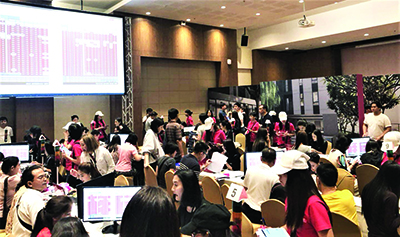
“This shows that the Thai people are very confident in positive Wattana, and in the potential sharp rise in property prices after the opening of the MRT.”

Located at the upcoming Sirat MRT station, there are 2 shopping malls and 3 hypermarkets within a radius of 2 kilometers.
For more information on the launch of Noble NUE Cheang Wattana, visit the official developer sales website.
source: www.udnbkk.com