by kevinyeo | Jan 11, 2018 | Bangkok Property Market Updates
Last year saw a wave of foreign investment in the Thai property market in the form of project-by-project development joint ventures.
Historically, foreign ownership restrictions and the availability of local funding meant there were limited foreign investments in the Thai property market, but tighter lending conditions and increased development costs due to rising land prices have forced Thai developers to look to overseas investors for funding.
We saw major players join hands with Japan-based companies, such as Ananda Development partnering with Mitsui Fudosan, AP with Mitsubishi Estate Group, Sansiri with Tokyu Corporation and Origin Property with Nomura Real Estate Development.
Other developers, like Charn Issara Development, partnered with China-based companies — Junfa Real Estate and Tianyuan Construction Group — for its projects in Phuket and Chiang Mai.
Most of the joint ventures are with foreign developers or construction companies. Teaming up with foreign companies not only gives Thai developers more ammunition to invest in new projects, but also lets them capitalise on the know-how and the technology that their partners could offer.
Implementing new innovations can either increase the quality and value of a project, commanding a higher price, or increase profit margins by reducing development costs.
Overseas investors need local expertise, especially in the residential market where the market is constantly changing, and successful developers need to be innovative market leaders, not market followers.
The condominium sector is the most popular recipient of foreign capital due to its fast return on investment, minimising the partners’ risk of tying up their capital in Thailand for too long.
Condominium developments typically take three years to give a return on investment compared to other developments such as rental office developments, which likely take at least 7-10 years.
However, Mitsui Fudosan, which has been in a joint venture with Ananda Development since 2013, has now expressed an interest in tapping into the office market for long-term investment.
Thailand’s infrastructure and its potential to be a hub for Southeast Asia have also attracted foreign investments, especially the opportunities created by mass transit development and expansion plans.
Most of the joint venture deals have been in Bangkok, but we started to see interests in the Eastern Economic Corridor development zones. Saha Group joined Tokyu Corporation in developing a serviced residence for expatriates in Si Racha area. Hankyu Realty, a Japan-based company who joined Sena Development in developing SENA Hankyu 1, sees Thailand as its base for Southeast Asia expansion.
Going forward, as foreign companies gain more confidence in Thailand’s economy, we expect more joint venture projects in other sectors such as offices and retail.
Foreign ownership restrictions mean that Thailand is likely to secure investments only from property developers, not institutional funds, which means that countries allowing 100% foreign ownership such as Japan, Hong Kong and Singapore will continue to be Asia’s key property investment gateways.

by kevinyeo | Jan 11, 2018 | Bangkok Property Market Updates, Developer Watch, Investment Analysis
Medium-sized developers have pinned their hopes on the country’s economic growth and government spending in megaprojects to help boost the property market this year.
Dusadee Tancharoen, managing director of SET-listed developer MK Real Estate Development Plc, said the Thai property market will continue growing, driven by government investment and people’s confidence in the political situation.
“The property market in the first half of 2017 slowed as most developers focused on selling inventory rather than launching new projects,” she said. “In the second half, the market improved after movement on the government’s investment in transport networks and infrastructure projects.”
Plans for a general election in 2018 have also boosted confidence among investors, said Ms Dusadee.
The Eastern Economic Corridor (EEC) is another key driver boosting economic sentiment and property investment, she said. MK has a housing project in Bang Na that received good feedback with a sales rate of 80% in the first phase during its October launch.
“Better sentiment in the fourth quarter of last year will continue this year. The property market is expected to grow 6-8% in 2018, compared with growth of 2-3% last year,” she said.
Chaiyan Chakarakul, managing director of SET-listed developer Lalin Property Plc, said economic expansion for Thailand and the world, on top of government investment in the EEC and mass transit lines, will help drive the Thai property market to grow 5-7% in 2018.
“There are good signs for the Thai economy. It will expand 3.8-3.9% this year, being boosted by an expansion in exports and tourism, government spending on infrastructure projects and a general election by the end of 2018 or early 2019,” he said.
This year Lalin plans to launch 8-10 new projects worth 4.5-5 billion baht in Greater Bangkok and beyond.
The company expects 4.4 billion baht in presales and 4 billion in revenue by year-end, up 15% from last year.
He said positive factors will include a reduction in the household debt-to-GDP ratio to 78% and steady interest rates despite an uptick in US interest rates. These factors will help boost purchasing power in the housing market.
About 80% of the new projects will be in Greater Bangkok and the rest in provinces, including Chachoengsao and Chon Buri, where the firm will develop units priced 2-6 million baht.
Lalin will spend 1 billion baht to buy new plots of land. The company will also issue bonds worth 1.1-1.2 billion baht in April, which will expire in three years, to support business expansion.
by kevinyeo | Jan 11, 2018 | Bangkok Property Market Updates
The Thai residential market benefited last year from foreign buyers, says property consultant Knight Frank Thailand.
Frank Khan, executive director and head of residential projects for Knight Frank Thailand, said 2017 was an outstanding year for foreign investors as new supply hit the market with innovative designs and modern facilities, helping to grow property investment.
An appealing investment climate gave foreign investors the chance to capitalise on their purchases without being affected by high taxes and stamp duties, he said. Last year also witnessed several listed developers significantly capitalize on their market share because of the influx of foreign buyers.
Mr Khan said the Thai residential market obviously received additional investment from the Chinese, even with stricter outbound investment rules.
The Bangkok metropolitan area, in particular, was a prime investment location. Several mid-priced condos in the capital have as much as 40% Chinese uptake. That uptake was actually quite slow until the second half of 2017 because of more strict controls from the Bank of China on transferring money.
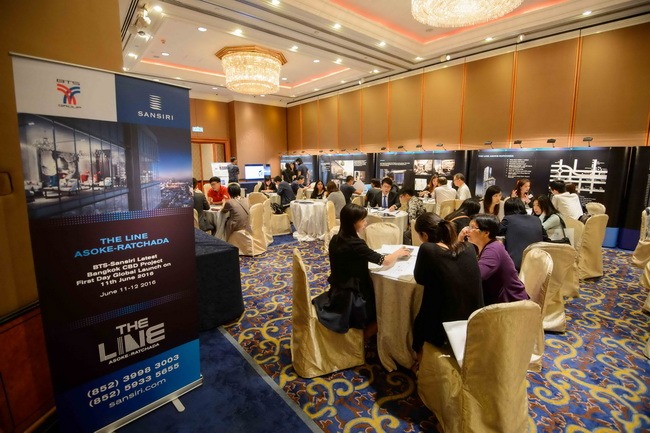
Roadshow expansion throughout Asia-Pacific, including China, marked an important part of marketing activities last year, a trend that should grow in 2018, he said.
Knight Frank foresees a healthy uptake from foreign investors across Asia-Pacific.
Mr Khan said developers should note that investors always aim for three basic criteria in their final purchase decision.
Location: the main factor for overseas buyers, particularly areas that have recognizable landmarks or mass transit accessibility.
Price: this is in direct correlation with the location, with the grading of the development a second factor in price determination.
Product: amenities, facilities, and fixtures — does the overall functionality match with the grading?
Marciano Birjmohun, associate director of international project marketing for Knight Frank Thailand, said with Thailand’s expanding mass transit system, BTS lines remain the key influencer of urban development.
Mass transport is the most important aspect of a community’s infrastructure, he said. In particular, interchange stations such as Bang Sue Grand Central Station, which is under construction, have become a focal point for overseas investors.
More overseas investors are also looking at peripheral areas of Bangkok, providing low entry levels for investment but benefiting from a direct connection to tourist areas and business districts.
With Tao Poon interchange completed and Samrong interchange station nearly finished, these areas have been classified as future hot spots.
“If we only look at the existing traffic at interchange stations like Asok and Siam, we can be certain that Tao Poon and Samrong will become major transit stations by 2020,” said Mr Birjmohun.
Furthermore, the quality of infrastructure systems in Bangkok, including its transport and telecommunications systems, are another important factor influencing real estate investment and development decisions, similar to other big cities around the world.
Infrastructure development has a direct impact on property values, especially in terms of how transport infrastructure affects communities and property values. This is clearly visible along the BTS lines.
“Residential properties located close to transport infrastructure tend to be labeled as ‘premium’ and it’s common for real estate prices to appreciate in line with the development of infrastructure,” he said.
by kevinyeo | Jan 2, 2018 | Bangkok Property Market Updates, Investment Analysis
BANGKOK’S residential property market will see a growth of up to 7 per cent in 2018 from this year, thanks to the government’s proposed expansion of investment for infrastructure projects, property agencies said.
Knight Frank Thailand Co Ltd’s managing director Phanom Kanjanathiemthao said that the capital’s residential property market would be among those segments set to experience the most growth, in the range of 5 to 7 per cent in terms of the number of units and project value.
This corresponds with the views of major project developers who, on the whole, continue to view the market as one with growth opportunities.
As such, their plans to propel their businesses reflect the residential market’s potential. At the same time, their offerings and products next year should remain the same, without major changes in room layout or unit sizes; developers will instead look to enhancing project facilities in order to differentiate themselves and help boost sales. In general, projects will include features like automated parking, which can add 20 to 30 per cent to their capacity, compared to the old parking systems; and home automation systems.
The development of residential projects next year will continue to focus on areas accessible by the train network, especially the Orange Line, the Blue Line, and the extension of the Green Line that is in progress. The market will expand to the outskirts of Bangkok, with the trains making it convenient for people to travel into the city as well as to anticipate their approximate travel times.
As for the single home and townhouse market in the outskirts of the city, the outlook is that the rate of expansion will be low, with traffic issues accounting for the main factor hampering growth. Also, single home and townhouse projects are generally far from the train lines. There are very few plans to build new roads to accommodate the number of cars and ease traffic issues. The condominium market thus has an advantage to being close to the train lines; moreover, they don’t require huge plots of land for development.
The market for B-C grade condos will remain largely comprised of Thai buyers. Condos in the Sukhumvit area, serviced by the Green Line – Baring trains and the subway from Bangsue – Ladprao, will attract more foreign investors such as those from mainland China, Hong Kong, Malaysia, Singapore, and Taiwan. Investors from other countries also exist but in small numbers. The factors that encourage target buyers to make their purchasing decisions vary from market to market.
Location viewed as priority
For the condominium market, buyers will first and foremost consider the location, with the ability |to travel easily into the city as an important factor. Also, they will look at the development, unit size, facilities and amenities, and pricing.
For the single house and townhouse market, buyers will first consider the usable space, followed by facilities and amenities in the development, and location, property agency said.
Meanwhile, the townhome market in Bangkok and Greater Bangkok – including Krathum Ban-Sam Phran, Thung Khru-Phra Pradaeng, Thon Buri-Rat Burana, Lat Lum Kaew, Don Mueang-Sai Mai, On Nut-Bang Na and Suvarnabhumi-Bang Sao Thong – will see current pricing continuing to attract buyers, according to a survey by Plus Property Co Ltd, a property agency and management arm of Sansiri Plc.
The company’s managing director Anukul Ratpitaksanti said that prices in these seven areas range between THB 1.2 and THB 2.99 million, and these development projects have been warmly received because of transportation linkages into Bangkok. Analysis deemed that offer prices (THB 1.2-THB 2.99 million) were not high for all of the locales, whereas offer prices in the Krathum Ban-Sam Phran area start lower than THB 1.2 million.
“Results from our surveys point to a return of purchasing power for the town house category. Demand and supply continued to grow healthily in 2017 although there were no specific policies to stimulate the real estate sector,” Anukul said.
“We expect the market for townhomes to continue growing in 2018 because offer prices have yet to rise significantly, and the prices match the purchasing power of locals in the suburbs. Consumer confidence is also expected to grow in the same direction as the continually improving economy in 2017, and this momentum is expected to carry over to 2018.”

by kevinyeo | Jan 2, 2018 | Bangkok Property Market Updates, Developer Watch, Rental Market & Landlord Guides
SET-listed Sansiri Plc is set to expand its Escape Hotel chain domestically over the next 3-5 years after entering the hospitality business four years ago.
Chief operating officer Uthai Uthaisangsuk said the company is targeting three major tourist destinations — Chiang Mai, Phuket and Chon Buri (Pattaya) — to open Escape Hotels.
The move is part of Sansiri’s plans to develop hotels and other real estate projects across the country.
“Having hotels at new projects will help strengthen Sansiri’s reputation as many of our real estate clients love receiving standard hotel services,” Mr Uthai said. “Moreover, tourism in Thailand will continue to grow, especially in 2018, after booming exports and growing GDP.”
Sansiri now operates two Escape Hotels, one in Hua Hin and another in Khao Yai, with 108 rooms combined. The company entered the hotel business four years ago and has invested 700 million baht in the two properties.
Mr Uthai said Escape Hua Hin has average daily room rates of 2,500 baht, with an average occupancy rate of 55%. The chain is expected to account for 40% (40 million baht) of the developer’s hotel business this year.
Escape Khao Yai, with the same room rate, has occupancy rates of 65-70% and is set to contribute 60 million baht in 2017, thanks to its meeting and conference room space.
In the coming year, Sansiri plans to invest 10-15 million baht to add two pool villas at Escape Khao Yai.
The company expects total revenue from its hotel business to grow by 10% to 110 million baht next year.
“We are expecting to end 2017 with 100 million baht in net income. As of now, our average occupancy rate [for both hotels] is above target and should reach 70% during the holiday season,” Mr Uthai said. “While domestic tourism from the first to the third quarter was not really active, bookings have really picked up during the fourth quarter.”
Local tourists are still Sansiri’s main target for both hotels, but it will be placing more emphasis abroad, especially in Asian markets such as China, Singapore, Malaysia, Japan and South Korea, through the company’s collaboration with online travel agents and online payment systems such as Alipay and WeChat Pay.
Online influencer engagement and a Chinese-language website will also be introduced to boost the company’s presence.
“We are looking for 7% growth in both our international and domestic markets,” Mr Uthai said.
SIRI shares closed yesterday on the Stock Exchange of Thailand at 2.14 baht, down four satang, in trade worth 65.9 million baht.
