
The Emsphere to open in December 2023

The Emsphere to open in December 2023

The Mall Group Co, a prominent retail operator in the country, is set to unveil The Emsphere on Sukhumvit Road in December 2023 as a vital component of their expansive retail district, requiring a substantial investment of 15 billion baht. The Emsphere represents the latest addition to the group’s “EM District” development initiative, encompassing 50 rai of land in the Sukhumvit area and offering a collective usable space of 650,000 square meters. Situated adjacent to Benchasiri Park, The Emsphere encompasses a mixed-use project developed on a 20-rai plot.


Conceived under the “Future Retail” concept, The Emsphere embraces the latest trends, immersive experiences, and a futuristic lifestyle for its customers. Its opening has been delayed by two years from the initial plan due to the impact of the Covid-19 pandemic. Chairwoman Ms. Supaluck Umpujh expressed, “We allocated a budget of 500 million baht to craft The Emsphere, infusing a fresh aura into Bangkok. Each of our malls within the EM District is tailored to address distinct consumer needs.”


She also described The Emsphere as the most challenging undertaking in the group’s four-decade history in Thailand’s retail sector. She emphasized the importance of making each of the three malls within the EM District a fun and enjoyable shopping destination for visitors.


The new mall is slated to house EmLive, a world-class arena in collaboration with UOB, spanning 20,000 square meters, equipped with more than 6,000 seats and managed by AEG, a prominent player in the entertainment and sports business. IKEA will take up the entirety of its 3rd floor, spanning 15,000 square metres, and it will also introduce the first 2 Gordon Ramsay restaurants in Thailand – Bread Street Kitchen & Bar, and Street Pizza.


The project will create 10,000 new job opportunities across all its complexes, with an ambitious goal of attracting 80,000 to 100,000 visitors daily, elevating Bangkok to a metropolis that can rival cities such as Paris, Shanghai, London, New York, Japan, and Seoul.


Yours sincerely,
The editorial team at IBP Real Estate Co., Ltd.
Developer sentiment index, while remaining positive, slips in 3rd quarter

Developer sentiment index, while remaining positive, slips in 3rd quarter

In the third quarter, housing developers’ sentiment for the next six months saw a decline, primarily driven by growing concerns about employment following the government’s announcement of a minimum daily wage of 400 baht for the next year. Vichai Viratkapan, the Acting Director-General of the Real Estate Information Centre (REIC), reported that the sentiment index for the upcoming six months dropped to 60.1 in the third quarter of this year, down from 62.1 in the previous quarter. Nevertheless, it’s worth noting that the index remained above the median of 50.0, indicating that developers still maintain a positive outlook on the overall property market for the next six months.

Among the six issues addressed by the REIC in its survey of both listed and non-listed developers, employment recorded the most significant decrease, falling from 62.1 in the second quarter to 56.8 in the third quarter. Songkran Issara, CEO of SET-listed developer Charn Issara Development, expressed his concerns about the policy to increase the minimum daily wage, emphasizing its potential impact on the overall economy.

According to Mr. Songkran, the wage hike’s impact will be substantial, given that the economy has not yet displayed robust growth or the necessary momentum to absorb additional costs, which would result in increased labor expenses for business owners. He also highlighted that the country’s economy has shown signs of recovery from the impact of the Covid-19 pandemic, largely driven by the resurgence of the tourism sector. However, global sentiment remains unfavorable, and concerns persist, both domestically and internationally, including conflicts and disputes such as the situation between Israel and Palestine.

The REIC’s report further reveals the second-largest drop in the expectations index, particularly in performance, which decreased from 69.4 to 65.0.

Mr. Vichai pointed out that the expectations index on costs was the only one to rise, with a 2.1-point increase. This suggests that developers may be able to achieve greater cost reductions compared to the second quarter.

The REIC also documented housing developers’ sentiment index regarding the current situation, which slightly improved to 49.7 in the third quarter from 47.5 in the second quarter but declined from 51.8 in the third quarter of the previous year.

Mr. Vichai attributed this decline to the fact that interest rates had been raised five times from 1.25% to 2.5% in the third quarter. Among these indices, only the current situation index for employment and the launch of new projects or phases exceeded 50.0, while those concerning performance, employment, cost, and the launch of new projects or phases showed improvement compared to the second quarter.

Yours sincerely,
The editorial team at IBP Real Estate Co., Ltd.
A rising thai baht…

A rising thai baht…

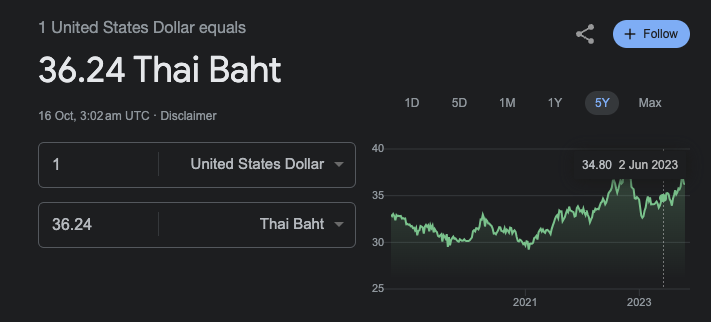
The US dollar saw a decline as the 10-year US Treasury yield dropped to 4.65% yesterday. Nevertheless, Poon Panitpiboon, a currency analyst at Krungthai Bank, has advised caution regarding the Thai Baht, indicating that it could face downward pressure should the Israel-Hamas conflict escalate, resulting in higher oil prices that adversely affect Thailand’s current account balance.


Simultaneously, the flow of foreign funds into the Thai stock market is expected to remain volatile, following the recent pattern of alternating periods of net buying and net selling. Additionally, importers may gradually increase their purchases of US dollars as the Baht strengthens.


Given these factors, Poon estimates that the Baht’s resistance level is likely around 37.25 per dollar. It is not anticipated that the Thai currency will weaken beyond 37.50, and there is a possibility of testing the support range of 36.25-36.30, according to Poon.


Whether a rising Thai Baht (THB) is good for Thailand can be a complex issue with both advantages and disadvantages. It’s important to note that economic conditions are influenced by a multitude of factors, and the impact of a stronger currency can vary depending on the context and the specific circumstances. Here are some potential effects:


Advantages of a Rising Thai Baht:

  1. Lower Import Costs: A stronger Baht can lead to lower import costs for Thailand. This benefits consumers as it makes imported goods, including raw materials and technology, cheaper.
  2. Inflation Control: A stronger currency can help control inflation by reducing the cost of imported goods and services. This can be beneficial for the overall stability of the economy.
  3. Attracting Foreign Investment: A stronger Baht may attract foreign investment, as it reflects economic stability and can increase the purchasing power of foreign investors.
  4. Reduced Debt Burden: If Thailand has significant foreign-denominated debt, a stronger Baht can reduce the cost of servicing that debt.


Disadvantages of a Rising Thai Baht:

  1. Exports Become More Expensive: A stronger Baht can make Thai exports more expensive for foreign buyers, potentially leading to a decrease in demand for Thai products and a negative impact on export-oriented industries.
  2. Tourism Impact: A stronger currency can make Thailand a more expensive destination for foreign tourists, potentially reducing tourism revenue.
  3. Negative Impact on Local Manufacturers: Export-oriented industries, such as manufacturing, may face increased competition and reduced profitability due to a stronger Baht.
  4. Economic Imbalance: A rapid and excessive appreciation of the Baht can lead to economic imbalances, potentially causing challenges for certain sectors of the economy.


Ultimately, the impact of a rising Thai Baht depends on various factors, including the pace and extent of the appreciation, the structure of the Thai economy, and government policies. The Thai government and central bank can use monetary and fiscal policies to manage the exchange rate to achieve their economic goals. They often aim for a balance that supports economic growth, controls inflation, and maintains a competitive export sector.


It is important to note that the Thai Baht has seen periods of sustained strength against the US Dollar. It follows that a strong Thai Baht cannot be viewed in a vacuum as a solely good or bad thing. However, if you are a foreigner looking to invest in Thai properties, it would serve you well to purchase Thai properties at periods when the Thai Baht is relatively weak as compared to your home currency. This is because you will need to make the purchase in your home currency. If there is any appreciation that was to occur to the Thai Baht subsequently, you will not only enjoy the appreciation in literal price but also the appreciation that happens due to the rise in the exchange rate.


The Thai Baht is hovering close to 5-year lows against the USD. This should be something that foreign buyers of Thai property will need to take note of. It could be a good time to enter the Thai property market if that is your immediate to short-term goal. This would allow you to enjoy not just possible capital appreciation but if the Thai Baht starts to appreciate, you will have more of your home currency when disposing of or renting your Thai property.


Yours sincerely,
The editorial team at IBP Real Estate Co., Ltd.
 

Central Pattana Plc (CPN) aims to complete B100billion worth of mega projects in Bangkok by 2027

Central Pattana Plc (CPN) aims to complete B100billion worth of mega projects in Bangkok by 2027

Central Pattana Plc (CPN), a prominent player in the retail and real estate sector, best known for managing Central shopping centres, has revealed its ambitious strategy to embark on the development of five extensive mixed-use projects in different parts of Bangkok. These areas encompass the downtown, central business district (CBD) and northern Bangkok. The company intends to carry out these projects between 2023 and 2027, with an estimated total cost exceeding 100 billion baht.


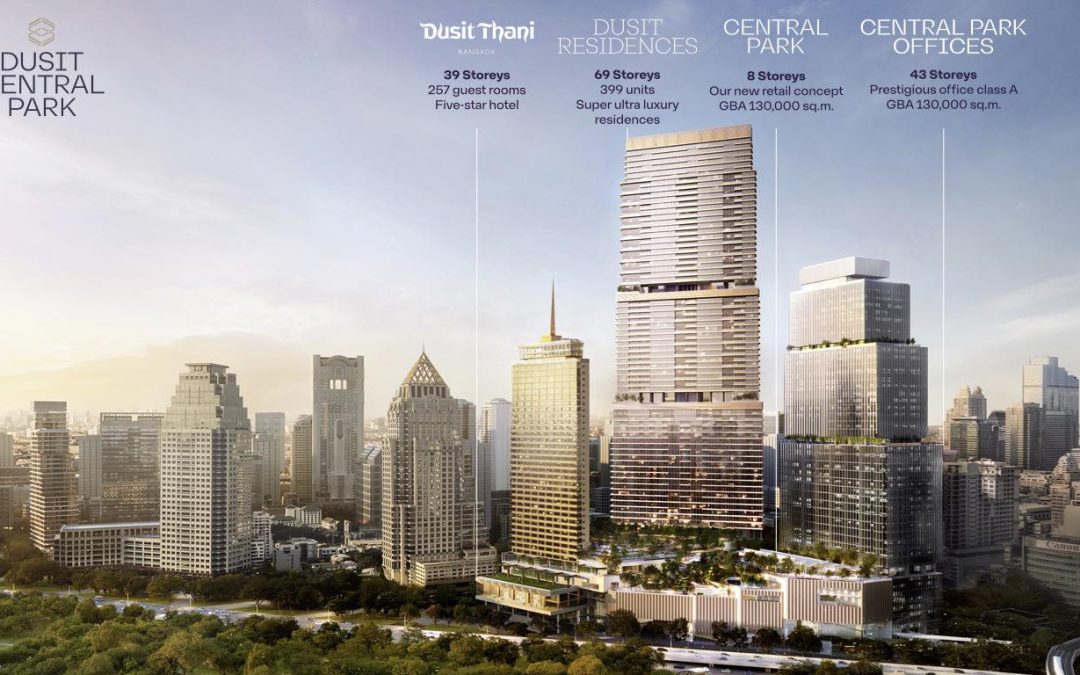
These five projects are strategically distributed across various locations, with one of them, Central Park, planned to be situated within Dusit Central Park and slated for unveiling in the third quarter of 2025. In addition, there is a project neighboring the existing Central Embassy at the Wireless Road intersection, another discreetly positioned behind the Central Shopping Complex on Rama 9, and two expansive developments covering 700 rai of land in the Rangsit area and across from Magic Land in the Phahon Yothin locale. Construction work for the latter two projects has already commenced. Each of these mixed-use endeavors necessitates a minimum investment of 20 billion baht and offers an extensive space of 350,000 square meters. Central Park, a pivotal element of this five-year business plan, is poised to redefine the urban landscape of Bangkok, much like Central Park in New York or Hyde Park in London.


Wallaya Chirathivat, the president and chief executive of CPN, expressed her confidence in the company’s capacity to adapt to changing circumstances and capitalize on government policies and promotional strategies. She anticipates a significant surge in foreign tourist arrivals, with projections of 25-30 million visitors for the current year, 40 million in 2024, and an expected surpassing of 40 million by 2025. These forecasts align with a steady annual GDP growth rate of 3-4%.


Chanavat Uahwatanasakul, CPN’s chief development and commercial officer, highlighted that the Dusit Central Park project distinguishes itself in four key aspects. Firstly, it leverages the collective strengths of Central Group, Central Pattana, and Dusit Thani Group. Secondly, its prime location in the bustling CBD of Bangkok and the affluent neighborhood offers significant potential. Thirdly, the project aims to deliver unique, tailor-made experiences. Lastly, with a substantial seven-rai green space, it strives to enhance people’s quality of life. Chanavat expressed the aspiration to transform Rama 4 into a vibrant hub for a new luxury lifestyle.


Isareit Chirathivat, CPN’s head of fashion and luxury partner management, introduced Central Park as a new brand under the Central Pattana umbrella. This brand plays a pivotal role in the 46-billion-baht Dusit Central Park project, situated on a 23-rai land plot at the Silom-Rama 4 road intersection. Other components of this project include the 39-floor Dusit Thani Bangkok Hotel, expected to open in mid-2024, Central Park Offices covering 130,000 square meters, scheduled to open in the second quarter of 2025, and residential areas encompassing 50,500 square meters. Additionally, the Central Park shopping centre, with a gross building area of 130,000 square meters, is set to open in the third quarter of 2025.


Nattakit Tangpoonsinthana, CPN’s chief marketing officer, acknowledged that the Israel-Hamas conflict might have a short-term impact on the retail business, but the company will closely monitor its influence on different regions. He emphasized that Middle Eastern customers typically visit Thailand during specific seasons, with the majority of the company’s customer base being weekend travelers from neighboring countries.


Lastly, according to Ms. Wallaya, the company is ready to engage in negotiations with the State Railway of Thailand for the renewal of the Central Latphrao agreement and holds an optimistic outlook regarding this renewal.


Thailand is now the 5th most popular property investment destination for Chinese investors

Thailand is now the 5th most popular property investment destination for Chinese investors

Chinese real estate investors who once dominated the market for luxury condos and apartments in Thailand are now scaling back their activity due to China’s economic downturn and the real estate turmoil there.

Conventional English-speaking nations such as Australia, Canada, the United Kingdom, and the United States have become more appealing to Chinese property buyers, overshadowing Thailand’s popularity.

In contrast to Thailand, Vietnam has experienced consistent interest from Chinese investors in apartment purchases, especially in major cities like Hanoi and Ho Chi Minh.

Thailand, which previously held the top spot for Chinese investors, has now slipped to fifth place, with Australia, Canada, the UK, and the US taking precedence.

Chinese buyers are increasingly acquiring homes in Australia for personal use or to secure Australian citizenship.

Over the past few years, Thailand had been a favoured choice for Chinese investors seeking residential properties. A real estate agency report revealed that Thailand was the preferred destination for Chinese buyers from 2018 to 2021. However, by 2022, Thailand had fallen to fourth place, and in the first half of 2023, it descended further to fifth.

China’s economic difficulties, encompassing issues like high youth unemployment, diminishing exports, and a real estate crisis, have raised concerns about its economic growth stalling.

Consequently, Chinese investors are becoming more cautious about ventures in Thailand, leading to prolonged deal closures. The long-term consequences will hinge on the actions of Chinese investors and how Southeast Asian nations navigate the aftermath.

Translate 翻译 »